
Kawruh
Parts Burner OVD VAD MCVD: Komponen Endi sing Perlu Spesifikasi Kapisah
Okt
Tim pengadaan asring nganggep “bagean burner” minangka kategori siji nalika sumber kanggo produksi preform. Ing praktik, bagean burner OVD VAD MCVD nduweni fungsi sing beda banget ing saben proses, lan spesifikasi sing bisa digunakake kanggo siji metode deposisi bisa nyebabake masalah serius ing metode liyane. Diameter nozzle, materi faceplate, utawa antarmuka pemasangan sing cocog karo lathe OVD bisa uga ora cocog kanggo obor pangolahan kaca MCVD, sanajan loro komponen kasebut diarani “kepala burner.” Ngerteni komponen endi sing bener-bener mbutuhake spesifikasi kapisah — lan endi sing bisa nuduhake standar umum — mbantu insinyur lan panuku ngindhari ketidakcocokan sing larang lan nyepetake proses penawaran.
Napa Proses Telu Ora Bisa Nggunakake Siji Spesifikasi
OVD (Outside Vapor Deposition) lan VAD (Vapor Axial Deposition) loro-lorone mbangun preform soot silika keropos, nanging padha nindakake ing geometri sing beda. OVD nyimpen soot kanthi radial menyang rod target utawa bait rod sing muter, kanthi susunan burner biasane dipanggonke ing jarak sing dikontrol saka permukaan sing tuwuh. VAD nyimpen soot kanthi aksial menyang ujung seed rod, supaya burner madhep tip pertumbuhan lan geometri deposisi owah nalika preform saya dawa.
MCVD (Modified Chemical Vapor Deposition) beda maneh kanthi kimia lan fisik: gas prekursor mili ing njero tabung silika sing muter, lan obor eksternal ngliwati tabung kanggo nyurung reaksi suhu dhuwur lan sintering sabanjure. MCVD minangka proses deposisi lan konsolidasi ing njero tabung substrat, dudu proses akumulasi soot ing permukaan njaba. Amarga bedane kasebut, panjaluk fungsional kanggo bagean burner OVD VAD MCVD beda ing paling ora papat area: lingkungan termal, kimia gas, geometri mekanik, lan kontrol posisi.
Bedane Lingkungan Termal lan Kimia
Kondisi termal lan kimia ing njero obor utawa ing faceplate ora identik ing telung proses kasebut, lan bedane kasebut nyebabake pilihan spesifikasi. Obor OVD lan VAD beroperasi ing ruang deposisi terbuka ing ngendi partikel soot lan gas proses berinteraksi karo faceplate, dene obor MCVD dadi panas tabung silika sing terbatas liwat temboke. Suhu permukaan puncak, tingkat pemanasan lan pendinginan, lan anane spesies reaktif kabeh beda-beda.
Faktor kasebut mengaruhi spesifikasi bagean burner OVD VAD MCVD utama: alloy utawa keramik endi sing cocog, perawatan permukaan apa sing dibutuhake, lan sepira kerepe inspeksi kudu ditindakake. Ndhokumentasikake lingkungan termal lan kimia kanggo saben proses — sanajan sacara kualitatif, dirujuk menyang dokumentasi peralatan — menehi konteks sing dibutuhake supplier kanggo nyaranake materi lan geometri sing cocog tinimbang alternatif umum.
Komponen sing Biasane Mbutuhake Spesifikasi Kapisah
Klompok komponen ing ngisor iki meh mesthi mbutuhake spesifikasi sing beda saben proses. Angka sing tepat kudu teka saka gambar peralatan lan dokumentasi proses; tujuan bagean iki yaiku kanggo ngenali ing ngendi spesifikasi kudu beda, supaya pitakonan sing bener bisa ditakokake. Kanggo metode terstruktur, deleng pandhuan babagan sumber burner OVD & VAD khusus.
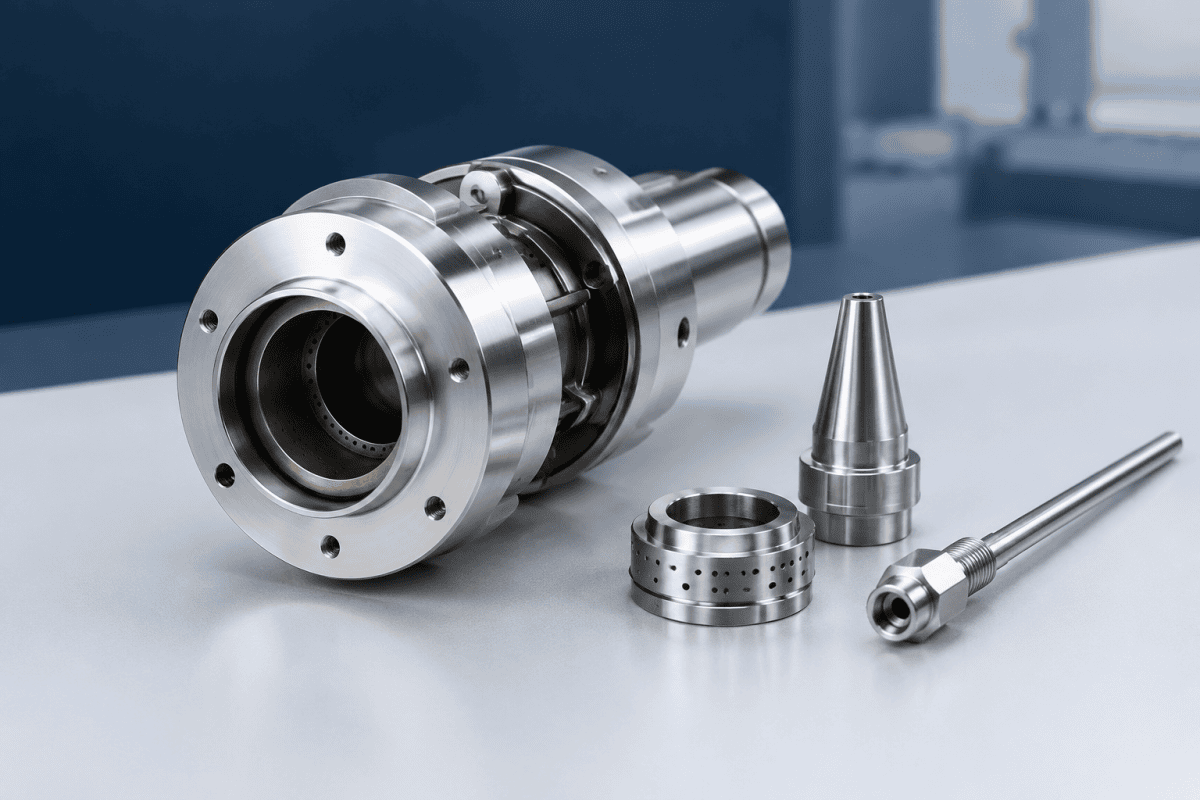
Kepala burner lan rakitan nozzle
Kepala burner OVD biasane ngemot pirang-pirang saluran gas sing disusun kanggo ngasilake aliran soot sing amba lan stabil ing permukaan preform. Jumlah saluran, jarak, diameter orifice, lan geometri metu kabeh ditemtokake dening tingkat deposisi lan diameter preform target. Kepala burner VAD umume madhep ujung pertumbuhan lan kudu ngasilake pola nyala sing cocog kanggo deposisi aksial, sing ngowahi standoff sing dibutuhake lan cara pirang-pirang saluran disusun relatif marang sumbu pertumbuhan. Obor MCVD asring nggunakake saluran sing luwih sithik lan bentuk nyala sing beda, amarga tujuane yaiku pemanasan lokal tabung tinimbang pangiriman soot menyang permukaan terbuka.
Iki sebabe geometri nozzle sing wis divalidasi kanggo siji proses ora kudu ditransfer menyang proses liyane tanpa review adhedhasar gambar. Iki uga sebabe dhaptar sumber campuran sing nglompokake kabeh bagean burner OVD VAD MCVD ing “burner nozzles” cenderung ngasilake komponen sing ora cocog. Spesifikasi kapisah kanggo bagean obor OVD titanium lan kanggo kepala obor MCVD utawa VAD minangka standar sing luwih aman.
Faceplate lan permukaan sing madhep deposisi
Faceplate minangka komponen sing paling cedhak karo zona reaksi suhu dhuwur lan langsung kapapar soot, panas radian, lan spesies reaktif. Ing OVD lan VAD, soot bisa nglumpukake ing faceplate saka wektu; ing MCVD, faceplate obor kapapar siklus termal sing beda nalika ngliwati tabung. Spesifikasi kapisah kudu ngatasi finish permukaan, kekandelan faceplate, kondisi pinggiran orifice, lan pilihan materi kanggo saben proses. Faceplate sing dioptimalake kanggo ngeculake soot ing lingkungan OVD bisa uga ora cocog kanggo pola siklus termal traverse MCVD. Kanggo ndeleng luwih cedhak babagan kontaminasi sisih deposisi, deleng diskusi babagan panggantian auxiliary tail burner lan pamriksan antarmuka.
Badan distribusi gas multi-saluran
Multi-channel torches gumantung ing saluran internal sing njaga bahan bakar, oksigen, lan aliran carrier utawa prekursor tetep kapisah nganti tekan metu. Geometri internal — cross-section saluran, finish permukaan internal, antarmuka sealing, lan tata letak port feed — nemtokake sepira rata distribusi aliran. Amarga torch OVD, VAD, lan MCVD beroperasi kanthi kombinasi gas, rentang aliran, lan beban termal sing beda, syarat aerodinamika internal uga beda. Desain saluran sing nyaimbangake aliran ing siji torch bisa nggawe distribusi sing ora rata ing torch liyane. Prinsip ing mburi iki dibahas ing pandhuan kanggo Komponen distribusi gas torch VAD.
Antarmuka pemasangan, penyesuaian, lan kinematik
Cara torch dicekel, diselarasake, lan dipindhah iku spesifik kanggo proses. Sistem OVD lan VAD nggunakake deposition lathe kanthi geometri burner-to-target sing ditemtokake; sistem MCVD nggunakake carriage sing ngliwati tabung. Mounting flange, rentang adjustment, lan fitur alignment kudu cocog karo syarat kinematik saben mesin. Kategori iki asring diremehake nalika sourcing, nanging torch body sing bener bisa ora bisa digunakake yen antarmuka mounting ora cocog karo lathe utawa carriage. Kanggo detail spesifik carriage, delengen Bagean gerbong pembakar MCVD.
Bagian Burner OVD VAD MCVD Endi sing Bisa Dienggo Bareng — Kanthi Verifikasi
Ora kabeh part mbutuhake telung spesifikasi sing kapisah. Sawetara komponen upstream utawa utilitas kadhangkala bisa distandarisasi ing antarane proses, yen kondisi operasi kompatibel:
- Konektor lan fitting feed gas — asring bisa dienggo bareng yen thread, metode sealing, lan kompatibilitas material cocog karo dhaptar gas proses. Verifikasi marang standar koneksi peralatan tinimbang nganggep interchangeability. Ing Pandhuan panggantos sirah burner OVD nyakup pitakonan koneksi umum.
- Antarmuka cooling utawa purge — kadhangkala umum, nanging jalur aliran lan beban termal sing dibutuhake kudu dikonfirmasi kanggo saben proses.
- Bracket struktural lan guard — asring bisa dienggo bareng yen geometri mounting lan paparan termal padha.
Malah kanggo komponen sing dienggo bareng, pilihan material kudu didorong dening fungsi spesifik, paparan suhu, lingkungan kimia, lan syarat engineering — ora dening label kategori generik. Loro torch sing katon padha ing njaba bisa beroperasi ing beban termal sing beda lan karo spesies reaktif sing beda. Yen ana hardware cladding, pitakonan ing Komponen VAD cladding burner mbantu njlentrehake pamisahan antarane item custom lan standar.
Cara Nggawe Paket Spesifikasi Khusus Proses
Cara praktis kanggo nyegah mismatch yaiku njaga rekaman spesifikasi sing kapisah kanggo saben kulawarga proses. Saben rekaman kudu nyathet, paling ora:
- Identitas proses lan referensi peralatan — OVD, VAD, utawa MCVD, plus nomer mesin utawa gambar.
- Fungsi komponen — pangiriman soot, pemanasan tabung, distribusi gas, posisi mekanik, utawa antarmuka utilitas.
- Interface dimensions — mounting pattern, gas port positions, sealing surfaces, and overall envelope.
- Thermal and chemical exposure — a qualitative description of the environment, referenced to the equipment documentation rather than guessed values.
- Material requirements — stated as a function of the application, not as a single fixed alloy or grade.
- Inspection criteria — what will be checked on incoming parts, such as orifice dimensions, surface condition, channel alignment, and sealing faces.
Keeping these records separate makes it obvious which components can be grouped in a single purchase order and which must be quoted individually. It also makes reverse-engineering projects faster, because a supplier receives a complete functional description rather than a part number alone. When drawings are incomplete, Bagéan pembakar deposisi inti VAD can support drawing-based production and dimension-led reconstruction of non-standard components.
Material choice is part of that record, not an afterthought. Two OVD VAD MCVD burner parts with the same nominal alloy can behave differently after machining, welding, or prolonged thermal cycling. Documenting the specified grade, condition, and any post-machining treatment keeps later replacement orders consistent with the original build and prevents a well-intentioned substitution from changing the thermal response of the torch face. For additional reference on high-temperature materials behavior, see the material measurement work published by NIST.
Pertimbangan Inspeksi lan Verifikasi
Because burner components directly influence deposition uniformity, inspection should focus on the features that affect flow and geometry. A mismatch among OVD VAD MCVD burner parts is often first noticed not at installation but as a drift in deposition behavior, so incoming checks deserve real attention. Useful checks include:
- Orifice and channel dimensions — measured against the drawing, with attention to edge condition and any burrs or deformation.
- Concentricity and alignment — particularly for multi-channel bodies, where channel misalignment can shift the flame or soot pattern.
- Surface finish on deposition-facing surfaces — relevant to soot adhesion and cleanability, though the required finish depends on the process.
- Sealing face condition — flatness and freedom from scratches, since gas leaks at internal interfaces are difficult to diagnose after installation.
- Mounting interface fit — verified against the lathe or carriage before the part is placed into service.
If a deposition problem appears after a component change — for example, a drift in deposition rate or an asymmetrical soot pattern — the cause is not automatically the new part. It should be verified through a structured check: compare the installed dimensions against the drawing, inspect the gas connections, review the alignment, and confirm that the process conditions match the specification.
Distinguishing a possible cause from a confirmed diagnosis prevents unnecessary replacement of components that are functioning correctly. It also protects the process history: when OVD VAD MCVD burner parts are changed without a recorded baseline, the next investigation has no reference point for comparison.
Dokumentasi sing Nggawa Saben Bagian
Specifications only prevent mismatches when they stay attached to the components they describe. A practical package includes the drawing revision, material certificate or stated grade, dimensional inspection record, and a short note on the intended process. For OVD VAD MCVD burner parts, that note should name the process explicitly, because a part record labeled only “burner nozzle” loses the context a future buyer needs.
Suppliers can also support this by returning the drawing revision they manufactured to, along with any approved deviations. If a deviation is accepted on one order, it should be reflected in the specification record so the next order does not silently drift from the validated geometry. This discipline matters most for flow-carrying and deposition-facing OVD VAD MCVD burner parts, where small dimensional changes can shift deposition behavior.
Kesalahan Sumber sing Umum kudu Dihindari
Several recurring errors cause mismatches when new OVD VAD MCVD burner parts are introduced into an existing process. A short review of these mistakes helps buyers and engineers catch problems before a purchase order is issued.
- Grouping all three processes under one part number. A shared stock code hides the differences that separate specifications are meant to capture.
- Quoting from a photograph alone. Photographs cannot confirm internal channels, sealing faces, or gas port depths. Drawings or measured dimensions are needed.
- Assuming material equivalence. Similar-looking alloys may differ in thermal conductivity, oxidation resistance, or machinability.
- Skipping the mounting check. An interface that does not match the lathe or carriage makes an otherwise correct torch unusable.
- Treating inspection as optional. Without an incoming check on orifice and sealing features, a defect may only surface as a deposition problem.
Each of these mistakes is avoidable when the specification record is built around the process rather than the part category. The effort is modest, and it pays back in fewer rejected components and faster quotations.
Ing Endi Spesifikasi Kapisah Ngirit Paling Akeh Wektu
In practice, the components that benefit most from separate documentation are the ones closest to the reaction zone. Burner heads, faceplates, and multi-channel distribution bodies carry the greatest functional risk, because their geometry and material directly shape the flame, soot stream, or thermal profile. Utility fittings and structural brackets rarely justify three separate records, provided their dimensions and materials are verified.
For teams building a first specification set, starting with the flow-carrying and deposition-facing items is usually enough to prevent the majority of mismatches. The remaining items can be standardized later, once the operating conditions are confirmed.
Efek Biaya lan Wektu Lead saka Pemecahan Spesifikasi
Splitting specifications across OVD VAD MCVD burner parts has a direct effect on cost and lead time, and it is worth understanding before a sourcing program begins. Components that need custom geometries, dedicated inspection criteria, or specific material certifications generally require a longer quotation cycle because the supplier must review drawings, confirm dimensions, and verify the proposed material against the intended process.
Standardized items — fittings, brackets, and utility interfaces — can often be quoted quickly and produced from inventory or routine stock. The practical effect is that a purchase order combining both categories will have a lead time determined by the slowest item. Breaking the order into groups by specification type helps buyers schedule the custom parts earlier and avoid holding up standard parts unnecessarily.
There is also a maintenance-planning angle. Custom burner components that are unique to a single process should be treated as critical spares with a defined review interval. When a spare is needed, the specification record should already exist so that no time is lost reconstructing dimensions or material requirements from the machine itself.
Pitakonan Praktis Babagan Pemecahan Spesifikasi
Apa kepala burner OVD bisa digunakake ing sistem VAD?
Not without a full engineering review. OVD and VAD use different deposition geometries, so the required standoff, flame shape, and channel arrangement differ. Compatibility must be confirmed against the equipment drawings, dimensions, gas connections, and application requirements rather than assumed from a shared category name.
Apa bagean obor MCVD bisa diijolake karo bagean OVD utawa VAD?
Generally no. MCVD uses an external torch to heat a rotating substrate tube, while OVD and VAD deliver soot to an open growth surface. The functional requirements — thermal profile, flame shape, and positioning — are different, so separate specifications for these OVD VAD MCVD burner parts remain the safer default.
Informasi apa sing kudu dilebokake ing pitakonan bagean burner khusus?
Provide the process type, the component’s function, mounting and connection dimensions, a drawing or sketch where available, the material or material requirements, and a description of the operating environment. If the original drawing is unavailable, dimensional measurements and photographs of the installed part can support reverse engineering. A complete request can be submitted through contacting the OVDParts team for review.
Apa kabeh komponen ing rakitan obor mbutuhake spesifikasi individu?
No. Components that are upstream of the process or purely structural — certain fittings, brackets, or utility interfaces — may be standardized if their dimensions and materials are compatible. The deciding factor is whether the component’s function is affected by the differences between OVD, VAD, and MCVD. Flow-carrying and deposition-facing parts usually require individual specifications; utility parts sometimes do not.
Sepira kerepe spesifikasi komponen burner kudu ditinjau?
A practical interval is whenever a process change, equipment modification, or supplier change occurs, and otherwise on a periodic maintenance schedule defined by the facility. Any accepted deviation or drawing revision should be folded back into the record so the next review starts from the current validated configuration.
Langkah Sabanjure
The fastest way to get an accurate quotation is to submit the drawings, key dimensions, material requirements, and a short description of the operating conditions for each component. If you are specifying OVD VAD MCVD burner parts for a new build or a replacement program, reviewing the OVD burner head replacement guide can help you identify which items are standard and which need a custom specification. Because each process family places different demands on these OVD VAD MCVD burner parts, the specification record should travel with the drawing rather than live only in a shared spreadsheet. Send the details for your OVD, VAD, or MCVD application, and the engineering team can review the requirements and respond with a quotation or a request for clarification. Whether the goal is a single replacement or a full set of custom preform burner parts, clear specifications remain the most reliable way to keep each process running as validated.
