
Kawruh
Penggantian OVD Burner Head: Mbandhingake Gambar lan Sambungan Gas
Okt
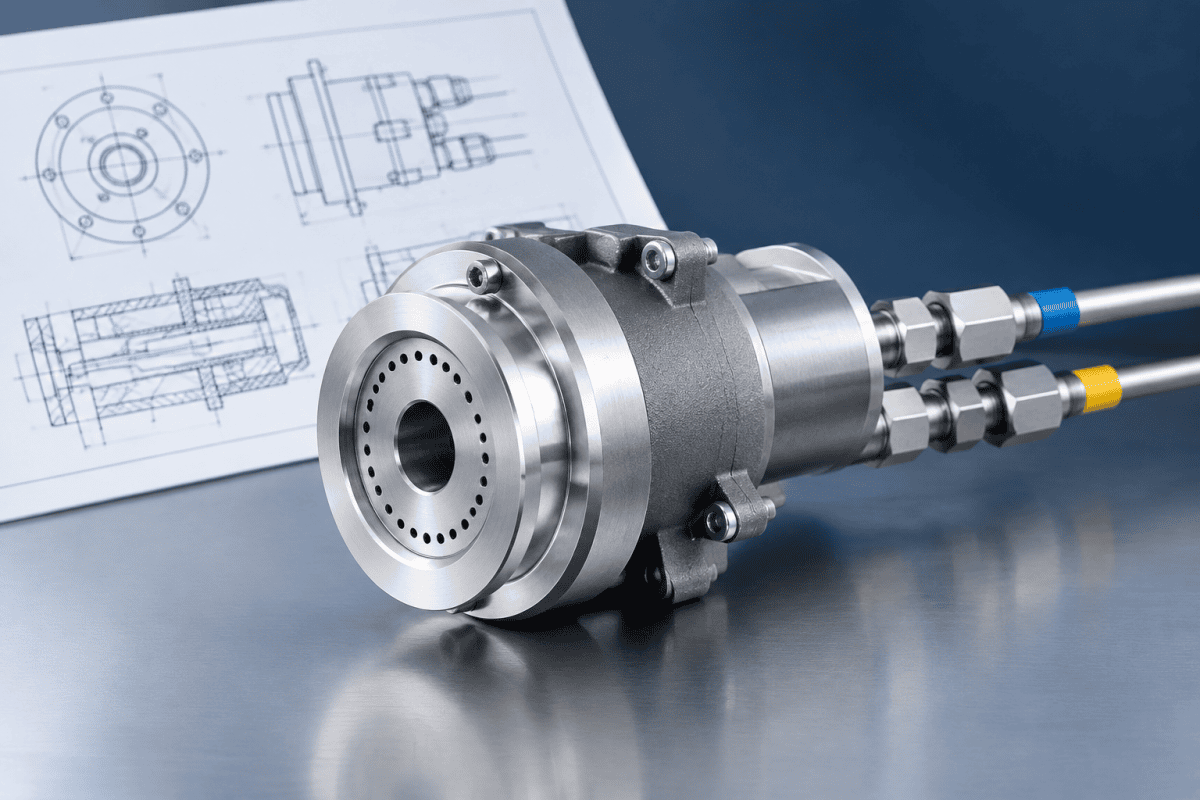
Ngrancang penggantian kepala OVD burner arang banget mung ganti part sing prasaja. Burner dumunung ing tengah deposisi soot, ing ngendi beda cilik ing geometri nozzle, flatness faceplate, lan susunan feed gas bisa ngganti wujud flame, pembentukan partikel, lan pungkasane kualitas preform. Sadurunge nindakake penggantian, insinyur maintenance lan proses kudu mbandhingake rong dokumen kanthi bebarengan: panggambar burner lan jadwal sambungan gas. Artikel iki nerangake apa sing kudu digoleki ing saben dokumen, kepiye loro kasebut kudu cocog, lan kepiye nyiapake panjalukan sourcing sing jelas kanggo penggantian kepala OVD burner.
Napa Panggambar lan Sambungan Gas Kudu Diwaca Bebarengan
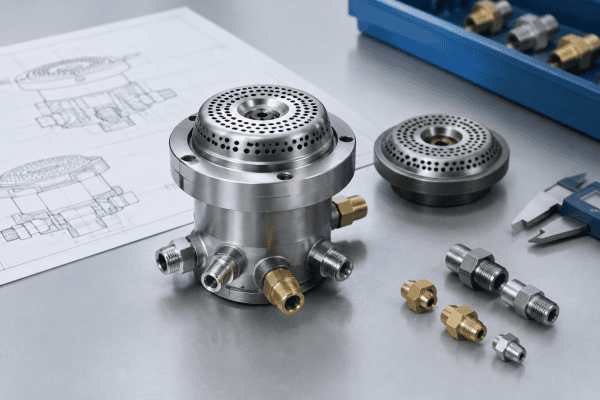
Panggambar burner nemtokake part fisik: envelope sakabèhé, pola nozzle, diameter saluran, permukaan faceplate, fitur pemasangan, lan callout material. Jadwal sambungan gas nemtokake kepiye part kasebut nyambung karo sistem deposisi liyane: port endi sing nampa gas endi, jinis thread utawa flange, metode sealing, lan watesan routing.
Pengganti bisa cocog karo panggambar kanthi sampurna lan isih bisa mlaku kanthi ora apik yen port ditugasake kanggo layanan sing salah, yen permukaan sealing diowahi, utawa yen fitting ora bisa tekan pasangane ing manifold torch. Kosok baline, tugas port sing bener ora akeh tegese yen concentricity nozzle utawa kondisi faceplate wis nyimpang saka maksud desain asli. Anggep loro dokumen kasebut minangka paket spesifikasi siji.
Apa sing Kudu Diverifikasi ing Panggambar OVD Burner
Panggambar komponen kepala OVD burner kudu cukup rinci supaya bisa digawe tanpa asumsi lisan. Nalika mriksa kanggo tujuan penggantian, priksa ing ngisor iki.
Geometri Nozzle lan Tata Letak Saluran
- Jumlah lan susunan nozzle: Verifikasi jumlah saluran (biasane bahan bakar, oksigen, lan siji utawa luwih jalur carrier utawa dopan) lan posisi relatif. Malah owah-owahan cilik ing jarak utawa diameter ring bisa ngaruhi struktur flame lan ing ngendi soot deposisi.
- Diameter orifice lan toleransi: Cathet apa diameter ditemtokake kanthi toleransi lan apa toleransi kasebut fungsional utawa mung standar bengkel. Presisi nozzle duwe hubungan langsung karo stabilitas deposisi, kaya sing dibahas ing artikel iki babagan presisi nozzle burner lan hasil preform.
- Konsentrisitas: Goleki callout concentricity utawa runout antarane saluran tengah lan ring njaba. Callout sing ilang minangka celah umum ing panggambar lawas.
- Finish permukaan: Finish faceplate ngaruhi adhesi soot lan prilaku reresik. Permukaan kasar cenderung nglumpukake deposit kanthi beda tinimbang sing dipoles.
Bahan lan Konstruksi
Callout material kudu diwaca minangka syarat fungsional, dudu preferensi. Kepala burner bisa nggunakake siji alloy kanggo awak utama lan material beda kanggo faceplate utawa insert nozzle, gumantung saka paparan suhu, siklus termal, lan lingkungan kimia. Yen panggambar ora ngenali permukaan endi sing ngalami panas paling dhuwur utawa joint endi sing brazed, welded, utawa mechanically sealed, takon sadurunge menehi penawaran. Logika sing luwih jembar babagan nyocogake material karo tugas burner dibahas ing pandhuan iki kanggo sourcing burner custom lan reverse engineering.
Fitur Pemasangan lan Alignment
Cathet kepiye burner dumunung ing rakitan torch: dowel pin, diameter pilot, flange keyed, utawa permukaan clamp. Fitur kasebut nyetel posisi burner relatif marang preform lan marang burner tambahan. Yen pengganti ngganti metode lokasi, alignment optik bisa owah sanajan flame dhewe tumindak kanthi bener.
Apa sing Kudu Diverifikasi ing Jadwal Sambungan Gas
Sambungan gas minangka papan proyek penggantian paling kerep mandheg. Burner sing teka kanthi pola nozzle sing bener nanging thread port utawa permukaan sealing sing ora kompatibel ora bisa dioperasikake kanthi aman.
- Pemetaan port-to-service: Konfirmasi port endi sing nggawa bahan bakar, oksigen, gas carrier, lan jalur dopan utawa tambahan. Aja nganggep urutan port konsisten antarane revisi panggambar.
- Standar thread lan fitting: Identifikasi jinis thread, ukuran, lan pitch, utawa apa sambungan nggunakake compression fitting, flange, utawa desain face-seal. Campuran metrik lan imperial minangka sumber mismatch sing kerep. Kanggo referensi babagan konvensi thread lan fitting, deleng perpustakaan kode lan standar ASME.
- Metode sealing: Cathet apa seal iku metal-to-metal, basis gasket, utawa basis elastomer, lan apa permukaan sealing minangka bagean saka burner utawa manifold pasangane.
- Routing lan clearance: Priksa sudut pendekatan lan ruang sing kasedhiya ing sekitar saben port. Fitting sing pas ing bangku bisa uga ora pas yen burner wis dipasang ing lathe utawa kamar deposisi.
- Jalur purge utawa tambahan: Sawetara instalasi OVD nggunakake jalur purge khusus utawa feed tambahan. Iki kudu diidentifikasi supaya ora sengaja ditutup utawa disambungake silang.
Yen distribusi oksigen ditangani dening manifold kapisah, bandhingake syarat inlet burner karo outlet manifold kasebut. Ing manifold distribusi oksigen and auxiliary tail burner arrangement is one example where burner and manifold specifications must be reviewed as a pair.
Mbandhingake Burner sing Ana karo Pengganti sing Diusulake
When a replacement is being sourced from a drawing rather than a catalog number, the most reliable approach is a structured dimensional and interface comparison.
- Lay out both drawings at the same scale. Overlay or compare envelope dimensions, nozzle positions, and mounting features. Do not rely on visual similarity alone.
- Build a port-by-port table. List each gas connection on the original and the proposed replacement: service, thread or fitting, sealing type, and position. Flag every difference.
- Check tolerances, not just nominal dimensions. A nozzle at the same nominal diameter but with a wider tolerance band may behave differently across a production run.
- Confirm material equivalence functionally. Two alloys with similar names can differ in thermal conductivity, oxidation resistance, or machinability. State the function each material must perform.
- Verify interface fit with the mating hardware. This includes the torch body, manifold, and any alignment fixture. Interface fit is often where a “drop-in” replacement turns out not to be one.
If the original drawing is incomplete or unavailable, reverse engineering from a retired burner is possible, but it should be treated as a measurement and documentation project rather than a quick copy. Worn nozzles and distorted sealing faces can mislead dimensional readings, so cleaned and inspected reference parts matter.
Titik Inspeksi Sadurunge Masang Kepala Pengganti
Even a correctly specified burner head should be inspected on receipt. Useful checks include:
- Visual inspection of nozzle orifices for burrs, debris, or machining residue.
- Faceplate flatness and surface condition, particularly around the nozzle field.
- Thread condition and sealing face condition on every gas port.
- Dimensional spot checks against the drawing’s critical features.
- Cleanliness of internal channels, where accessible, to avoid introducing contamination into the gas path.
Soot accumulation and faceplate condition are routine maintenance concerns covered in more detail in this article on preventing silica soot clogging on OVD burner faceplates. Establishing a consistent incoming inspection routine makes it easier to distinguish a genuine OVD burner head replacement problem from an installation or process issue.
Nalika Panggambar Mung Ora Cukup
Some replacement decisions require operating context that drawings do not capture. If a burner has been modified in service, if the process window has changed, or if the original part was itself a non-standard variant, a drawing-based quotation may need additional input. In those cases, supplying the following helps a supplier respond accurately:
- Marked-up drawings showing critical dimensions and tolerances.
- Photographs of the existing burner and its installed connections.
- A list of gas services and their connection types.
- Any known constraints on materials, cleaning, or assembly.
Custom and non-standard components can be produced from drawings or from measured samples through layanan mesin OEM/ODM, provided the interface requirements are documented clearly.
Kepiye Desain Burner Ngaruhi Deposisi Soot lan Hasil Preform
The reason drawings and gas schedules deserve this level of attention is that the burner is an active process component, not a passive fixture. Flame chemistry, velocity, and shape determine where silica particles form and how they deposit on the growing preform. A change in nozzle diameter, channel spacing, or gas velocity can shift the deposition profile enough to affect core-to-clad ratios and refractive index uniformity.
When evaluating an OVD burner head replacement, it helps to trace how each drawing feature influences the process:
- Nozzle diameter: Sets exit velocity for a given flow, which in turn affects flame length and particle residence time.
- Channel spacing: Influences mixing between fuel, oxygen, and carrier streams, and therefore flame temperature distribution.
- Faceplate condition: Soot buildup near the nozzle field can distort local flow and alter deposition symmetry.
- Port assignment: Incorrect routing changes the stoichiometry at the nozzle exit, even if total flows are unchanged.
Because these effects compound, a replacement that is dimensionally “close” is not necessarily process-equivalent. Documenting the functional role of each critical feature makes it easier to judge which drawing callouts are negotiable and which are not.
Review Dimensi lan Toleransi ing Praktek
Drawing comparison is most effective when it follows a repeatable sequence. The steps below are suitable for both internal review and supplier communication.
- Establish the governing revision. Confirm which drawing revision reflects the currently installed burner, including any approved deviations.
- Identify critical-to-function dimensions. Mark nozzle diameters, concentricity, sealing faces, and mounting locations as critical; treat cosmetic or non-interface features as secondary.
- Record tolerance bands, not just nominal values. A dimension without a tolerance cannot be verified, and a wide tolerance on a critical feature is a risk.
- Cross-check against the gas schedule. Confirm that each documented port on the drawing corresponds to a defined service in the schedule.
- Note measurement uncertainty. When reverse engineering, record the instruments used and their resolution so future comparisons are meaningful.
Keeping this review in a single controlled document reduces the chance that a critical requirement is lost between engineering, procurement, and the machine shop.
Detail Sambungan Gas sing Paling Kerep Nyebabake Masalah
In practice, a small number of connection issues account for most commissioning delays. Reviewing them explicitly before ordering an OVD burner head replacement saves significant rework.
- Sealing face geometry: A mismatch between a metal-to-metal seat and a gasket-style seat is not solved by tightening; it requires a corrected part.
- Thread compatibility: Similar-looking threads in different standards can engage partially and leak under pressure.
- Port orientation: A port rotated by a few degrees can interfere with adjacent fittings or obstruct access for torque tools.
- Material compatibility of fittings: Dissimilar metals at a connection can accelerate corrosion or galling over thermal cycles.
- Purge and vent paths: Omitting or capping a purge line can leave stagnant gas volumes that affect startup behavior.
Where any of these points is uncertain, resolving it at the drawing stage is far cheaper than resolving it during installation.
Dokumentasi Persyaratan kanggo Penawaran Supplier
A clear requirements package speeds up quotation and reduces the risk of a non-conforming part. At minimum, include:
- The burner drawing with critical dimensions and tolerances highlighted.
- The gas connection schedule with port-to-service mapping.
- Material requirements stated by function, not just by alloy name.
- Any cleanliness, packaging, or traceability requirements.
- Operating conditions such as gas types, flow ranges, and thermal cycling.
When documentation is incomplete, state clearly what was measured, what was assumed, and what remains unknown. Suppliers can work with gaps if they are identified; they cannot work with gaps that are hidden.
Pitakonan sing Sering Ditakoni
Apa aku bisa ngganti kepala OVD burner mung nganggo nomer part?
Only if the part number is tied to a complete and current drawing that matches your installed configuration. Part numbers alone rarely capture gas connection details, tolerance revisions, or in-service modifications. Always verify against the drawing and the connection schedule before an OVD burner head replacement is approved.
Kepiye yen sambungan gas ing pengganti ora cocog karo manifoldku?
Do not force a fit or adapt threads without engineering review. Mismatched sealing methods or thread standards can create leak paths or mechanical stress. Document the mismatch and either source a corrected burner or have an adapter evaluated by qualified personnel.
Apa kepala OVD lan VAD burner bisa diganti-ganti?
No. OVD and VAD burners differ in geometry, gas distribution, and process role, and MCVD uses different hardware again. Treat drawings and connection schedules as process-specific documents. A comparison of nozzle approaches across these processes is available in this OVD, VAD, and MCVD nozzle guide.
Kepiye aku ngerti apa bedane dimensi iku penting?
Map each difference to a function: gas flow path, flame geometry, alignment, or sealing. Differences on non-functional surfaces are usually tolerable; differences in nozzle geometry, concentricity, or sealing faces deserve engineering review before installation.
Pira suwene perencanaan penggantian kepala OVD burner sing khas?
Timing depends on documentation quality. If drawings and gas schedules are current, quotation and review can proceed quickly. If reverse engineering is required, allow additional time for measurement, verification, and supplier confirmation before an OVD burner head replacement is scheduled.
Nyiapake Panjalukan Pengganti
A well-prepared request shortens the path from inquiry to quotation. Gather the original burner drawing, the gas connection schedule, a port-by-port service list, material requirements, and any photographs or measurements of the installed part. If the documentation is incomplete, note which dimensions were measured and which were assumed.
To discuss a specific replacement, you can contact our team with your drawings, dimensions, gas connection details, and operating conditions so the component requirements can be reviewed against your application.
Ringkesan: Nindakake Penggantian Kepala OVD Burner kanthi Bener
A successful OVD burner head replacement depends less on the part itself than on how thoroughly the drawing and the gas connection schedule are reconciled before the order is placed. Compare nozzle geometry, tolerances, materials, and mounting features against the original design. Then map every gas port by service, thread, sealing method, and physical clearance. Where the documentation is incomplete, document what was measured and what was assumed. An OVD burner head replacement should end with a complete interface record that the next maintenance cycle can reuse. Treated this way, an OVD burner head replacement becomes a controlled engineering change rather than a troubleshooting exercise.
