
Kawruh
Panggantos Nozzle Burner OVD Custom: Spesifikasi Utama sing Kudu Dikonfirmasi
Okt
Ngganti nozzle burner ing sistem deposisi OVD dudu ijol-ijolan parts sing prasaja. Nozzle minangka salah sawijining komponen pungkasan sing mbentuk aliran gas sadurunge pembakaran, mula beda cilik ing geometri, fit, utawa material bisa ngowahi bentuk nyala, prilaku deposisi soot, lan stabilitas pambangunan preform. Nalika parts katalog standar ora kasedhiya utawa ora cocog maneh karo gambar, panggantos nozzle burner OVD custom asring dadi dalan praktis — nanging mung yen spesifikasi wis dikonfirmasi sadurunge machining diwiwiti. Njupuk spesifikasi kanthi bener minangka latihan teknis ing geometri, aliran gas, lan prilaku material, dudu mung transaksi purchasing.
Artikel iki njlentrehake spesifikasi sing paling penting nalika sumber panggantos nozzle burner OVD custom, cara verifikasi, lan informasi apa sing dibutuhake supplier kanggo ngutip kanthi akurat. Iki fokus khusus ing burner deposisi OVD; desain torch VAD lan MCVD beda ing geometri lan logika operasi — perbandingan kasebut dibahas ing pandhuan nozzle torch OVD vs. VAD vs. MCVD — lan nozzle-ne ora kena dianggep bisa diijolake.
Napa Panggantos Nozzle Burner OVD Custom Kedadeyan
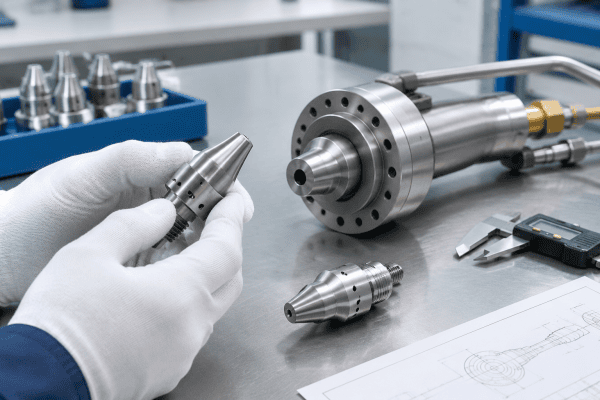
Nozzle iku consumable ing pangertèn sing nyata. Suwe-suwe, faceplate lan bore nozzle kena suhu dhuwur, siklus termal, lan kimia proses. Panyebab umum sing mbutuhake panggantos nozzle burner OVD custom kalebu:
- Akumulasi soot lan clogging ing faceplate utawa ing njero passage cilik, sing bisa mbatesi aliran lan ngrusak nyala.
- Aus utawa erosi ing exit nozzle, ngowahi bentuk orifice efektif.
- Distorsi utawa creep sawise paparan termal sing suwe, mengaruhi konsentrisitas.
- Parts obsolete utawa ora didokumentasikake, ing ngendi gambar asli ilang lan panggantos sing direkayasa bali dadi siji-sijine pilihan.
- Konfigurasi non-standar, ing ngendi torch sing ana wis dimodifikasi utawa proses mbutuhake owah-owahan distribusi gas.
Ing saben kasus, tujuan panggantos nozzle burner OVD custom padha: mulihake karakteristik aliran gas lan nyala sing dirancang kanggo proses kasebut, tanpa ngenalake variabel anyar ing deposition run. Tujuan kasebut dadi sebabe spesifikasi, dudu mung rega, kudu dadi dhasar keputusan sumber. Tim purchasing sing nganggep nozzle minangka parts komoditas asring nemokake bedane sajrone deposition run pisanan sawise instalasi.
Spesifikasi Utama sing Kudu Dikonfirmasi Sadurunge Pesen
Spesifikasi ing ngisor iki dadi checklist kanggo panggantos nozzle burner OVD custom apa wae. Saben item kudu dikonfirmasi kanthi tulisan lan dilacak menyang pangukuran saka parts sing gagal, gambar asli, utawa dokumentasi peralatan — ora dianggep saka kategori katalog.
Dimensi lan Toleransi Nozzle
Dimensi nozzle OVD minangka dhasar kanggo panggantos nozzle burner OVD custom apa wae. Konfirmasi dimensi kudu nyakup:
- Dawane sakabèhé, diameter njaba, lan dimensi antarmuka mounting.
- Diameter bore kanggo saben saluran gas, kalebu bagean stepped utawa tapered.
- Ukuran orifice, sudut exit, lan jarak antarane saluran konsentris.
- Flatness faceplate lan finish permukaan ing ngendi nyala dibentuk.
- Geometri thread utawa flange, yen nozzle dipasang kanthi mekanis.
Yen bisa, njaluk dimensi kritis dijupuk saka parts sing gagal lan dipriksa silang karo dokumentasi peralatan asli. Yen parts wis aus banget, cathet permukaan endi sing aus lan endi sing isih reference-grade — ngukur parts sing distorsi bisa ngode distorsi kasebut menyang sing anyar. Panggantos nozzle burner OVD custom sing dibangun saka sampel sing distorsi bakal niru kesalahan sing kudune diilangi.
Toleransi pantes diwenehi perhatian sing padha karo dimensi nominal. Bore sing nominal bener nanging ing ujung longgar saka band toleransi bisa tumindak beda karo sing ing ujung ketat, utamane ing orifice cilik ing ngendi sawetara atus milimeter ngowahi area aliran efektif. Sebutna toleransi endi sing kritis lan endi sing konvensional, supaya machine shop bisa ngalokasiake upaya inspeksi kanthi tepat.
Konfigurasi Saluran Gas
Torch OVD multi-saluran gumantung marang aliran gas sing seimbang kanthi ati-ati. Nozzle kudu njaga jumlah saluran, area cross-sectional relatif, lan cara mbukak menyang atmosfer. Owah-owahan ing rasio antarane area saluran tengah lan njaba, sanajan cilik, bisa nggeser nyala lan mengaruhi deposisi. Iki minangka spesifikasi sing paling kerep diremehake nalika panggantos nozzle burner OVD custom dikutip saka sketsa prasaja.
Yen burner nggunakake manifold distribusi oksigen utawa auxiliary tail burner, konfirmasi cara nozzle antarmuka karo hardware kasebut. Geometri distribusi minangka bagean saka jalur aliran, dudu detail sing kapisah. Antarmuka antarane nozzle lan manifold nemtokake cara gas teka ing orifice, lan mismatch ing kana bisa mbatalake geometri nozzle sing bener.
Kanggo diskusi sing luwih jembar babagan cara geometri saluran interaksi karo aliran, artikel babagan sumber burner OVD lan VAD custom liwat material science lan reverse engineering minangka referensi sing migunani, utamane nalika tata letak saluran asli kudu direkonstruksi saka sampel fisik tinimbang gambar.
Konsentrisitas lan Alignment
Konsentrisitas nemtokake apa geni tetep pusat ing preform. Nozzle eksentrik bisa ngasilake deposisi soot asimetris, sing banjur nyumbang kanggo drift profil indeks bias. Nalika nemtokake panggantian nozzle burner OVD khusus, sebutna syarat konsentrisitas kanthi eksplisit, luwih becik minangka nilai sing diukur relatif marang datum pemasangan, ora minangka cathetan umum kaya “pusat.”
Alignment uga gumantung ing antarmuka pemasangan, ora mung awak nozzle. Yen awak torch wis pindah utawa kursi pemasangan wis aus, nozzle sing sampurna konsentris isih bakal lungguh ing sumbu sing salah. Hubungan antarane alignment lan kontrol profil dibahas luwih rinci ing artikel babagan kenapa geni burner OVD miring lan kepiye pilihan alloy mulihake stabilitas deposisi.
Pemilihan Material
Nozzle material should be chosen based on function, not habit. The relevant factors for a custom OVD burner nozzle replacement are:
- Paparan suhu at the nozzle face and along the bore.
- Lingkungan kimia, including the gases and vapors present and any reaction products that may form deposits.
- Thermal cycling, which drives fatigue and dimensional drift.
- Machinability and surface finish, since fine bores and smooth faces are often required.
Common choices include high-temperature alloys and, for some mounting or support components, aluminum where thermal and chemical conditions allow. Aluminum is not a universal substitute for hot-face nozzle materials; it is appropriate only for components whose function and environment suit it. An aluminum OVD part may be a good fit for certain brackets or manifolds, but hot-section nozzles require different selection logic.
If the original material is unknown, a supplier may need to infer suitability from the part’s function and the process conditions, rather than assuming a material from the part number or category. Where the process has moved to higher deposition rates or more aggressive chemistry, material selection for a custom OVD burner nozzle replacement may also justify upgrading from the original alloy rather than matching it.
Finish Permukaan lan Kondisi Faceplate
The faceplate is where soot tends to collect first. Surface roughness and edge condition influence how deposits form and how easily they can be removed. For custom nozzles, specify the required finish on sealing surfaces and on the flame-facing face, and clarify whether any coating or treatment is required. A custom OVD burner nozzle replacement that matches dimensions but not surface finish may still show different deposition behavior over a long run.
Faceplate condition also evolves during service. Understanding how deposits build and how cleaning procedures affect the surface helps set realistic replacement intervals and finish specifications. The article on Bagian deposisi OVD shows the range of components affected by the same deposition environment, which is useful context when the replacement decision touches more than the nozzle.
Antarmuka Mounting lan Sealing
Mechanical fit is where many replacement projects fail quietly. Confirm bolt patterns, thread pitch, flange thickness, O-ring or gasket grooves, and gas inlet connections. Sealing surfaces should be dimensioned to the same standard as the original, and any change in sealing method should be reviewed against the torch body design. A nozzle that fits but leaks will not reproduce the original flow behavior.
Sealing materials matter as well. Elastomer compatibility with the gases in use, and with the temperature reached at the sealing location, determines whether the seal survives a full campaign or fails early. For a custom OVD burner nozzle replacement, the sealing specification should be reviewed alongside the nozzle geometry rather than treated as a consumable detail.
Pertumbuhan Termal lan Fit ing Suhu Operasi
Dimensions measured at room temperature are not the dimensions that matter at operating temperature. Different materials expand at different rates, and a custom OVD burner nozzle replacement made from a different alloy than the original can change the fit at the mounting interface once the torch reaches process temperature.
For critical interfaces, consider whether the drawing should specify dimensions at operating temperature, or whether the room-temperature dimensions already account for thermal growth. Where the original drawing includes this information, preserve it; where it does not, discuss the operating temperature range with the supplier so the fit can be reviewed analytically before machining.
Dokumentasi lan Traceability
A custom OVD burner nozzle replacement should come with documentation that supports future maintenance: a final drawing reflecting as-built dimensions, material certification, and inspection records for critical features. Without this, the next replacement cycle starts from a physical sample again, and any measurement uncertainty compounds over successive generations of parts.
Traceability also helps when deposition behavior changes. If the nozzle can be linked to a specific build record and material lot, the investigation can focus on process variables instead of questioning the hardware.
Pertimbangan Inspeksi lan Verifikasi
Before accepting a custom OVD burner nozzle replacement, verify what can be verified:
- Dimensional check against the confirmed drawing, with particular attention to bore diameters and concentricity.
- Visual inspection for machining marks, burrs, or blocked passages.
- Fit check on the torch body, without gas flow, to confirm seating and alignment.
- Flow verification, where the equipment and procedures allow, using the manufacturer’s guidance and qualified personnel.
- First-run monitoring, comparing deposition behavior against the established baseline for that torch position.
A dimensional match does not guarantee a process match. It establishes that the hardware is correct; the process behavior still needs to be observed under controlled conditions. Standards such as those published by the International Organization for Standardization provide useful reference frameworks for dimensional verification and quality documentation in this kind of procurement.
Panyebab Umum lan Diagnosis sing Dikonfirmasi
When deposition quality changes, the nozzle is one possible cause among several. It helps to separate likely causes from confirmed ones before committing to a custom OVD burner nozzle replacement:
- Possible cause: nozzle wear or distortion. How to verify: measure the installed part against the drawing and inspect the faceplate and orifices.
- Possible cause: soot clogging. How to verify: inspect passages and faceplate for deposits; compare flow behavior before and after cleaning according to approved procedures.
- Possible cause: gas supply or distribution issue. How to verify: check upstream hardware, including manifolds and regulators, against equipment documentation.
- Possible cause: mounting or alignment shift. How to verify: check concentricity and seating relative to the torch datum.
Only after the cause is confirmed should a replacement be specified. A custom OVD burner nozzle replacement ordered for a nozzle that was not the root cause adds cost and introduces a new variable into a process that was already drifting.
Sumber Nozzle Custom: Apa sing Kudu Dikirim
A clear sourcing request shortens lead time and reduces the risk of a non-conforming part. Useful information for a custom OVD burner nozzle replacement quote includes:
- Drawings or sketches with critical dimensions and tolerances.
- Photos of the failed part, including close-ups of the faceplate and any wear.
- The material, if known, or the operating conditions that govern material choice.
- The torch position and function (for example, main deposition versus auxiliary).
- Any known constraints on gas connections, mounting, or available space.
- Quantity and expected replacement interval, which influence manufacturing method and cost.
Where no drawing exists, reverse engineering from a sample is often the practical path. This is a normal part of OEM and ODM machining services for optical fiber equipment, and it works best when the sample is accompanied by as much process context as the customer can share. Customers who supply operating data, not just a worn part, tend to receive a more robust custom OVD burner nozzle replacement that accounts for the conditions the nozzle actually sees.
Pitakonan sing Sering Ditakoni
Apa nozzle custom bisa digawe tanpa gambar asli?
Yes, in many cases. The supplier measures the sample, identifies critical dimensions, and produces a drawing for customer approval before machining. The accuracy of the result depends heavily on the condition of the sample and the clarity of the customer’s requirements.
Apa nozzle OVD bisa diijolake karo nozzle VAD utawa MCVD?
No. These processes use different torch designs, flow configurations, and deposition geometries. A nozzle that fits mechanically may not reproduce the intended flame or flow behavior. Confirm the process before specifying a replacement.
Kepiye cara milih material nozzle?
Base the choice on temperature exposure, chemical environment, thermal cycling, and required surface finish. Where the original material is unknown, describe the operating conditions and let the supplier recommend candidates for review.
Informasi apa sing dibutuhake kanggo penawaran?
At minimum, dimensions or a sample, the quantity, the material requirement or operating conditions, and the interface details. Drawings and photos speed up the review considerably.
Pira suwene produksi panggantos nozzle burner OVD custom?
Lead time depends on whether a drawing exists, whether material is in stock, and how much inspection is required. Reverse-engineering projects that include drawing approval typically take longer than repeat orders against an existing drawing.
Apa material nozzle kudu tansah cocog karo asline?
Not necessarily. Matching the original is the safe default, but if the process conditions have changed — higher temperature, different chemistry, longer campaigns — an upgraded alloy may deliver better service life. Discuss the operating conditions with the supplier before deciding.
Langkah Sabanjure
If you are planning a custom OVD burner nozzle replacement, gather the drawing, the failed part, and the operating context, then send them for review. For a wider view of available components, the case study on upgrading OVD torch consumables to titanium alloy shows how material selection has played out in a real production environment. You can contact our team to discuss dimensions, material requirements, and interface details, and to request a quotation based on your actual component rather than a generic assumption. A well-specified custom OVD burner nozzle replacement restores the deposition behavior the process was designed around — and gives the maintenance team a documented starting point for the next cycle.
