
지식
맞춤형 OVD 버너 노즐 교체: 확인해야 할 주요 사양
10월
OVD 증착 시스템의 버너 노즐 교체는 단순한 부품 교환이 아닙니다. 노즐은 연소 전 가스 흐름을 형성하는 마지막 구성 요소 중 하나이므로, 형상, 끼워맞춤 또는 재료의 작은 차이도 화염 형상, 그을음 증착 거동 및 프리폼 성형의 안정성을 변화시킬 수 있습니다. 표준 카탈로그 부품을 구할 수 없거나 더 이상 도면과 일치하지 않는 경우, 맞춤형 OVD 버너 노즐 교체가 종종 실용적인 해결책이 됩니다. 다만 가공이 시작되기 전에 사양이 확인된 경우에만 해당합니다. 사양을 정확하게 확정하는 것은 단순한 구매 거래가 아니라 형상, 가스 유동 및 재료 거동에 관한 기술적 작업입니다.
이 글에서는 맞춤형 OVD 버너 노즐 교체를 소싱할 때 가장 중요한 사양, 이를 검증하는 방법, 그리고 공급업체가 정확하게 견적을 제시하는 데 필요한 정보를 설명합니다. 특히 OVD 증착 버너에 초점을 맞춥니다. VAD 및 MCVD 토치 설계는 형상과 작동 논리가 다르며, 이 비교는 저희의 OVD vs. VAD vs. MCVD 토치 노즐 가이드 에서 다루고 있으며, 이들의 노즐은 호환 가능한 것으로 취급되어서는 안 됩니다.
맞춤형 OVD 버너 노즐 교체가 발생하는 이유
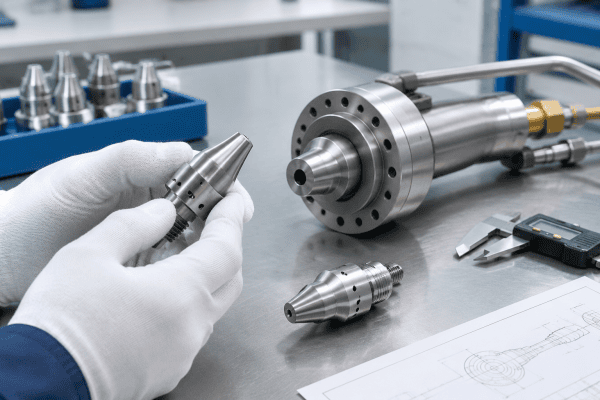
노즐은 실질적인 의미에서 소모품입니다. 시간이 지남에 따라 페이스플레이트와 노즐 보어는 고온, 열 사이클링 및 공정 화학 물질에 노출됩니다. 맞춤형 OVD 버너 노즐 교체가 필요한 일반적인 이유는 다음과 같습니다:
- 그을음 축적 및 막힘 페이스플레이트 또는 작은 통로 내부에 침착되어 유동을 제한하고 화염을 왜곡할 수 있습니다.
- 마모 또는 침식 이 노즐 출구에서 발생하여 실효 오리피스 형상을 변화시킵니다.
- 변형 또는 크리프 가 장시간 열 노출 후 발생하여 동심도에 영향을 미칩니다.
- 단종되거나 문서화되지 않은 부품, 으로, 원본 도면이 없어 역설계한 교체품이 유일한 선택인 경우입니다.
- 비표준 구성, 으로, 기존 토치가 개조되었거나 공정에서 가스 분배 변경이 필요한 경우입니다.
각 경우에서 맞춤형 OVD 버너 노즐 교체의 목표는 동일합니다: 증착 공정에 새로운 변수를 도입하지 않고, 공정이 설계된 원래의 가스 유동 및 화염 특성을 복원하는 것입니다. 이러한 목표 때문에 가격만이 아니라 사양이 소싱 결정을 이끌어야 합니다. 노즐을 범용 부품으로 취급하는 구매팀은 설치 후 첫 번째 증착 공정에서 그 차이를 발견하는 경우가 많습니다.
주문 전 확인해야 할 핵심 사양
아래 사양은 모든 맞춤형 OVD 버너 노즐 교체를 위한 체크리스트를 구성합니다. 각 항목은 서면으로 확인되어야 하며, 카탈로그 분류에서 가정하는 것이 아니라 고장난 부품, 원본 도면 또는 장비 문서의 측정값으로 추적되어야 합니다.
노즐 치수 및 공차
OVD 노즐 치수는 모든 맞춤형 OVD 버너 노즐 교체의 기초입니다. 치수 확인은 다음을 포함해야 합니다:
- 전체 길이, 외경 및 장착 인터페이스 치수.
- 각 가스 채널의 보어 직경, 단차 또는 테이퍼 구간 포함.
- 오리피스 크기, 출구 각도 및 동심 채널 간 간격.
- 화염이 형성되는 페이스플레이트의 평탄도 및 표면 조도.
- 노즐이 기계적으로 장착되는 경우 나사 또는 플랜지 형상.
가능한 경우, 고장난 부품에서 핵심 치수를 측정하고 원래 장비 문서와 교차 확인할 것을 요청하십시오. 부품이 심하게 마모된 경우, 어떤 표면이 마모되었고 어떤 표면이 아직 기준 등급인지 기록하십시오. 변형된 부품을 측정하면 그 변형이 새 부품에 반영될 수 있습니다. 변형된 샘플을 기반으로 제작된 맞춤형 OVD 버너 노즐 교체품은 제거하려 했던 바로 그 오류를 재현하게 됩니다.
공차는 공칭 치수와 동일한 주의를 기울일 가치가 있습니다. 공칭상 올바르지만 공차 범위의 느슨한 쪽에 있는 보어는 빡빡한 쪽에 있는 보어와 다르게 거동할 수 있으며, 특히 수백분의 1밀리미터의 변화가 실효 유동 면적을 변화시키는 작은 오리피스에서 그러합니다. 어떤 공차가 핵심이고 어떤 것이 일반적인지 명시하여, 가공 업체가 검사 노력을 적절히 배분할 수 있도록 하십시오.
가스 채널 구성
다채널 OVD 토치는 신중하게 균형 잡힌 가스 유량에 의존합니다. 노즐은 채널 수, 상대적 단면적, 그리고 대기로 개방되는 방식을 유지해야 합니다. 중심 채널과 외부 채널 면적 간의 비율 변화는 작은 것이라도 화염을 이동시키고 증착에 영향을 미칠 수 있습니다. 이는 맞춤형 OVD 버너 노즐 교체가 단순한 스케치로 견적될 때 가장 자주 과소평가되는 사양입니다.
버너가 산소 분배 매니폴드 또는 보조 테일 버너를 사용하는 경우, 노즐이 해당 하드웨어와 어떻게 인터페이스하는지 확인하십시오. 분배 형상은 별도의 세부 사항이 아니라 유동 경로의 일부입니다. 노즐과 매니폴드 사이의 인터페이스는 가스가 오리피스에 도달하는 방식을 결정하며, 그곳의 불일치는 올바른 노즐 형상을 무효화할 수 있습니다.
채널 형상이 유동과 상호작용하는 방식에 대한 더 넓은 논의는 재료 과학 및 역설계를 통한 맞춤형 OVD 및 VAD 버너 소싱에 관한 글이 유용한 참고 자료가 되며, 특히 원본 채널 레이아웃을 도면이 아닌 실제 샘플에서 재구성해야 하는 경우에 그러합니다.
동심도 및 정렬
동심도는 화염이 프리폼 중심에 유지되는지를 결정합니다. 편심 노즐은 비대칭 그을음 증착을 발생시킬 수 있으며, 이는 다시 굴절률 프로파일 드리프트에 기여합니다. Custom OVD burner nozzle replacement를 지정할 때는 동심도 요구 사항을 명시적으로 기재해야 하며, 이상적으로는 “중심 정렬됨”과 같은 일반적인 메모가 아니라 장착 기준면에 대한 측정값으로 제시해야 합니다.”
정렬은 노즐 본체뿐만 아니라 장착 인터페이스에도 의존합니다. 토치 본체가 변형되었거나 장착 시트가 마모된 경우, 완벽하게 동심인 노즐이라도 여전히 축에서 벗어나 위치하게 됩니다. 정렬과 프로파일 제어의 관계는 다음 문서에서 더 자세히 다룹니다: OVD 버너 화염이 기울어지는 이유와 합금 선택이 증착 안정성을 회복하는 방법.
재료 선정
노즐 재질은 관습이 아닌 기능에 따라 선택해야 합니다. Custom OVD burner nozzle replacement에 관련된 요소는 다음과 같습니다:
- 온도 노출 at the nozzle face and along the bore.
- 화학적 환경, including the gases and vapors present and any reaction products that may form deposits.
- Thermal cycling, which drives fatigue and dimensional drift.
- Machinability and surface finish, since fine bores and smooth faces are often required.
Common choices include high-temperature alloys and, for some mounting or support components, aluminum where thermal and chemical conditions allow. Aluminum is not a universal substitute for hot-face nozzle materials; it is appropriate only for components whose function and environment suit it. An aluminum OVD part may be a good fit for certain brackets or manifolds, but hot-section nozzles require different selection logic.
If the original material is unknown, a supplier may need to infer suitability from the part’s function and the process conditions, rather than assuming a material from the part number or category. Where the process has moved to higher deposition rates or more aggressive chemistry, material selection for a custom OVD burner nozzle replacement may also justify upgrading from the original alloy rather than matching it.
표면 조도 및 페이스플레이트 상태
The faceplate is where soot tends to collect first. Surface roughness and edge condition influence how deposits form and how easily they can be removed. For custom nozzles, specify the required finish on sealing surfaces and on the flame-facing face, and clarify whether any coating or treatment is required. A custom OVD burner nozzle replacement that matches dimensions but not surface finish may still show different deposition behavior over a long run.
Faceplate condition also evolves during service. Understanding how deposits build and how cleaning procedures affect the surface helps set realistic replacement intervals and finish specifications. The article on OVD deposition parts shows the range of components affected by the same deposition environment, which is useful context when the replacement decision touches more than the nozzle.
장착 및 밀봉 인터페이스
Mechanical fit is where many replacement projects fail quietly. Confirm bolt patterns, thread pitch, flange thickness, O-ring or gasket grooves, and gas inlet connections. Sealing surfaces should be dimensioned to the same standard as the original, and any change in sealing method should be reviewed against the torch body design. A nozzle that fits but leaks will not reproduce the original flow behavior.
Sealing materials matter as well. Elastomer compatibility with the gases in use, and with the temperature reached at the sealing location, determines whether the seal survives a full campaign or fails early. For a custom OVD burner nozzle replacement, the sealing specification should be reviewed alongside the nozzle geometry rather than treated as a consumable detail.
열팽창 및 작동 온도에서의 끼워맞춤
Dimensions measured at room temperature are not the dimensions that matter at operating temperature. Different materials expand at different rates, and a custom OVD burner nozzle replacement made from a different alloy than the original can change the fit at the mounting interface once the torch reaches process temperature.
For critical interfaces, consider whether the drawing should specify dimensions at operating temperature, or whether the room-temperature dimensions already account for thermal growth. Where the original drawing includes this information, preserve it; where it does not, discuss the operating temperature range with the supplier so the fit can be reviewed analytically before machining.
문서화 및 추적성
A custom OVD burner nozzle replacement should come with documentation that supports future maintenance: a final drawing reflecting as-built dimensions, material certification, and inspection records for critical features. Without this, the next replacement cycle starts from a physical sample again, and any measurement uncertainty compounds over successive generations of parts.
Traceability also helps when deposition behavior changes. If the nozzle can be linked to a specific build record and material lot, the investigation can focus on process variables instead of questioning the hardware.
검사 및 검증 고려사항
Before accepting a custom OVD burner nozzle replacement, verify what can be verified:
- Dimensional check against the confirmed drawing, with particular attention to bore diameters and concentricity.
- Visual inspection for machining marks, burrs, or blocked passages.
- Fit check on the torch body, without gas flow, to confirm seating and alignment.
- Flow verification, where the equipment and procedures allow, using the manufacturer’s guidance and qualified personnel.
- First-run monitoring, comparing deposition behavior against the established baseline for that torch position.
A dimensional match does not guarantee a process match. It establishes that the hardware is correct; the process behavior still needs to be observed under controlled conditions. Standards such as those published by the International Organization for Standardization provide useful reference frameworks for dimensional verification and quality documentation in this kind of procurement.
일반적인 원인 및 확인된 진단
When deposition quality changes, the nozzle is one possible cause among several. It helps to separate likely causes from confirmed ones before committing to a custom OVD burner nozzle replacement:
- Possible cause: nozzle wear or distortion. 확인 방법: measure the installed part against the drawing and inspect the faceplate and orifices.
- Possible cause: soot clogging. 확인 방법: inspect passages and faceplate for deposits; compare flow behavior before and after cleaning according to approved procedures.
- Possible cause: gas supply or distribution issue. 확인 방법: check upstream hardware, including manifolds and regulators, against equipment documentation.
- Possible cause: mounting or alignment shift. 확인 방법: check concentricity and seating relative to the torch datum.
Only after the cause is confirmed should a replacement be specified. A custom OVD burner nozzle replacement ordered for a nozzle that was not the root cause adds cost and introduces a new variable into a process that was already drifting.
맞춤형 노즐 소싱: 무엇을 보내야 하는가
A clear sourcing request shortens lead time and reduces the risk of a non-conforming part. Useful information for a custom OVD burner nozzle replacement quote includes:
- Drawings or sketches with critical dimensions and tolerances.
- Photos of the failed part, including close-ups of the faceplate and any wear.
- The material, if known, or the operating conditions that govern material choice.
- The torch position and function (for example, main deposition versus auxiliary).
- Any known constraints on gas connections, mounting, or available space.
- Quantity and expected replacement interval, which influence manufacturing method and cost.
Where no drawing exists, reverse engineering from a sample is often the practical path. This is a normal part of OEM and ODM machining services for optical fiber equipment, and it works best when the sample is accompanied by as much process context as the customer can share. Customers who supply operating data, not just a worn part, tend to receive a more robust custom OVD burner nozzle replacement that accounts for the conditions the nozzle actually sees.
자주 묻는 질문
원본 도면 없이 맞춤형 노즐을 제작할 수 있습니까?
Yes, in many cases. The supplier measures the sample, identifies critical dimensions, and produces a drawing for customer approval before machining. The accuracy of the result depends heavily on the condition of the sample and the clarity of the customer’s requirements.
OVD 노즐은 VAD 또는 MCVD 노즐과 호환됩니까?
No. These processes use different torch designs, flow configurations, and deposition geometries. A nozzle that fits mechanically may not reproduce the intended flame or flow behavior. Confirm the process before specifying a replacement.
노즐 재료는 어떻게 선택합니까?
Base the choice on temperature exposure, chemical environment, thermal cycling, and required surface finish. Where the original material is unknown, describe the operating conditions and let the supplier recommend candidates for review.
견적에 필요한 정보는 무엇입니까?
At minimum, dimensions or a sample, the quantity, the material requirement or operating conditions, and the interface details. Drawings and photos speed up the review considerably.
맞춤형 OVD 버너 노즐 교체 제작에는 얼마나 걸립니까?
Lead time depends on whether a drawing exists, whether material is in stock, and how much inspection is required. Reverse-engineering projects that include drawing approval typically take longer than repeat orders against an existing drawing.
노즐 재료는 항상 원본과 일치해야 합니까?
Not necessarily. Matching the original is the safe default, but if the process conditions have changed — higher temperature, different chemistry, longer campaigns — an upgraded alloy may deliver better service life. Discuss the operating conditions with the supplier before deciding.
다음 단계
If you are planning a custom OVD burner nozzle replacement, gather the drawing, the failed part, and the operating context, then send them for review. For a wider view of available components, the case study on upgrading OVD torch consumables to titanium alloy shows how material selection has played out in a real production environment. You can contact our team to discuss dimensions, material requirements, and interface details, and to request a quotation based on your actual component rather than a generic assumption. A well-specified custom OVD burner nozzle replacement restores the deposition behavior the process was designed around — and gives the maintenance team a documented starting point for the next cycle.
