
지식
맞춤형 OVD 버너 바디: 다채널 부품 가공
10월
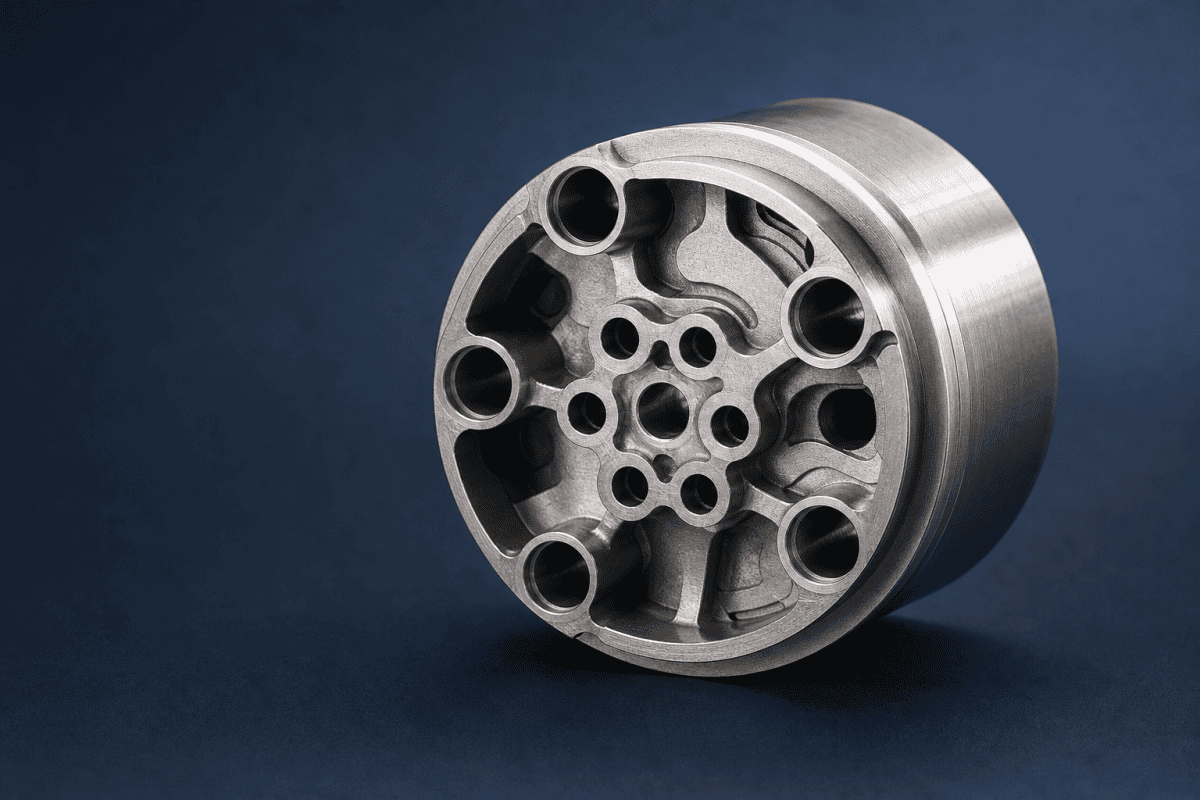
OVD 증착 라인이 그을음 균일도, 화염 형상 또는 런 간 반복성에서 드리프트하기 시작할 때, 버너 바디는 종종 가장 마지막에 의심받는 부품이자 가장 먼저 의심받아야 하는 부품입니다. Custom OVD 버너 바디는 증착 공정의 중심에 위치합니다. 즉, 노즐 어레이를 고정하고, 가스 채널을 계량하며, 연료, 산소 및 도펀트 스트림이 토치 면을 떠나는 방식을 정의합니다. 제조사가 바디 도면을 공개하거나 구형 증착 시스템용 드롭인 예비품을 제공하는 경우가 드물기 때문에, 많은 프리폼 팀은 원래 장비 제조사 대신 전문 업체로부터 다채널 버너 가공을 조달하게 됩니다.
이 글에서는 custom OVD 버너 바디를 가공하기 어렵게 만드는 요소, 성능을 좌우하는 특징, 그리고 기계 가공 업체가 정확하게 견적을 낼 수 있는 사양을 준비하는 방법을 설명합니다.
Custom OVD 버너 바디가 실제로 하는 일
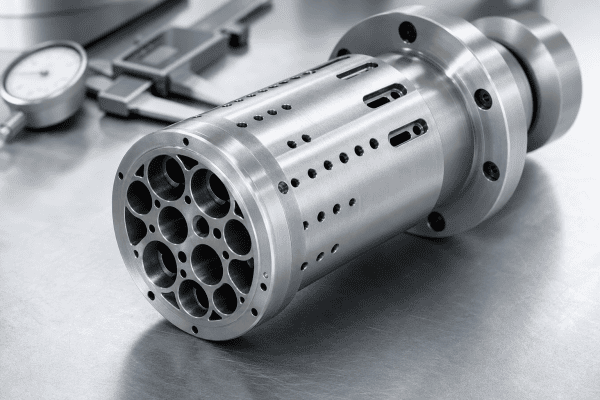
외부 증착 공정에서 custom OVD 버너 바디는 토치의 구조적 및 유체적 허브입니다. 공급 매니폴드로부터 가스를 받아 각 스트림을 자체 통로로 분배하고, 모든 노즐을 대상 로드에 대해 정의된 이격 거리와 각도로 위치시킵니다. 일반적인 다채널 바디는 여러 가지 역할을 동시에 수행합니다:
- 제어된 동심도와 각도 정렬로 노즐 플레이트 또는 개별 노즐을 기계적으로 위치시키는 것
- 반응성 또는 비호환성 가스 스트림을 화염에 도달할 때까지 분리하는 것
- 채널 전반에 걸쳐 유량이 균형을 유지하도록 내부 통로 형상을 유지하는 것
- 선반 또는 증착 스테이션에 대해 토치를 반복 가능하게 인덱싱하는 장착 특징을 제공하는 것
- 페이스플레이트에서 열을 방출하여 열 성장이 화염 패턴을 왜곡하지 않도록 하는 것
이러한 기능들이 상호 작용하기 때문에, custom OVD 버너 바디는 단순한 브래킷으로 평가할 수 없습니다. 통로 직경, 표면 조도 또는 채널 간 대칭성의 작은 변화는 화염 형상과 그을음 분포의 변화로 나타납니다. 이러한 민감도가 바로 버너 노즐 정밀도가 프리폼 수율에 직접적인 영향을 미치는 이유이며, 동일한 논리가 노즐에 공급하는 바디에도 한 단계 상류로 적용됩니다.
Custom OVD 버너 바디를 정의하는 설계 특징
채널 수 및 레이아웃
다채널 토치는 일반적으로 연료 스트림, 산소 또는 산화제 스트림, 캐리어 또는 도펀트 스트림, 그리고 때로는 차폐 또는 퍼지 스트림을 분리합니다. 바디 레이아웃은 이러한 통로가 동심 환형, 평행 드릴 보어 또는 이들의 조합으로 배치되는지를 결정합니다. 각 배열은 기계 가공 업체에 서로 다른 요구를 부과합니다. 동심 환형 채널은 정밀 보링과 벽 두께 제어가 필요하고, 드릴된 평행 채널은 어레이 전반에 걸쳐 유동 저항이 일치하도록 엄격한 위치 공차와 일관된 깊이가 필요합니다.
실링 면 및 가스 연결부
채널 간 누설 경로는 공정 불안정의 흔한 원인입니다. 제대로 견적을 낼 가치가 있는 custom OVD 버너 바디는 모든 인터페이스에서 실링 방법을 정의합니다. 금속 대 금속 시트, 엘라스토머 씰 또는 용접 및 브레이징 조인트 등입니다. 가공 업체는 어떤 면이 가스 기밀을 유지해야 하는지, 허용 가능한 누설률은 얼마인지, 출하 전에 바디가 압력 또는 헬륨 테스트를 어떻게 거칠 것인지를 알아야 합니다. 모호한 실링 요구사항은 견적이 넓은 공차 범위와 함께 돌아오는 주요 이유 중 하나입니다.
열 관리
버너 바디의 페이스플레이트 끝단은 지속적인 열에 노출됩니다. 이러한 부품은 종종 변형을 제한하기 위해 냉각 통로, 열 차단부 또는 고전도성 섹션으로 설계됩니다. 이 지점에서 재료 선택과 형상을 독립적으로가 아니라 함께 고려해야 합니다.
재료 선택은 기본값이 아닌 엔지니어링 결정이다
버너 바디에 단 하나의 정답 재료는 없습니다. 적합성은 부품의 기능, 사용 중 노출되는 온도, 접촉하는 가스 및 동반 공정 화학물질, 그리고 장착 및 열 사이클링으로 인한 기계적 하중에 따라 달라집니다.
Custom OVD 버너 바디의 일반적인 후보 재료로는 오스테나이트계 스테인리스강, 니켈 기반 합금, 그리고 고온 강도보다 열전도성이 더 중요한 경우 구리 합금이 있습니다. 알루미늄은 일부 OVD 토치 예비 부품, 에 등장하지만, 알루미늄의 낮은 융점과 열팽창 거동은 엔지니어링 요구사항이 실제로 이를 뒷받침하는 경우에만 적합하며, 일반적인 대체재로는 적합하지 않습니다.
가공 시작 전에 확정해야 할 실질적인 선택 질문:
- 페이스플레이트와 장착 플랜지에서 최대 연속 및 피크 온도는 얼마입니까?
- 어떤 가스 또는 증기가 바디에 접촉하며, 작동 온도에서 후보 합금을 공격하는 것이 있습니까?
- 페이스플레이트를 보호하기 위해 열전도성이 필요합니까, 아니면 치수 안정성을 위해 낮은 팽창이 더 중요합니까?
- 재료가 용접 가능, 브레이징 가능 또는 특정 표면 처리와 호환되어야 합니까?
- 가스 접촉 통로에 대한 청정도 요구사항이 있습니까?
이러한 트레이드오프가 버너 제품군 전반에서 어떻게 전개되는지에 대한 더 깊은 내용은 OVD 및 VAD 버너용 소싱 및 역설계 가이드 에서 재료 과학을 더 자세히 다룹니다. 고온에서의 합금 거동에 대한 일반 지침은 NIST 재료 측정 연구.
다채널 버너 바디의 가공 과제
다채널 가공이 어려운 이유는 이국적인 것이 아니라 구조적인 데 있습니다. 인접한 채널 사이의 얇은 벽은 절삭력과 공구 압력을 제한합니다. 깊고 작은 직경의 보어는 휘어질 수 있는 장심도 공구를 필요로 합니다. custom OVD burner body의 경우, 가공 계획은 공작 기계만큼이나 중요합니다.
동심 채널은 보링 작업이 공통 데이텀을 공유하여 완성된 custom OVD burner body가 플랜지에서 페이스플레이트까지 중심선을 유지하도록 요구합니다. 그리고 모든 작업은 둘 이상의 평면에 위치할 수 있는 실링 면의 평탄도와 마감도를 보존해야 합니다.
실제로, 유능한 다채널 burner body 제조 시퀀스는 일반적으로 다음을 포함합니다:
- 소재 여유를 둔 황삭 가공, 이어서 재료와 형상이 요구하는 경우 응력 제거
- 동심도를 보호하기 위해 단일 셋업 데이텀에서 주 채널의 반정삭 보링
- Finish machining of sealing faces and nozzle-seat features, with in-process inspection of position and perpendicularity
- Deburring and internal passage cleaning to remove chips and cutting residue from gas paths
- Pressure or leak testing of separated channels, then dimensional verification against the drawing
Note that step two is where many low-cost quotes quietly cut corners. If a shop re-fixtures between bores, concentricity between channels can shift, and the resulting torch may run acceptably on a test bench but produce an asymmetric flame in production. The consequences of that asymmetry are discussed in detail in 굴절률 프로파일 드리프트 및 버너 동심도.
견적을 위한 사양 체크리스트
Custom OVD Burner Bodies are rarely catalog items, which means the quality of the quotation depends almost entirely on the quality of the specification you provide. A drawing pack that supports an accurate quote typically includes:
- Fully dimensioned drawing or a complete 3D model, with tolerances on all critical features
- Channel schedule: count, function, nominal bore, and any flow-balance requirements
- Material specification with condition and any heat treatment
- Surface finish requirements on sealing faces and gas-wetted passages
- Sealing method and acceptance criteria for leak testing
- Mounting interface dimensions, including how the body indexes to the torch holder
- Operating conditions the body must survive, stated as a range rather than a single point
If the original drawing no longer exists, a physical sample can often be measured and reverse engineered into a manufacturable drawing. This is a normal path for legacy deposition equipment. When only the sample is available, expect the shop to ask about allowable deviations, since some worn features on the sample may reflect service damage rather than original design intent.
입고 검사 및 초도품 검사
Once a body arrives, a first-article inspection should confirm the features that affect deposition, not just overall dimensions. Useful checks include centerline runout between the mounting flange and the nozzle seat, position of each channel relative to the datum, flatness of sealing faces, and the results of any leak or pressure test. Where the body feeds a nozzle plate, a quick flow comparison across channels can reveal a partially blocked passage before the torch goes into a deposition run.
It is equally important to keep the inspection record attached to the part. When a process shift occurs months later, having baseline dimensional data for the installed custom OVD burner body turns a guessing game into a comparison. The same discipline applies to consumable torch components; the logic behind scheduled inspection and replacement is covered in the preform equipment and torch parts FAQ.
주의해야 할 일반적인 고장 및 끼워맞춤 문제
When a newly installed custom OVD burner body underperforms, the cause is not always the body itself. Distinguish between possible causes and confirmed ones before requesting rework:
- Channel contamination — machining debris or handling residue partially restricts a passage. Verify by flow comparison or borescope inspection of individual channels.
- Seal interface mismatch — the body seals correctly on the bench but leaks once hot. Verify by checking whether sealing features were specified for the actual thermal condition.
- Alignment error at the mounting interface — the flame sits off-center despite correct custom OVD burner body geometry. Verify by indicating the nozzle face relative to the lathe axis, not just to the body flange.
- Wrong material for the duty — distortion or oxidation appears after a short period of service. Verify by reviewing the specified alloy against the actual temperature and gas environment.
Recording which of these you have actually confirmed, and which remain hypotheses, makes the conversation with a supplier far more productive than a general report of poor performance.
공차 철학에 관한 간략한 참고
Not every dimension on a custom OVD burner body deserves the same tolerance. Over-tolerancing drives cost without improving deposition stability, while under-tolerancing the wrong feature can make a torch unusable. As a practical rule, tolerance the features that directly control gas flow, sealing integrity, and nozzle position most tightly, and relax dimensions that only affect fit or appearance.
It also helps to state which datum the shop should use for each group of features. When a drawing leaves datum selection open, two machine shops can produce parts that are individually correct yet not interchangeable. For custom OVD burner bodies that will be replicated over years, datum discipline is what keeps replacements consistent.
표면 조도 및 청정도 요구사항
Surface finish inside gas passages affects both flow behavior and contamination retention. A finish that is too rough traps residue and can slowly change flow resistance; an unnecessarily fine finish adds machining time and cost. Specify finish values for sealing faces and gas-wetted passages separately, and state whether passivation or another cleaning step is required after machining.
Cleanliness verification is often overlooked. A documented cleaning and packaging routine, plus a final flow check, prevents a body that met every dimensional requirement from failing on first use because of residual debris.
Custom OVD 버너 바디의 가공 요구사항
The machining plan for these components should be treated as a controlled process, not a one-off job. Key requirements include a single setup datum for all concentric features, controlled cutting parameters when wall thickness falls below a defined threshold, and in-process inspection at each transition from roughing to finishing. A custom OVD burner body that is machined to a stable sequence will hold its geometry far better than one produced on an ad hoc basis.
It also helps to specify which operations must be performed without re-fixturing between channels, and to agree in advance how the shop will prove that requirement. When a custom OVD burner body is intended to be repeated across multiple builds, documenting that sequence becomes part of the deliverable, not an internal shop decision.
출하 전 가스 기밀 채널 검증
Every custom OVD burner body should leave the shop with evidence that its channels are separated and gas-tight. The usual approach is a pressure decay or helium leak test on each isolated passage, with recorded values against an agreed limit. Where the body includes welded or brazed joints, that verification should follow the joining operation rather than precede it.
For a custom OVD burner body that feeds a sensitive process, a documented leak test is more useful than a visual inspection. Keep the record with the part, and reference it when the body is reinstalled or compared with a replacement.
자주 묻는 질문
Custom OVD 버너 바디를 기존 토치의 직접 교체품으로 제작할 수 있습니까?
Custom OVD Burner Bodies can be manufactured to match an existing part, but compatibility should be verified against drawings, dimensions, gas connections, materials, and the specific application rather than assumed from a brand or model reference. A sample or drawing is the reliable starting point.
가공된 버너 바디는 몇 개의 채널을 지원할 수 있습니까?
There is no fixed limit, but channel count is constrained by the available cross-section, minimum wall thickness between passages, and the sealing method. Sharing a proposed layout with the machine shop early will reveal whether the custom OVD burner body geometry is manufacturable as drawn.
버너 바디 견적을 빠르게 하는 정보는 무엇입니까?
A dimensioned drawing or 3D model, the channel schedule, material and heat treatment, sealing and leak-test requirements, and the operating conditions the part must survive. Where drawings are missing, a physical sample plus allowable deviation notes is the next best input.
바디 재료가 원래 부품과 정확히 일치해야 합니까?
Not necessarily. What matters is that the chosen material meets the temperature, chemical, and mechanical requirements of the application. An equivalent or improved alloy may be appropriate if the engineering rationale is documented.
다음 단계
If you are replacing a discontinued burner body, qualifying a second source, or developing a new multi-channel torch layout, the fastest path to a usable quotation is a complete specification package. Send your drawings, sample dimensions, channel schedule, material requirements, and operating conditions to discuss your component requirements with the OVDParts team, and the manufacturability review of your custom OVD burner bodies can start from real data rather than assumptions.
