
지식
OVD 버너 페이스플레이트 교체: 홀 형상 및 검사
10월
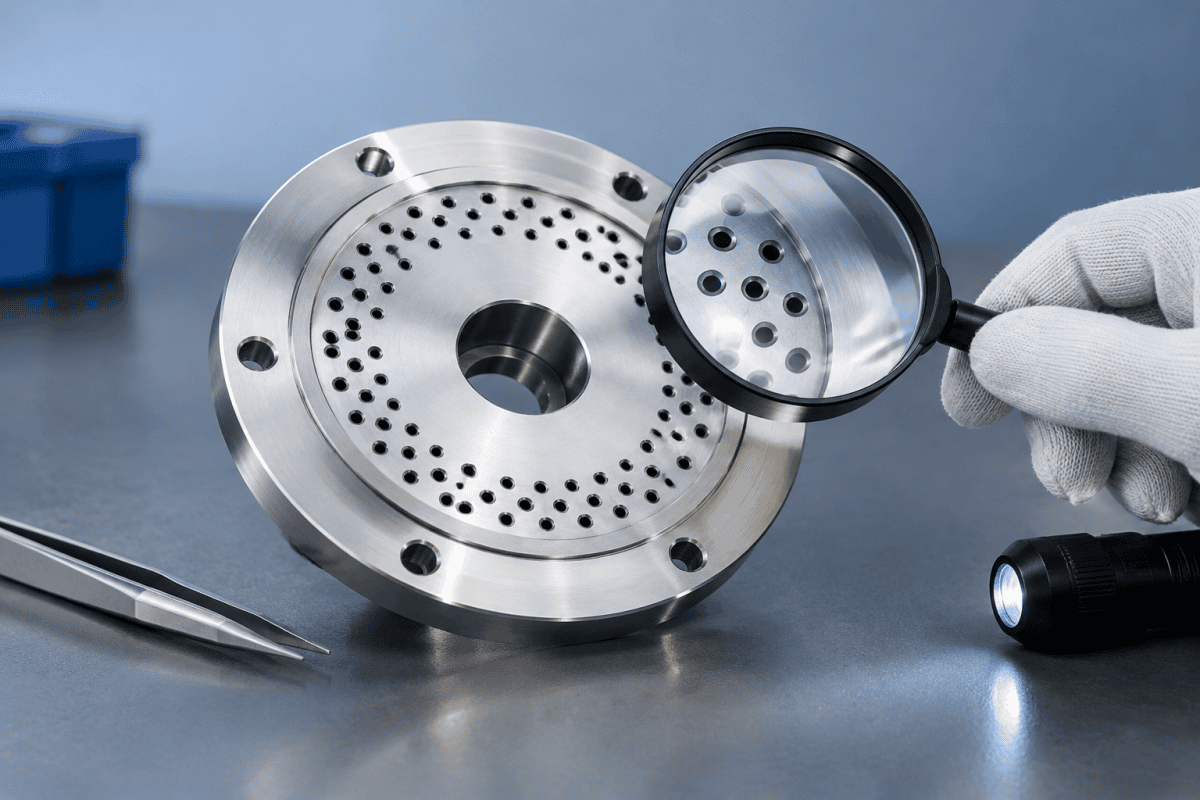
OVD 버너 페이스플레이트 교체는 단순한 부품 교환이 아닌 경우가 대부분입니다. 페이스플레이트—증착 화염에 공급되는 가스 흐름을 형성하는 작은 오리피스가 천공된 버너 헤드 전면 플레이트—는 전구체 및 연료 가스가 토치를 빠져나가는 형상을 결정합니다. 이 홀들이 침식, 변형 또는 막히면 프리폼을 형성하는 그을음 흐름이 변하며, 그 변화가 충분히 점진적이어서 하드웨어가 아닌 공정 파라미터의 문제로 오인되는 경우가 많습니다. 본 문서에서는 검사할 항목, 페이스플레이트 교체 필요 여부 판단 방법, 그리고 새 페이스플레이트 소싱 시 준비해야 할 정보를 다룹니다. 페이스플레이트는 가스 공급과 화염 사이의 최종 기계적 인터페이스이므로, OVD 버너 페이스플레이트 교체를 관리된 엔지니어링 이벤트가 아닌 일상적인 소모품 교체로 취급하는 것은 흔하고도 비용이 큰 실수입니다.
페이스플레이트의 실제 역할
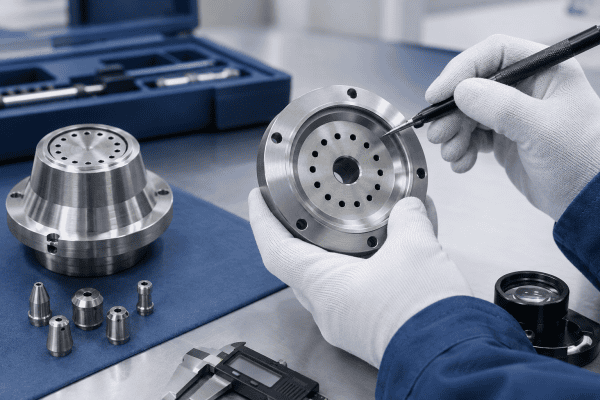
외부 증착(OVD) 공정에서 버너는 회전하는 타겟 로드를 가로질러 화염을 방향 설정합니다. 일반적으로 연료, 산소, 그리고 전구체 증기로 포화된 캐리어 가스 등 여러 가스 채널이 페이스플레이트를 통해 배출되며, 서로에 대해 안정적이고 올바른 위치를 유지해야 합니다. 페이스플레이트는 연소 및 증착 전에 이러한 흐름에 접촉하는 마지막 기계적 요소입니다.
따라서 페이스플레이트 홀 형상은 일차 공정 변수입니다. 홀 직경, 진원도, 입구 및 출구 챔퍼, 홀 간 간격, 각도 방향 모두 국부 가스 속도와 혼합에 영향을 미칩니다. 페이스플레이트 전반에 걸친 작은 편차는 화염 프로파일을 변화시킬 수 있으며, 이는 다시 증착 효율과 성장하는 그을음체의 균일성에 영향을 미칩니다.
이는 또한 페이스플레이트가 다른 공정 입력과 마찬가지로 상태를 추적해야 하는 마모 부품임을 의미합니다. 팀이 OVD 버너 페이스플레이트 교체를 계획할 때, 그들은 실제로 일련의 기하학적 경계 조건—각 오리피스의 출구 면적, 타겟으로부터의 이격 거리, 그리고 서로에 대한 가스 흐름의 방향—을 복원하는 것입니다. 이러한 조건을 일관되게 복원하는 것이 관리된 교체와 시행착오적 부품 교환을 구분 짓는 요소입니다.
시간 경과에 따라 홀 형상이 변하는 이유
열 사이클링 및 크리프
버너 페이스플레이트는 운전 사이클 전반에 걸쳐 반복적인 가열과 냉각이 이루어지는 고온 환경에서 작동합니다. 재료와 설계에 따라 점진적인 치수 크리프, 뒤틀림 또는 홀 프로파일의 작은 변화가 발생할 수 있습니다. 새것일 때 평평했던 페이스플레이트도 버너와 타겟 사이의 이격 거리를 변화시킬 만큼 충분한 변형이 발생할 수 있습니다.
열적 영향은 좀처럼 단독으로 작용하지 않습니다. 설치 시 한계적으로 평평했던 플레이트는 충분한 사이클 후에 육안으로 확인 가능하게 뒤틀릴 수 있으며, 그로 인한 이격 거리 변화는 화염이 타겟 표면과 상호작용하는 방식을 바꿉니다. 이는 운전 시간에만 연계된 OVD 버너 페이스플레이트 교체 주기가 이미 증착에 영향을 미치고 있는 초기 형상 변화를 놓칠 수 있는 이유 중 하나입니다.
산화 및 재료 손실
일부 페이스플레이트 재료는 작동 온도에서 산화되거나 침식됩니다. 홀 가장자리의 재료 손실은 오리피스를 확대하거나 변형시키며, 그 영향이 플레이트 전반에 걸쳐 균일하지 않기 때문에 가스 출구 패턴은 새것일 때의 대칭성을 잃게 됩니다. 주어진 페이스플레이트에 적합한 재료는 부품의 일반적인 범주가 아니라 그 기능, 온도 노출, 화학적 환경, 그리고 토치 설계의 엔지니어링 요구사항에 따라 달라집니다.
따라서 재료 선택은 페이스플레이트가 형상을 얼마나 오래 유지하는지에 직접적인 영향을 미치는 설계 결정이 됩니다. OVD 버너 페이스플레이트 교체가 계획되는 경우, 원래 재료와 실제 사용 환경을 비교하는 것은 사양 검토의 합리적인 부분입니다.
그을음 축적 및 막힘
실리카 그을음과 반응 부산물이 페이스플레이트 홀 위나 내부에 축적될 수 있습니다. 부분적인 막힘은 유효 오리피스 면적을 변화시켜, 공급 가스 설정의 변화 없이도 흐름 분포를 바꿉니다. 이는 공급 가스 파라미터는 변하지 않은 것으로 보이는데 버너가 다르게 작동하기 시작하는 가장 흔한 이유 중 하나입니다. 이 고장 모드에 대한 실용적인 지침은 다음 문서에서 다룹니다: OVD 및 VAD 버너 유지보수 및 수명 연장.
검사: 확인할 항목과 검증 방법
검사는 다음을 분리해야 합니다: 관찰된 증상 과 확인된 원인. 페이스플레이트는 공정 변화의 가능한 원인 중 하나일 뿐이며, 다른 원인이 배제되지 않은 상태에서 의심만으로 교체해서는 안 됩니다.
유용한 검사 순서는 공정에서 부품 쪽으로 외향적으로 진행합니다: 먼저 증상을 문서화하고, 가능한 원인을 좁힌 다음, 그제서야 토치를 분해하여 페이스플레이트를 직접 확인합니다. OVD 버너 페이스플레이트 교체 결정은 직감보다 그러한 증거에 근거할 때 훨씬 더 방어하기 쉽습니다.
증착 증상부터 시작
실제로 무엇이 변했는지 기록하십시오: 그을음 증착 속도, 프리폼 직경 균일성, 화염 외관 또는 굴절률 프로파일. 이러한 증상은 검색 범위를 좁힙니다. 증착 속도의 완만한 감소는 페이스플레이트 마모나 막힘을 가리킬 수 있지만, 가스 공급, 토치 이격 거리 또는 타겟 회전과도 관련될 수 있습니다. 증착 속도 감소와 버너 상태의 관계는 다음 문서에서 논의됩니다: OVD 버너 화염이 기울어지는 이유.
굴절률 프로파일 드리프트는 가스 설정보다는 기하학적 형상에서 기인하는 경우가 많은 또 다른 증상입니다. 동심도나 스트림 정렬이 틀어지면 증착된 층이 공정이 의존하는 대칭성을 잃을 수 있습니다. 이러한 고장 경로는 다음 문서에서 검토됩니다: OVD 버너의 굴절률 프로파일 드리프트. 프로파일 드리프트와 완만한 증착량 감소가 동시에 나타난다면, 페이스플레이트 점검은 진단 목록의 최상위에 놓여야 합니다.
육안 및 치수 검사
사이트 절차에 따라 버너를 분리하고 냉각한 후:
- 홀별 비교—각 오리피스를 검증된 기준품 또는 원본 도면과 대조하여 점검합니다. 확대, 타원화, 버(burr), 또는 규정된 프로파일과 더 이상 일치하지 않는 둥글어진 모서리를 확인합니다.
- 평탄도 및 휨—페이스플레이트 표면을 기준 평면과 대조하여 점검합니다. 국부적 변형은 홀과 증착 표면 사이의 실효 거리를 변화시킵니다.
- 막힘 및 퇴적물—가능한 경우 확대경과 배면 조명을 사용하여 홀을 검사합니다. 퇴적물은 입구, 출구, 또는 내경 내부에서 육안으로 확인될 수 있습니다.
- 홀 패턴 대칭성—verify hole-to-hole spacing and alignment with the gas channel layout behind the plate. Pattern drift is easier to see by comparison than by absolute measurement.
- Sealing surfaces—check mating faces, gasket seats, and any locating features for wear, scoring, or distortion that could cause leakage or misalignment.
For dimensional measurement practices, the general guidance published by NIST on dimensional metrology is a useful reference for calibration and measurement uncertainty, which matters when the tolerance being judged is measured in micrometers.
페이스플레이트가 원인인지 확인
Where the process allows, the most reliable verification is substitution with a known-good faceplate, followed by a controlled run and comparison against baseline data. This converts a suspicion into evidence before committing to replacement. If symptoms persist after substitution, the faceplate was not the root cause, and attention should shift to gas delivery, torch position, or other components.
Timing matters here as well. If substitution restores baseline deposition, the case for a permanent OVD burner faceplate replacement is straightforward. If it does not, the investigation continues without spending a replacement cycle on the wrong component.
세정, 재생, 교체 중 결정
Not every contaminated faceplate needs replacement. Surface deposits that can be removed without altering hole geometry may be addressed through the cleaning procedure specified by the equipment documentation and approved by qualified personnel. Follow manufacturer guidance and your site’s safety rules for any cleaning operation—this article does not prescribe chemical or mechanical cleaning methods.
Replacement is the more appropriate path when:
- Hole geometry has measurably changed—enlargement, ovality, or profile deviation beyond the drawing tolerance.
- The faceplate is warped or distorted beyond acceptable flatness.
- Deposits have bonded or penetrated in a way that cannot be removed without damaging the orifice.
- Cleaning has already been attempted and the process symptom returns.
- Sealing or locating features are worn enough to affect alignment.
Where dimensional evidence is ambiguous, a dimensional report from a qualified inspection source is more useful than a judgment call at the machine. An OVD burner faceplate replacement performed on ambiguous evidence tends to be repeated sooner than one backed by measurement.
교체용 페이스플레이트에서 중요한 것
The quality of an OVD burner faceplate replacement depends less on how the part is ordered than on how completely its geometry is specified. Three areas deserve attention before a purchase order is raised: the hole pattern, the material, and the interfaces that seat and seal the plate.
홀 형상이 곧 사양
The defining requirement of a replacement is that the hole pattern matches the original drawing—diameter, tolerance, spacing, orientation, and edge condition. A faceplate that fits mechanically but differs in hole geometry is not an equivalent replacement. This is why drawing-based production and dimensional verification matter more here than broad dimensional similarity. Precision in nozzle and orifice features has a direct relationship to preform outcomes, as explored in the article on 맞춤형 OVD 버너 노즐 교체.
It also explains why a faceplate should not be accepted on the basis of a visual match alone. Two plates can look identical and still differ in one chamfer angle or spacing dimension that governs local mixing. When an OVD burner faceplate replacement is specified, the drawing is the acceptance criterion, not the appearance of the part.
재료 선정
Faceplate material should be selected against the actual service conditions: peak temperature, thermal cycling, exposure to process gases and reaction products, and mechanical requirements. Two burners with the same external dimensions may legitimately use different faceplate materials. Treat any recommendation as conditional on the specific application rather than as a general rule.
Material also interacts with replacement frequency. A plate that resists oxidation and retains flatness longer will extend the interval between services, which is often worth more than a marginal reduction in part cost. For context on how alloy choices have performed in demanding service, the case study on titanium OVD burner parts for a tier-one fiber manufacturer reviews one such upgrade.
끼워맞춤, 정렬 및 가스 연결
Mounting features, locating pins, gasket interfaces, and gas inlet geometry all affect how the faceplate seats and seals. A replacement should be checked against the burner body drawing, not just the faceplate outline. Gas connection details are frequently where substitution goes wrong, and they are examined in the article on OVD burner head replacement and gas connections.
Alignment features deserve the same scrutiny. A locating pin that no longer seats cleanly can rotate the plate slightly relative to the torch body, which shifts the entire stream pattern even though every individual hole is within tolerance. That is why an OVD burner faceplate replacement should include verification of how the plate registers against the body, not only how the holes measure on the bench.
페이스플레이트 교체 시 흔한 실수
Most failed replacements share a small number of causes. Reviewing them before the job starts is cheaper than repeating the work.
- Replacing on symptom alone. A process shift without dimensional evidence may point somewhere other than the faceplate.
- Accepting mechanical fit as equivalence. A plate that bolts up correctly can still have the wrong hole pattern.
- Skipping the post-change baseline. Without a controlled run against baseline data, there is no way to confirm the replacement actually resolved the issue.
- Mixing parts across processes. OVD, VAD, and MCVD burners differ in design and operating conditions and components are not interchangeable without engineering review.
- Reusing worn sealing hardware. Gaskets and sealing faces that were acceptable on the old plate may not seal correctly on a new one.
Each of these mistakes turns a single OVD burner faceplate replacement into a sequence of replacements, and each one is avoidable with a short checklist and a drawing on the bench.
소싱 요청 준비
A clear request shortens the path to a usable part. Include:
- The faceplate drawing, including hole pattern, tolerances, and edge specifications.
- Material specification and any surface or hardness requirements.
- Photos of the existing part, including any wear or damage.
- Burner model or torch assembly identification, with the caveat that compatibility must be verified against drawings rather than assumed from a model name.
- Operating conditions relevant to material selection—temperature range, gas environment, and cycling pattern.
- Quantity and any inspection documentation required.
Where drawings are unavailable or incomplete, reverse engineering from a physical sample is a practical route. Custom faceplates and other non-standard components can be produced through OEM and ODM machining services based on supplied drawings, dimensions, and material requirements.
For standard replacement options across burner and torch assemblies, the OVD torch spare parts range includes burner heads, nozzle components, and related consumables, and specific configurations are listed under OVD 보조 테일 버너 및 산소 분배 매니폴드. Note that OVD, VAD, and MCVD burners differ in design and operating conditions; components are not interchangeable across these processes without engineering review.
자주 묻는 질문
OVD 버너 페이스플레이트는 얼마나 자주 검사해야 합니까?
Inspection frequency depends on duty cycle, process sensitivity, and how quickly the burner environment degrades the faceplate. Rather than a fixed interval, tie inspection to process monitoring: when deposition rate, flame stability, or profile uniformity drifts beyond your control limits, add a faceplate inspection to the diagnostic sequence.
막힌 페이스플레이트를 교체 대신 세정할 수 있습니까?
Sometimes, if the deposit is surface-level and can be removed without changing hole geometry. If cleaning alters the orifice edge, enlarges the hole, or if the symptom returns quickly, replacement is the more reliable option. Cleaning methods should follow equipment documentation and qualified personnel guidance.
교체용 페이스플레이트에서 확인해야 할 가장 중요한 치수는 무엇입니까?
Hole geometry—diameter, tolerance, spacing, and edge condition—because it directly governs gas distribution. Flatness and mounting alignment come next, since they affect seating and standoff. Mechanical fit alone does not confirm a faceplate is equivalent.
한 버너 모델의 페이스플레이트를 다른 모델에 사용할 수 있습니까?
Not without verification. Compatibility must be confirmed against drawings, dimensions, gas connections, materials, and application requirements. Model names alone are not sufficient evidence of interchangeability.
OVD 버너 페이스플레이트 교체 시 어떤 문서가 함께 제공되어야 합니까?
At minimum, a dimensional report covering hole geometry and flatness, plus material certification where the application requires it. Records of the pre-change symptom and the post-change baseline run are equally useful, because they establish whether the replacement achieved its purpose and give the next inspection a reference point.
다음 단계
If you are evaluating an OVD burner faceplate replacement, the fastest route to a correct part is a complete data package. Send the faceplate drawing, material requirements, photos of the current part, and the relevant operating conditions to request a quotation. Where drawings are missing or incomplete, note that in your inquiry so the reverse engineering route can be assessed alongside standard replacement options. A complete package also makes it easier to confirm that the replacement you receive matches the geometry your process was built around, which is ultimately the point of planning an OVD burner faceplate replacement carefully in the first place.
