
지식
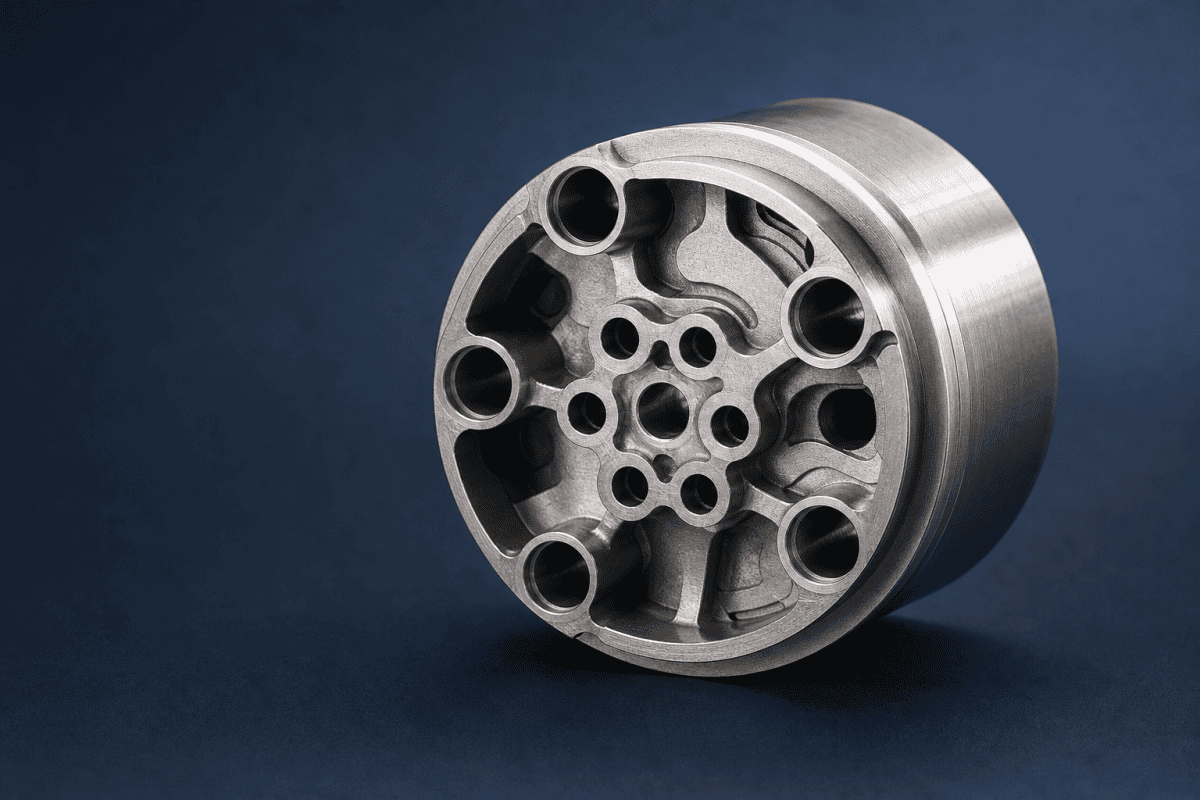
맞춤형 OVD 버너 바디: 다채널 부품 가공
10월
When an OVD deposition line starts drifting on soot uniformity, flame shape, or run-to-run repeatability, the burner body is often the last component to be questioned and the first one that should be. A custom OVD burner body sits at the center of the deposition process: it holds the nozzle array, meters the gas channels, and defines how fuel, oxygen, and dopant streams leave the torch face. Because manufacturers rarely publish body drawings or offer drop-in spares for older deposition systems, many preform teams end up sourcing multi-channel burner machining from a specialist rather than the original equipment builder.
This article explains what makes custom OVD burner bodies difficult to machine, which features drive performance, and how to prepare a specification that a machine shop can quote accurately.
What a Custom OVD Burner Body Actually Does
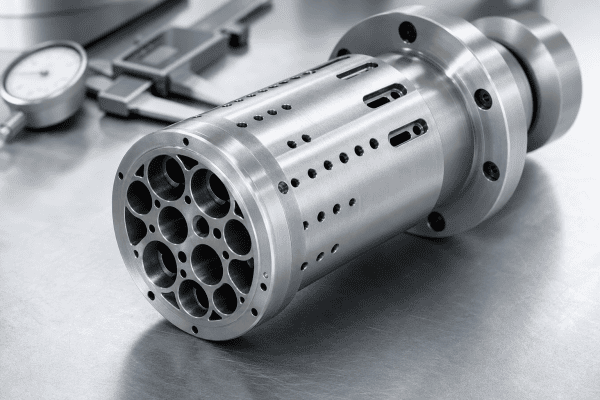
In outside vapor deposition, a custom OVD burner body is the structural and fluidic hub of the torch. It receives gas from the supply manifold, distributes each stream to its own passage, and positions every nozzle at a defined standoff and angle relative to the target rod. A typical multi-channel body performs several jobs at once:
- Mechanically locating the nozzle plate or individual nozzles with controlled concentricity and angular alignment
- Separating reactive or incompatible gas streams until they reach the flame
- Maintaining internal passage geometry that keeps flow balanced across channels
- Providing mounting features that repeatably index the torch relative to the lathe or deposition station
- Transferring heat away from the faceplate so thermal growth does not distort the flame pattern
Because these functions interact, custom OVD burner bodies cannot be evaluated as a simple bracket. Small changes in passage diameter, surface finish, or channel-to-channel symmetry show up as changes in flame shape and soot distribution. That sensitivity is the reason burner nozzle precision has a direct effect on preform yield, and the same logic applies one level upstream, to the body that feeds the nozzles.
Design Features That Define a Custom OVD Burner Body
Channel count and layout
Multi-channel torches commonly separate a fuel stream, an oxygen or oxidizer stream, a carrier or dopant stream, and sometimes a shielding or purge stream. The body layout determines whether those passages run as concentric annuli, parallel drilled bores, or a combination. Each arrangement places different demands on the machine shop: concentric annular channels require precise boring and wall-thickness control, while drilled parallel channels require tight positional tolerance and consistent depth so that flow resistance matches across the array.
Sealing surfaces and gas connections
Leak paths between channels are a common source of process instability. Custom OVD burner bodies worth quoting properly will define the sealing method at every interface: metal-to-metal seats, elastomer seals, or welded and brazed joints. The shop needs to know which surfaces must be gas-tight, what leak rate is acceptable, and how the body will be pressure- or helium-tested before shipment. Vague sealing requirements are one of the main reasons quotations come back with wide tolerance bands.
Thermal management
The faceplate end of a burner body sees sustained heat. These components are often designed with cooling passages, thermal breaks, or high-conductivity sections to limit distortion. This is where material choice and geometry must be considered together rather than independently.
Material Selection Is an Engineering Decision, Not a Default
There is no single correct material for a burner body. Suitability depends on the component’s function, the temperature it sees in service, the gases and any entrained process chemistry it contacts, and the mechanical loads from mounting and thermal cycling.
Common candidates for custom OVD burner bodies include austenitic stainless steels, nickel-based alloys, and copper alloys where thermal conductivity matters more than high-temperature strength. Aluminum appears in some OVD torch spare parts, but aluminum’s lower melting point and thermal expansion behavior make it appropriate only where the engineering requirements actually support it, not as a general substitute.
Practical selection questions to settle before machining begins:
- What is the maximum continuous and peak temperature at the faceplate and at the mounting flange?
- Which gases or vapors contact the body, and do any of them attack a candidate alloy at operating temperature?
- Is thermal conductivity needed to protect the faceplate, or is low expansion more important for dimensional stability?
- Does the material need to be weldable, brazeable, or compatible with a specific surface treatment?
- Are there cleanliness requirements for the gas-wetted passages?
For a deeper treatment of how these trade-offs play out across burner families, the sourcing and reverse engineering guide for OVD and VAD burners walks through the material science in more detail. General guidance on alloy behavior at elevated temperature is also documented by NIST materials measurement research.
Machining Challenges in Multi-Channel Burner Bodies
Multi-channel machining is difficult for reasons that are structural rather than exotic. Thin walls between adjacent channels limit cutting forces and tool pressure. Deep, small-diameter bores require long-reach tooling that can deflect. For a custom OVD burner body, the machining plan matters as much as the machine tool.
Concentric channels demand that boring operations share a common datum so that the finished custom OVD burner body holds its centerline from flange to faceplate. And every operation has to preserve the flatness and finish of sealing faces that may be located on more than one plane.
In practice, a capable multi-channel burner body manufacturing sequence usually includes:
- Rough machining with stock allowance, followed by stress relief where the material and geometry warrant it
- Semi-finish boring of primary channels from a single setup datum to protect concentricity
- Finish machining of sealing faces and nozzle-seat features, with in-process inspection of position and perpendicularity
- Deburring and internal passage cleaning to remove chips and cutting residue from gas paths
- Pressure or leak testing of separated channels, then dimensional verification against the drawing
Note that step two is where many low-cost quotes quietly cut corners. If a shop re-fixtures between bores, concentricity between channels can shift, and the resulting torch may run acceptably on a test bench but produce an asymmetric flame in production. The consequences of that asymmetry are discussed in detail in 굴절률 프로파일 드리프트 및 버너 동심도.
Specification Checklist for a Quotation
Custom OVD Burner Bodies are rarely catalog items, which means the quality of the quotation depends almost entirely on the quality of the specification you provide. A drawing pack that supports an accurate quote typically includes:
- Fully dimensioned drawing or a complete 3D model, with tolerances on all critical features
- Channel schedule: count, function, nominal bore, and any flow-balance requirements
- Material specification with condition and any heat treatment
- Surface finish requirements on sealing faces and gas-wetted passages
- Sealing method and acceptance criteria for leak testing
- Mounting interface dimensions, including how the body indexes to the torch holder
- Operating conditions the body must survive, stated as a range rather than a single point
If the original drawing no longer exists, a physical sample can often be measured and reverse engineered into a manufacturable drawing. This is a normal path for legacy deposition equipment. When only the sample is available, expect the shop to ask about allowable deviations, since some worn features on the sample may reflect service damage rather than original design intent.
Incoming Inspection and First-Article Checks
Once a body arrives, a first-article inspection should confirm the features that affect deposition, not just overall dimensions. Useful checks include centerline runout between the mounting flange and the nozzle seat, position of each channel relative to the datum, flatness of sealing faces, and the results of any leak or pressure test. Where the body feeds a nozzle plate, a quick flow comparison across channels can reveal a partially blocked passage before the torch goes into a deposition run.
It is equally important to keep the inspection record attached to the part. When a process shift occurs months later, having baseline dimensional data for the installed custom OVD burner body turns a guessing game into a comparison. The same discipline applies to consumable torch components; the logic behind scheduled inspection and replacement is covered in the preform equipment and torch parts FAQ.
Common Failure and Fit Problems to Watch For
When a newly installed custom OVD burner body underperforms, the cause is not always the body itself. Distinguish between possible causes and confirmed ones before requesting rework:
- Channel contamination — machining debris or handling residue partially restricts a passage. Verify by flow comparison or borescope inspection of individual channels.
- Seal interface mismatch — the body seals correctly on the bench but leaks once hot. Verify by checking whether sealing features were specified for the actual thermal condition.
- Alignment error at the mounting interface — the flame sits off-center despite correct custom OVD burner body geometry. Verify by indicating the nozzle face relative to the lathe axis, not just to the body flange.
- Wrong material for the duty — distortion or oxidation appears after a short period of service. Verify by reviewing the specified alloy against the actual temperature and gas environment.
Recording which of these you have actually confirmed, and which remain hypotheses, makes the conversation with a supplier far more productive than a general report of poor performance.
A Brief Note on Tolerancing Philosophy
Not every dimension on a custom OVD burner body deserves the same tolerance. Over-tolerancing drives cost without improving deposition stability, while under-tolerancing the wrong feature can make a torch unusable. As a practical rule, tolerance the features that directly control gas flow, sealing integrity, and nozzle position most tightly, and relax dimensions that only affect fit or appearance.
It also helps to state which datum the shop should use for each group of features. When a drawing leaves datum selection open, two machine shops can produce parts that are individually correct yet not interchangeable. For custom OVD burner bodies that will be replicated over years, datum discipline is what keeps replacements consistent.
Surface Finish and Cleanliness Requirements
Surface finish inside gas passages affects both flow behavior and contamination retention. A finish that is too rough traps residue and can slowly change flow resistance; an unnecessarily fine finish adds machining time and cost. Specify finish values for sealing faces and gas-wetted passages separately, and state whether passivation or another cleaning step is required after machining.
Cleanliness verification is often overlooked. A documented cleaning and packaging routine, plus a final flow check, prevents a body that met every dimensional requirement from failing on first use because of residual debris.
Machining Requirements for Custom OVD Burner Bodies
The machining plan for these components should be treated as a controlled process, not a one-off job. Key requirements include a single setup datum for all concentric features, controlled cutting parameters when wall thickness falls below a defined threshold, and in-process inspection at each transition from roughing to finishing. A custom OVD burner body that is machined to a stable sequence will hold its geometry far better than one produced on an ad hoc basis.
It also helps to specify which operations must be performed without re-fixturing between channels, and to agree in advance how the shop will prove that requirement. When a custom OVD burner body is intended to be repeated across multiple builds, documenting that sequence becomes part of the deliverable, not an internal shop decision.
Verification of Gas-Tight Channels Before Shipment
Every custom OVD burner body should leave the shop with evidence that its channels are separated and gas-tight. The usual approach is a pressure decay or helium leak test on each isolated passage, with recorded values against an agreed limit. Where the body includes welded or brazed joints, that verification should follow the joining operation rather than precede it.
For a custom OVD burner body that feeds a sensitive process, a documented leak test is more useful than a visual inspection. Keep the record with the part, and reference it when the body is reinstalled or compared with a replacement.
자주 묻는 질문
Can a custom OVD burner body be made as a direct replacement for an existing torch?
Custom OVD Burner Bodies can be manufactured to match an existing part, but compatibility should be verified against drawings, dimensions, gas connections, materials, and the specific application rather than assumed from a brand or model reference. A sample or drawing is the reliable starting point.
How many channels can a machined burner body support?
There is no fixed limit, but channel count is constrained by the available cross-section, minimum wall thickness between passages, and the sealing method. Sharing a proposed layout with the machine shop early will reveal whether the custom OVD burner body geometry is manufacturable as drawn.
What information speeds up a burner body quotation?
A dimensioned drawing or 3D model, the channel schedule, material and heat treatment, sealing and leak-test requirements, and the operating conditions the part must survive. Where drawings are missing, a physical sample plus allowable deviation notes is the next best input.
Does the body material need to match the original part exactly?
Not necessarily. What matters is that the chosen material meets the temperature, chemical, and mechanical requirements of the application. An equivalent or improved alloy may be appropriate if the engineering rationale is documented.
다음 단계
If you are replacing a discontinued burner body, qualifying a second source, or developing a new multi-channel torch layout, the fastest path to a usable quotation is a complete specification package. Send your drawings, sample dimensions, channel schedule, material requirements, and operating conditions to discuss your component requirements with the OVDParts team, and the manufacturability review of your custom OVD burner bodies can start from real data rather than assumptions.
