
Connaissances
Remplacement de la buse du brûleur OVD Nextrom : dimensions et connexions à vérifier
FAQ
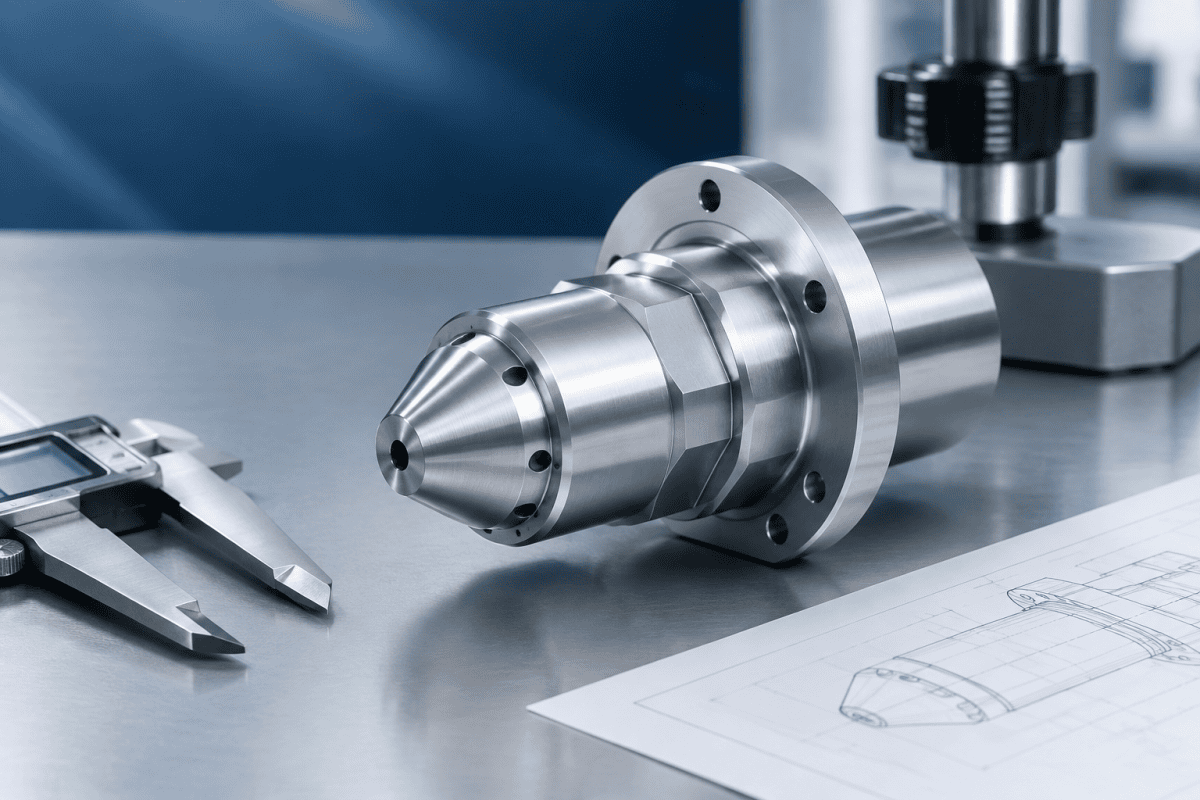
La planification d'un remplacement de buse de brûleur OVD Nextrom commence par une série de vérifications dimensionnelles et de connexions faciles à sous-estimer. Un brûleur OVD (dépôt en phase vapeur externe) est une torche multicanale : les canaux de combustible et d'oxygène alimentent une flamme qui hydrolyse le tétrachlorure de silicium et d'autres précurseurs, déposant de la suie de silice sur une tige cible en rotation. La buse — la plaque frontale, l'embout ou l'ensemble d'orifices à la sortie de la torche — façonne cette flamme et détermine en grande partie où la suie se dépose.
Parce qu'un remplacement de buse de brûleur OVD Nextrom doit s'insérer dans un corps de torche existant, se raccorder aux conduites de gaz existantes et reproduire une enveloppe de flamme existante, la vérification se fait sur papier avant toute commande. Cet article décrit ce qu'il faut mesurer, ce qu'il faut comparer et ce qu'il faut inclure dans une demande de sourcing afin qu'un remplacement de buse de brûleur OVD Nextrom ou un buse de dépôt personnalisée programme démarre à partir de données précises.
Une remarque avant les détails : les équipements Nextrom ont connu de multiples configurations au cours de leur vie de production, et aucun fournisseur ne peut confirmer la compatibilité à partir d'un nom de marque ou d'une photo seule. La compatibilité est établie à partir de plans, de dimensions mesurées, de détails de connexion, de matériaux et de l'application. Considérez chaque chiffre ci-dessous comme un élément à confirmer sur votre propre unité.
Pourquoi la buse est l'interface critique dans un brûleur OVD
Le corps du brûleur positionne et alimente les gaz ; la buse définit comment ils sortent. Le diamètre des orifices, l'espacement des canaux, la planéité de la plaque frontale et la concentricité d'un canal par rapport à un autre influencent tous la forme de la flamme, la distribution des vitesses et le mélange. Lorsqu'une buse de remplacement diffère subtilement de l'originale, les effets se manifestent généralement par une dérive du procédé plutôt que par une défaillance immédiate : un profil de dépôt de suie qui se décale, une flamme qui penche d'un côté, ou un profil d'indice de réfraction qui évolue lentement dans la préforme. La relation entre la géométrie de la buse et les résultats sur la préforme est traitée plus en profondeur dans cet article sur la précision des buses de brûleur et le rendement des préformes.
C'est pourquoi un remplacement de buse de brûleur OVD Nextrom est d'abord un exercice dimensionnel et ensuite un exercice d'achat. Deux buses peuvent sembler identiques et différer néanmoins de manière significative après des heures de dépôt.
Dimensions à vérifier avant de commander un remplacement de buse de brûleur OVD Nextrom
Encombrement global et géométrie de montage
Commencez par l'extérieur de la pièce, car cela détermine si la buse se loge correctement dans le corps de la torche. Un remplacement de buse de brûleur OVD Nextrom doit commencer par une longueur hors tout mesurée — y compris tout épaulement, bride ou gradin qui positionne la buse contre le corps de la torche.
- Longueur hors tout et diamètre — y compris tout épaulement, bride ou gradin qui positionne la buse contre le corps de la torche.
- Caractéristiques de montage — pas et classe de filetage, gorges de bague de retenue, positions de goujons ou de clavettes, et dimensions du cercle de boulons si la buse est fixée par boulonnage plutôt que par filetage.
- Surfaces d'appui — les faces qui doivent s'accoupler métal contre métal ou contre un joint. Notez leur largeur, leur angle et leur état de surface.
- Caractéristiques d'orientation — toute asymétrie qui impose une seule position de rotation pour l'installation de la buse.
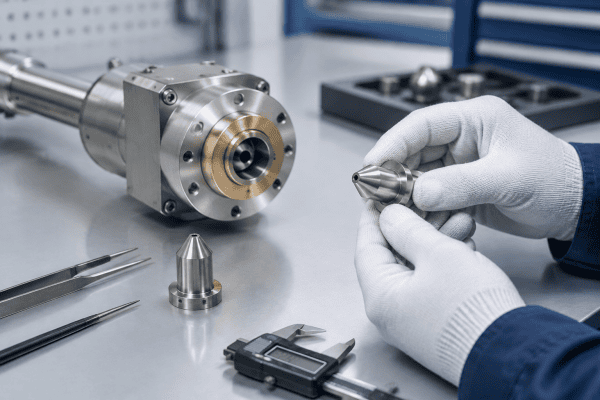
Mesurez ces éléments sur la pièce déposée, et non sur un plan de révision inconnue, et consignez la méthode de mesure (pied à coulisse, micromètre, MMT, comparateur optique) à côté de chaque valeur. Pour les petites caractéristiques, un rapport MMT ou un plan d'inspection dimensionnelle est bien plus utile à un machiniste que des chiffres esquissés à la main.
Géométrie des canaux de gaz et des orifices
C'est ici que réside la majeure partie de la variation pertinente pour le procédé :
- Nombre et disposition des canaux — une torche OVD typique peut comporter des passages séparés pour le précurseur, le combustible et l'oxygène, parfois avec des canaux de protection ou auxiliaires. Comptez-les et cartographiez leurs positions.
- Diamètres des orifices — mesurez chaque canal individuellement ; ne supposez pas qu'ils sont tous de la même taille.
- Entraxe — le pas entre les orifices ou entre les anneaux concentriques de trous.
- Planéité de la plaque frontale — particulièrement sur les embouts multi-orifices, où la planéité locale affecte la symétrie de la flamme.
- Concentricité et faux rond — entre la référence de montage et les passages de gaz, et entre les canaux individuels.
Si la buse d'origine est usée, obstruée ou partiellement endommagée, mesurez les caractéristiques non affectées par l'usure et documentez les dommages séparément. Un orifice érodé ne représente pas la dimension d'origine.
Matériaux et état de surface
Consignez le matériau du corps de la buse et de la plaque frontale du mieux que vous pouvez le déterminer, ainsi que tout revêtement. La sélection du matériau de la buse dépend de la fonction du composant, de son exposition à la température, de l'environnement chimique près de la face de la torche et des exigences d'ingénierie du procédé — et non d'une catégorie générique.
Copper alloys, nickel-based alloys, stainless steels, and refractory metals all appear in torch components, and each brings different thermal conductivity, oxidation resistance, and machinability trade-offs. If the material is unknown, say so; a supplier can propose options and explain the reasoning rather than guess. The guide d'approvisionnement en brûleurs personnalisés et de rétro-ingénierie covers how material and geometry decisions interact.
Connexions à vérifier parallèlement à la buse
A nozzle that fits the torch body but not the facility’s gas and cooling interfaces is still the wrong part. Verify the interfaces around the nozzle as part of the same survey. For a Nextrom OVD burner nozzle replacement, these connection checks are just as important as the dimensional set.
- Gas inlet fittings — thread type, size, sealing method (face seal, gasket, tapered thread), and the tubing or hose connection at the torch body. Note whether the nozzle itself carries any of these interfaces or whether they belong to the body.
- Cooling passages — if the torch is water-cooled, record the port locations, thread sizes, and flow direction markings. Never assume flow direction; confirm against equipment documentation.
- Seals and gaskets — material, cross-section, and groove dimensions. These are frequently the first items to be reordered with a nozzle and the easiest to mis-specify.
- Ignition or pilot features — if present, their position relative to the nozzle face.
- Adjacent components — the OVD burner head components and any auxiliary hardware that the nozzle must clear or align with during installation.
Where gas connections or cooling circuits are involved, follow the equipment manufacturer’s documentation and have qualified personnel confirm the setup. Replacing a nozzle should not become an occasion to change operating parameters by trial and error. A Nextrom OVD burner nozzle replacement therefore begins with the connections, not with the order form.
Un workflow d'inspection pratique pour la buse déposée
Before you start measuring, set up a Nextrom OVD burner nozzle replacement file that will hold every photograph, number, and note generated by the inspection. An organized file makes the eventual quotation faster and reduces the chance that a key figure is lost between shifts.
- Photograph the part in place before removal, including the torch face, adjacent plumbing, and any orientation marks.
- Clean and inspect the removed nozzle. Distinguish wear (erosion, deformation, cracking) from deposits (soot, oxide scale, condensed material). Soot clogging on a faceplate is a common condition and is discussed in this article on preventing soot clogging on OVD burner faceplates.
- Measure the dimensional set listed above and log each value with its method.
- Inspect the mating surfaces on the torch body itself. A new nozzle seated against a damaged body surface will not reproduce the original flame.
- Compare against the last known-good baseline if one exists. A trend of measurements over several replacements is more informative than a single snapshot.
If the nozzle is severely degraded or the original dimensions are unknown, a reverse-engineering exercise based on the torch body and a sample part may be the practical route. That work still depends on the dimensional and connection data described here. Treat the reverse-engineered drawing as the reference for every future Nextrom OVD burner nozzle replacement on that torch position.
Ce qu'il faut inclure dans une demande de sourcing
A clear request shortens quotation cycles and reduces the risk of a near-miss part. For a Nextrom OVD burner nozzle replacement, the more data you supply up front, the faster the quotation. Include:
- Machine type and burner position, described as specifically as you can, with photos of the torch and the removed nozzle.
- A dimensioned drawing or inspection report of the existing nozzle, or a physical sample for reverse engineering.
- Material of the original part if known, plus any coating or surface finish requirement.
- Connection details for gas inlets and cooling ports, including sealing method.
- Quantity needed, whether the request is for a one-off replacement or an ongoing supply, and any documentation requirements.
- Application notes: process (OVD, VAD, or another method), and anything known about the thermal and chemical environment. OVD, VAD, and MCVD torches are not interchangeable, and nozzle designs differ by process; this nozzle comparison across OVD, VAD, and MCVD explains the distinctions.
For a broader replacement part, review the supplier’s range of des consommables de torche de dépôt to see whether standard options exist before committing to a fully custom build.
It also helps to state whether the Nextrom OVD burner nozzle replacement is urgent and whether the line can wait for a custom lead time, since that shapes the sourcing strategy. Suppliers often quote a Nextrom OVD burner nozzle replacement differently when a shutdown window is already booked.
For background on how high-purity quartz preforms are made and why torch geometry matters, the Corning optical fiber page provides an accessible overview of the deposition process.
Erreurs courantes menant à une incompatibilité de montage
Most failed replacements trace back to a handful of avoidable errors. Watch for these during your Nextrom OVD burner nozzle replacement or a custom burner replacement project.
- Measuring only the outside of the nozzle and assuming the internal channels match.
- Using a drawing of unknown revision instead of the actual installed part.
- Replicating worn dimensions as if they were original.
- Ignoring the condition of the mating surfaces on the torch body.
- Specifying material by habit rather than by function.
- Overlooking seals, gaskets, and cooling connections until installation day.
A short review of these points before you send a request prevents most of the back-and-forth that delays a Nextrom OVD burner nozzle replacement.
Comment lire les tolérances lorsque les dimensions ont vieilli
Dimensions on an old part are not the same as nominal dimensions. Thermal cycling, chemical attack, and mechanical wear all shift the numbers. When you prepare data for a Nextrom OVD burner nozzle replacement, separate three categories of dimensions.
- Original nominal dimensions — what the part was made to, if a drawing exists.
- Current measured dimensions — what the part is now, including wear.
- Functional target dimensions — what the new part should be to restore the intended flame.
A supplier can only work with the first and third categories. If you supply only the second, you risk reproducing a degraded state — a mistake that will follow every subsequent Nextrom OVD burner nozzle replacement built from the same data.
Matériaux et revêtements : où ils s'inscrivent dans la vérification
Material choice is not a separate topic from dimensions — it affects how the part behaves in service. When you specify a Nextrom OVD burner nozzle replacement, note whether the original used a coating, a hardened surface, or a specific alloy, and share that with the supplier.
- Base material — copper alloy, nickel-based alloy, stainless steel, or refractory metal.
- Coating or surface treatment — if present, its type and purpose.
- Service environment — temperature range, gas exposure, and cleaning methods used.
These notes help a supplier recommend a material that matches the application rather than simply copying a label. If a coating on the original has worn away, say so — a Nextrom OVD burner nozzle replacement should restore the intended surface condition, not preserve an eroded one.
Joints, garnitures et les petites pièces que l'on oublie
A Nextrom OVD burner nozzle replacement is rarely just the nozzle. Seals and gaskets wear faster than the metal components and are the most common cause of leaks after installation. Verify their material, cross-section, and groove dimensions as part of the same survey.
It is also worth photographing the orientation of every seal before removal, because a small gasket installed the wrong way can pass a pressure test and still fail in service. Keep a matched seal kit on the shelf for each torch position, and label it against the same drawing used to order the next Nextrom OVD burner nozzle replacement.
Documentation qualité et inspection pour un remplacement de buse de brûleur OVD Nextrom
For a critical torch component, inspection documentation is part of the specification. Ask the supplier what dimensional report they provide with the finished part, and whether it includes the features that matter most to your process — orifice diameter, channel spacing, faceplate flatness, and concentricity.
- Dimensional report — measured values against the drawing for the key features.
- Material certification — confirming the alloy delivered.
- Surface finish record — for sealing faces and the nozzle tip.
- Packaging and marking — so the part can be matched to the correct torch position on receipt.
Good documentation makes the next Nextrom OVD burner nozzle replacement easier, because you start from a known baseline instead of an unknown one. File the report with the seal kit and the drawing so the full assembly record stays in one place.
Planification des pièces de rechange : quand commander plus d'une buse
Nozzle wear is inevitable in OVD deposition, and lead time for a custom part can be long. If the line cannot afford a stoppage, plan to keep at least one verified spare. A Nextrom OVD burner nozzle replacement sourced under pressure usually costs more and fits worse.
- Track the service hours on each nozzle.
- Record the reason for each removal — wear, clogging, or damage.
- Re-order from the same verified drawing to keep parts interchangeable.
- Review spares during scheduled maintenance rather than after a failure.
A simple log of removal reasons will, over time, tell you which torch position needs a Nextrom OVD burner nozzle replacement most often — a pattern that often points to an upstream problem in the burner body or the gas supply.
Vérification croisée de la buse par rapport au reste de la torche
The nozzle is only one interacting part. Before finalizing a Nextrom OVD burner nozzle replacement, walk through the rest of the torch and confirm that nothing else has changed since the last known-good run.
- Burner body — check for erosion at the seating face, distortion, or blocked internal passages.
- Feed lines — confirm flow rates and that no fittings have been changed during earlier maintenance.
- Mounting hardware — verify that the same fasteners, dowels, and keys are still present.
- Process records — compare the last few deposition runs to see whether drift started before or after the nozzle was last changed.
This cross-check is what turns a Nextrom OVD burner nozzle replacement from a reactive purchase into part of a controlled consumable program. When the geometry, the connections, and the surrounding hardware all agree, the new nozzle has the best possible chance of reproducing the original flame.
Où approfondir les composants associés
If your project covers more than the nozzle, these related topics will help: which OVD, VAD, and MCVD burner parts need separate specifications, and a case study on upgrading OVD torch consumables to titanium alloy for a global fiber manufacturer.
Together, these resources show how a Nextrom OVD burner nozzle replacement fits into a broader consumable strategy.
FAQ
Puis-je remplacer uniquement l'embout de la buse, ou l'ensemble du brûleur doit-il être remplacé ?
It depends on how the torch is constructed and on the condition of the body. If the nozzle is a discrete, serviceable component and the body’s mounting and sealing surfaces are within specification, tip replacement alone can be viable. If the seating surfaces are eroded or the channels in the body are damaged, a partial replacement may not restore the original flame. Inspect the body before deciding.
Que faire si je n'ai pas de plan de la buse d'origine ?
Reverse engineering from a physical sample is a common path. Send the removed part along with photos of the torch and the connection details. Note that worn dimensions should be identified rather than replicated — a supplier needs to know which features are original and which have changed through service.
Comment savoir si une différence de mesure est significative ?
Not every dimension has equal process significance. Orifice diameter, channel spacing, faceplate flatness, and concentricity generally have a more direct effect on flame shape than, for example, an external chamfer. Discuss tolerances with the supplier in terms of function: tell them which features influence deposition and which are non-critical.
Toutes les torches OVD Nextrom utilisent-elles la même buse ?
Do not assume so. Configurations vary, and the only reliable basis for a replacement is the actual part on your machine, verified by drawing or measurement. A supplier working from your data can match the specific configuration.
Prochaine étape
Gather the dimensional record, photographs, connection details, and material information for the nozzle you need to replace. Then request a Nextrom OVD burner nozzle replacement quote with those files, or send a sample part for reverse engineering. Done carefully, a Nextrom OVD burner nozzle replacement becomes a predictable, repeatable maintenance task rather than a source of downtime. For questions on optical fiber deposition, Photonics.com publishes industry news that can help you stay current with process trends.
