
Wissen
Nextrom OVD Burner Nozzle Replacement: Abmessungen und Anschlüsse zur Überprüfung
Okt.
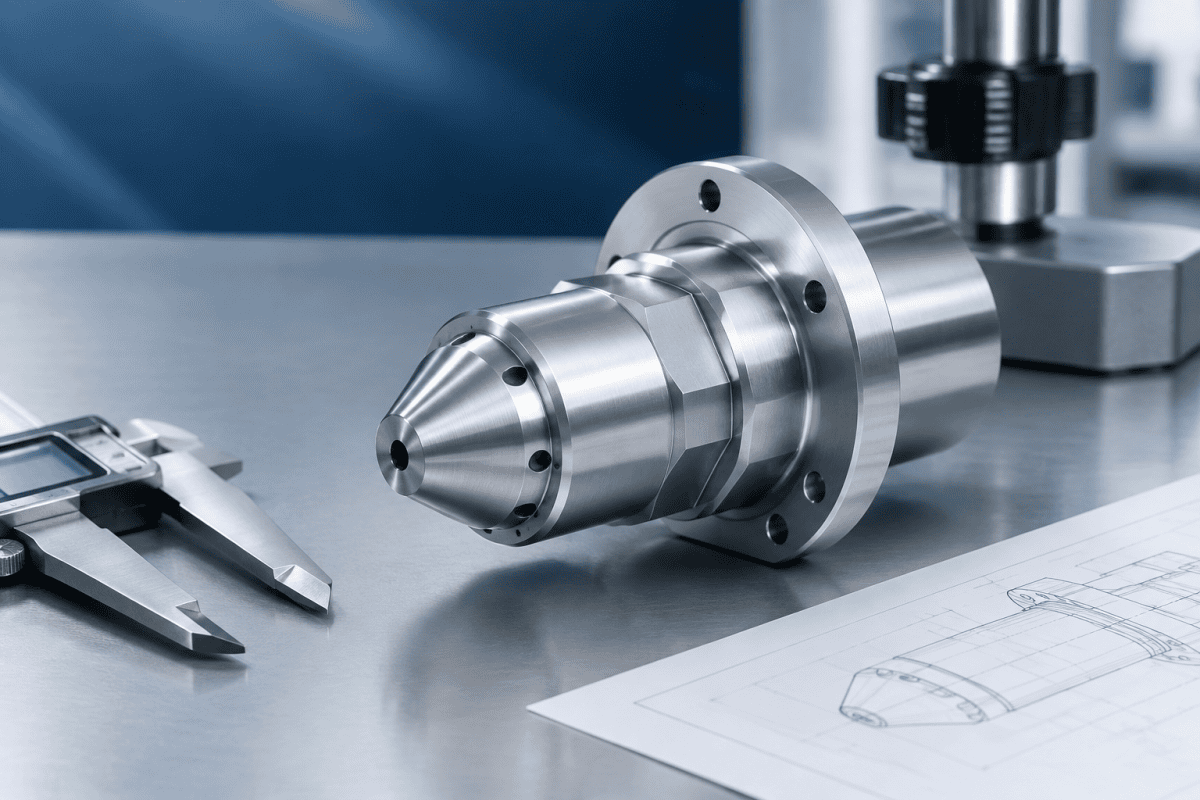
Die Planung eines Nextrom OVD-Brennerdüsen-Ersatzes beginnt mit einer Reihe von Abmessungs- und Anschlussprüfungen, die leicht unterschätzt werden. Ein OVD-Brenner (Outside Vapor Deposition) ist ein Mehrkanal-Brenner: Brennstoff- und Sauerstoffkanäle speisen eine Flamme, die Siliziumtetrachlorid und andere Precursoren hydrolysiert und Siliziumdioxid-Ruß auf einem rotierenden Targetstab abscheidet. Die Düse — die Stirnplatte, Spitze oder der Öffnungssatz am Brennerauslass — formt diese Flamme und bestimmt weitgehend, wo der Ruß auftrifft.
Da ein Nextrom OVD-Brennerdüsen-Ersatz in einen vorhandenen Brennerkörper passen, an vorhandene Gasleitungen anschließen und eine vorhandene Flammenhüllkurve reproduzieren muss, erfolgt die Verifikation auf dem Papier, bevor etwas bestellt wird. Dieser Artikel beschreibt, was zu messen, was zu vergleichen und was in eine Beschaffungsanfrage aufzunehmen ist, damit ein Nextrom OVD-Brennerdüsen-Ersatz oder ein kundenspezifisches Abscheidungsdüsen- Programm auf genauen Daten basiert.
Ein Hinweis vor den Details: Nextrom-Anlagen haben im Laufe ihrer Produktionszeit mehrere Konfigurationen erfahren, und kein Lieferant kann die Passung allein anhand eines Markennamens oder eines Fotos bestätigen. Die Kompatibilität wird anhand von Zeichnungen, gemessenen Abmessungen, Anschlussdetails, Werkstoffen und der Anwendung festgestellt. Betrachten Sie jede der folgenden Zahlen als etwas, das an Ihrer eigenen Einheit bestätigt werden muss.
Warum die Düse die kritische Schnittstelle in einem OVD-Brenner ist
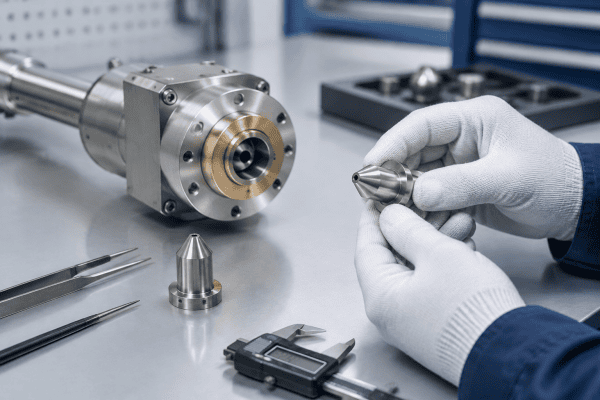
Der Brennerkörper positioniert und führt die Gase; die Düse bestimmt, wie sie austreten. Öffnungsdurchmesser, Kanalabstand, Ebenheit der Stirnplatte und die Konzentrizität eines Kanals relativ zu einem anderen beeinflussen alle die Flammenform, Geschwindigkeitsverteilung und Vermischung. Wenn eine Ersatzdüse geringfügig vom Original abweicht, zeigen sich die Auswirkungen normalerweise als Prozessdrift statt als sofortiger Ausfall: ein sich verschiebendes Rußabscheidungsprofil, eine Flamme, die zu einer Seite neigt, oder ein sich langsam änderndes Brechungsindexprofil in der Vorform. Die Beziehung zwischen Düsengeometrie und Vorformergebnisse wird ausführlicher behandelt in diesem Artikel über Düsenpräzision von Brennern und Preform-Ausbeute.
Deshalb ist ein Nextrom OVD-Brennerdüsen-Ersatz zuerst eine dimensionale Aufgabe und zweitens eine Beschaffungsaufgabe. Zwei Düsen können identisch aussehen und sich dennoch in einer Weise unterscheiden, die nach Stunden der Abscheidung relevant ist.
Abmessungen, die vor der Bestellung eines Nextrom OVD-Brennerdüsen-Ersatzes zu überprüfen sind
Gesamthüllkurve und Montagegeometrie
Beginnen Sie mit der Außenseite des Teils, denn sie bestimmt, ob die Düse korrekt im Brennerkörper sitzt. Ein Nextrom OVD-Brennerdüsen-Ersatz sollte mit einer gemessenen Gesamtlänge beginnen — einschließlich jeglicher Schulter, Flansch oder Stufe, die die Düse gegen den Brennerkörper positioniert.
- Gesamtlänge und -durchmesser — einschließlich jeglicher Schulter, Flansch oder Stufe, die die Düse gegen den Brennerkörper positioniert.
- Montagemerkmale — Gewindesteigung und -klasse, Halteringnuten, Passstift- oder Keilnutpositionen und Lochkreisdurchmesser, wenn die Düse befestigt statt verschraubt ist.
- Auflageflächen — die Flächen, die metallisch auf metallisch oder gegen eine Dichtung passen müssen. Notieren Sie deren Breite, Winkel und Oberflächenbeschaffenheit.
- Orientierungsmerkmale — jegliche Asymmetrie, die erzwingt, dass die Düse nur in einer Drehposition eingebaut werden kann.
Messen Sie diese am entfernten Teil, nicht an einer Zeichnung unbekannter Revision, und dokumentieren Sie die Messmethode (Messschieber, Mikrometer, CMM, optischer Komparator) zusammen mit jedem Wert. Für kleine Merkmale ist ein CMM-Bericht oder eine Maßprüfzeichnung für einen Zerspaner weitaus nützlicher als handgezeichnete Zahlen.
Gaskanal- und Öffnungsgeometrie
Hier liegt der größte Teil der prozessrelevanten Variation:
- Anzahl und Anordnung der Kanäle — ein typischer OVD-Brenner kann separate Precursor-, Brennstoff- und Sauerstoffkanäle haben, manchmal mit Abschirm- oder Hilfskanälen. Zählen Sie sie und kartieren Sie ihre Positionen.
- Öffnungsdurchmesser — messen Sie jeden Kanal einzeln; nehmen Sie nicht an, dass alle gleich groß sind.
- Mittenabstand — die Teilung zwischen Öffnungen oder zwischen konzentrischen Lochringen.
- Ebenheit der Stirnplatte — insbesondere bei Mehrfachöffnungsspitzen, wo die lokale Ebenheit die Flammensymmetrie beeinflusst.
- Konzentrizität und Rundlauf — zwischen dem Montagebezug und den Gaspassagen sowie zwischen einzelnen Kanälen.
Wenn die Originaldüse verschlissen, verstopft oder teilweise beschädigt ist, messen Sie Merkmale, die nicht vom Verschleiß betroffen sind, und dokumentieren Sie den Schaden separat. Eine erodierte Öffnung repräsentiert nicht das Originalmaß.
Werkstoffe und Oberflächenzustand
Dokumentieren Sie den Werkstoff des Düsenkörpers und der Stirnplatte so gut wie möglich, zusammen mit jeglicher Beschichtung. Die Werkstoffauswahl für Düsen hängt von der Funktion der Komponente, ihrer Temperaturbelastung, der chemischen Umgebung nahe der Brennerstirn und den technischen Anforderungen des Prozesses ab — nicht von einer allgemeinen Kategorie.
Kupferlegierungen, Nickelbasislegierungen, Edelstähle und Refraktärmetalle kommen alle in Brennerkomponenten vor, und jedes bringt unterschiedliche Wärmeleitfähigkeit, Oxidationsbeständigkeit und Zerspanbarkeit mit sich. Wenn der Werkstoff unbekannt ist, sagen Sie es; ein Lieferant kann Optionen vorschlagen und die Begründung erläutern, anstatt zu raten. Die guide to custom burner sourcing and reverse engineering covers how material and geometry decisions interact.
Anschlüsse, die zusammen mit der Düse zu überprüfen sind
A nozzle that fits the torch body but not the facility’s gas and cooling interfaces is still the wrong part. Verify the interfaces around the nozzle as part of the same survey. For a Nextrom OVD burner nozzle replacement, these connection checks are just as important as the dimensional set.
- Gas inlet fittings — thread type, size, sealing method (face seal, gasket, tapered thread), and the tubing or hose connection at the torch body. Note whether the nozzle itself carries any of these interfaces or whether they belong to the body.
- Cooling passages — if the torch is water-cooled, record the port locations, thread sizes, and flow direction markings. Never assume flow direction; confirm against equipment documentation.
- Seals and gaskets — material, cross-section, and groove dimensions. These are frequently the first items to be reordered with a nozzle and the easiest to mis-specify.
- Ignition or pilot features — if present, their position relative to the nozzle face.
- Adjacent components — the OVD burner head components and any auxiliary hardware that the nozzle must clear or align with during installation.
Where gas connections or cooling circuits are involved, follow the equipment manufacturer’s documentation and have qualified personnel confirm the setup. Replacing a nozzle should not become an occasion to change operating parameters by trial and error. A Nextrom OVD burner nozzle replacement therefore begins with the connections, not with the order form.
Ein praktischer Inspektionsablauf für die entfernte Düse
Before you start measuring, set up a Nextrom OVD burner nozzle replacement file that will hold every photograph, number, and note generated by the inspection. An organized file makes the eventual quotation faster and reduces the chance that a key figure is lost between shifts.
- Photograph the part in place before removal, including the torch face, adjacent plumbing, and any orientation marks.
- Clean and inspect the removed nozzle. Distinguish wear (erosion, deformation, cracking) from deposits (soot, oxide scale, condensed material). Soot clogging on a faceplate is a common condition and is discussed in this article on preventing soot clogging on OVD burner faceplates.
- Measure the dimensional set listed above and log each value with its method.
- Inspect the mating surfaces on the torch body itself. A new nozzle seated against a damaged body surface will not reproduce the original flame.
- Compare against the last known-good baseline if one exists. A trend of measurements over several replacements is more informative than a single snapshot.
If the nozzle is severely degraded or the original dimensions are unknown, a reverse-engineering exercise based on the torch body and a sample part may be the practical route. That work still depends on the dimensional and connection data described here. Treat the reverse-engineered drawing as the reference for every future Nextrom OVD burner nozzle replacement on that torch position.
Was in eine Beschaffungsanfrage aufzunehmen ist
A clear request shortens quotation cycles and reduces the risk of a near-miss part. For a Nextrom OVD burner nozzle replacement, the more data you supply up front, the faster the quotation. Include:
- Machine type and burner position, described as specifically as you can, with photos of the torch and the removed nozzle.
- A dimensioned drawing or inspection report of the existing nozzle, or a physical sample for reverse engineering.
- Material of the original part if known, plus any coating or surface finish requirement.
- Connection details for gas inlets and cooling ports, including sealing method.
- Quantity needed, whether the request is for a one-off replacement or an ongoing supply, and any documentation requirements.
- Application notes: process (OVD, VAD, or another method), and anything known about the thermal and chemical environment. OVD, VAD, and MCVD torches are not interchangeable, and nozzle designs differ by process; this nozzle comparison across OVD, VAD, and MCVD explains the distinctions.
For a broader replacement part, review the supplier’s range of Abscheidungsfackel-Verbrauchsmaterialien to see whether standard options exist before committing to a fully custom build.
It also helps to state whether the Nextrom OVD burner nozzle replacement is urgent and whether the line can wait for a custom lead time, since that shapes the sourcing strategy. Suppliers often quote a Nextrom OVD burner nozzle replacement differently when a shutdown window is already booked.
For background on how high-purity quartz preforms are made and why torch geometry matters, the Corning optical fiber page provides an accessible overview of the deposition process.
Häufige Fehler, die zu einer verfehlten Passung führen
Most failed replacements trace back to a handful of avoidable errors. Watch for these during your Nextrom OVD burner nozzle replacement or a custom burner replacement project.
- Measuring only the outside of the nozzle and assuming the internal channels match.
- Using a drawing of unknown revision instead of the actual installed part.
- Replicating worn dimensions as if they were original.
- Ignoring the condition of the mating surfaces on the torch body.
- Specifying material by habit rather than by function.
- Overlooking seals, gaskets, and cooling connections until installation day.
A short review of these points before you send a request prevents most of the back-and-forth that delays a Nextrom OVD burner nozzle replacement.
Wie Toleranzen zu lesen sind, wenn Abmessungen gealtert sind
Dimensions on an old part are not the same as nominal dimensions. Thermal cycling, chemical attack, and mechanical wear all shift the numbers. When you prepare data for a Nextrom OVD burner nozzle replacement, separate three categories of dimensions.
- Original nominal dimensions — what the part was made to, if a drawing exists.
- Current measured dimensions — what the part is now, including wear.
- Functional target dimensions — what the new part should be to restore the intended flame.
A supplier can only work with the first and third categories. If you supply only the second, you risk reproducing a degraded state — a mistake that will follow every subsequent Nextrom OVD burner nozzle replacement built from the same data.
Werkstoffe und Beschichtungen: Wo sie in der Verifikation einzuordnen sind
Material choice is not a separate topic from dimensions — it affects how the part behaves in service. When you specify a Nextrom OVD burner nozzle replacement, note whether the original used a coating, a hardened surface, or a specific alloy, and share that with the supplier.
- Base material — copper alloy, nickel-based alloy, stainless steel, or refractory metal.
- Coating or surface treatment — if present, its type and purpose.
- Service environment — temperature range, gas exposure, and cleaning methods used.
These notes help a supplier recommend a material that matches the application rather than simply copying a label. If a coating on the original has worn away, say so — a Nextrom OVD burner nozzle replacement should restore the intended surface condition, not preserve an eroded one.
Dichtungen, Dichtungen und die kleinen Teile, die vergessen werden
A Nextrom OVD burner nozzle replacement is rarely just the nozzle. Seals and gaskets wear faster than the metal components and are the most common cause of leaks after installation. Verify their material, cross-section, and groove dimensions as part of the same survey.
It is also worth photographing the orientation of every seal before removal, because a small gasket installed the wrong way can pass a pressure test and still fail in service. Keep a matched seal kit on the shelf for each torch position, and label it against the same drawing used to order the next Nextrom OVD burner nozzle replacement.
Qualitäts- und Inspektionsdokumentation für einen Nextrom OVD-Brennerdüsen-Ersatz
For a critical torch component, inspection documentation is part of the specification. Ask the supplier what dimensional report they provide with the finished part, and whether it includes the features that matter most to your process — orifice diameter, channel spacing, faceplate flatness, and concentricity.
- Dimensional report — measured values against the drawing for the key features.
- Material certification — confirming the alloy delivered.
- Surface finish record — for sealing faces and the nozzle tip.
- Packaging and marking — so the part can be matched to the correct torch position on receipt.
Good documentation makes the next Nextrom OVD burner nozzle replacement easier, because you start from a known baseline instead of an unknown one. File the report with the seal kit and the drawing so the full assembly record stays in one place.
Ersatzteilplanung: Wann mehr als eine Düse zu bestellen ist
Nozzle wear is inevitable in OVD deposition, and lead time for a custom part can be long. If the line cannot afford a stoppage, plan to keep at least one verified spare. A Nextrom OVD burner nozzle replacement sourced under pressure usually costs more and fits worse.
- Track the service hours on each nozzle.
- Record the reason for each removal — wear, clogging, or damage.
- Re-order from the same verified drawing to keep parts interchangeable.
- Review spares during scheduled maintenance rather than after a failure.
A simple log of removal reasons will, over time, tell you which torch position needs a Nextrom OVD burner nozzle replacement most often — a pattern that often points to an upstream problem in the burner body or the gas supply.
Abgleich der Düse mit dem restlichen Brenner
The nozzle is only one interacting part. Before finalizing a Nextrom OVD burner nozzle replacement, walk through the rest of the torch and confirm that nothing else has changed since the last known-good run.
- Burner body — check for erosion at the seating face, distortion, or blocked internal passages.
- Feed lines — confirm flow rates and that no fittings have been changed during earlier maintenance.
- Mounting hardware — verify that the same fasteners, dowels, and keys are still present.
- Process records — compare the last few deposition runs to see whether drift started before or after the nozzle was last changed.
This cross-check is what turns a Nextrom OVD burner nozzle replacement from a reactive purchase into part of a controlled consumable program. When the geometry, the connections, and the surrounding hardware all agree, the new nozzle has the best possible chance of reproducing the original flame.
Wo tiefergehende Informationen zu verwandten Komponenten zu finden sind
If your project covers more than the nozzle, these related topics will help: which OVD, VAD, and MCVD burner parts need separate specifications, and a case study on upgrading OVD torch consumables to titanium alloy for a global fiber manufacturer.
Together, these resources show how a Nextrom OVD burner nozzle replacement fits into a broader consumable strategy.
FAQ
Kann ich nur die Düsenspitze ersetzen, oder muss der gesamte Brenner ersetzt werden?
It depends on how the torch is constructed and on the condition of the body. If the nozzle is a discrete, serviceable component and the body’s mounting and sealing surfaces are within specification, tip replacement alone can be viable. If the seating surfaces are eroded or the channels in the body are damaged, a partial replacement may not restore the original flame. Inspect the body before deciding.
Was, wenn ich keine Zeichnung für die Originaldüse habe?
Reverse engineering from a physical sample is a common path. Send the removed part along with photos of the torch and the connection details. Note that worn dimensions should be identified rather than replicated — a supplier needs to know which features are original and which have changed through service.
Wie erkenne ich, ob ein Messunterschied relevant ist?
Not every dimension has equal process significance. Orifice diameter, channel spacing, faceplate flatness, and concentricity generally have a more direct effect on flame shape than, for example, an external chamfer. Discuss tolerances with the supplier in terms of function: tell them which features influence deposition and which are non-critical.
Verwenden alle Nextrom OVD-Brenner dieselbe Düse?
Do not assume so. Configurations vary, and the only reliable basis for a replacement is the actual part on your machine, verified by drawing or measurement. A supplier working from your data can match the specific configuration.
Nächster Schritt
Gather the dimensional record, photographs, connection details, and material information for the nozzle you need to replace. Then request a Nextrom OVD burner nozzle replacement quote with those files, or send a sample part for reverse engineering. Done carefully, a Nextrom OVD burner nozzle replacement becomes a predictable, repeatable maintenance task rather than a source of downtime. For questions on optical fiber deposition, Photonics.com publishes industry news that can help you stay current with process trends.
