
Kawruh
Nextrom OVD Burner Nozzle Replacement: Dimensions and Connections to Verify
Okt
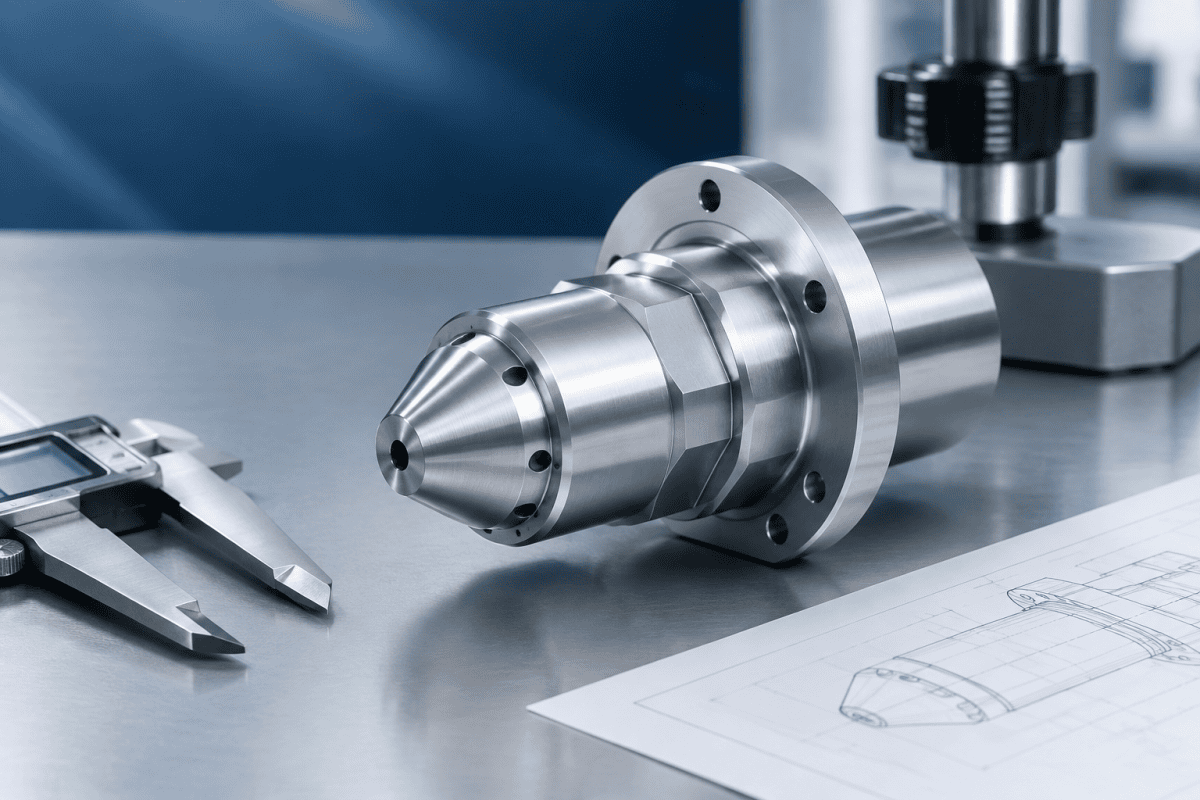
Planning a Nextrom OVD burner nozzle replacement starts with a set of dimensional and connection checks that are easy to underestimate. An OVD (outside vapor deposition) burner is a multi-channel torch: fuel and oxygen channels feed a flame that hydrolyzes silicon tetrachloride and other precursors, depositing silica soot onto a rotating target rod. The nozzle — the faceplate, tip, or orifice set at the torch outlet — shapes that flame and largely determines where the soot lands.
Because a Nextrom OVD burner nozzle replacement has to sit in an existing torch body, connect to existing gas lines, and reproduce an existing flame envelope, verification happens on paper before anything is ordered. This article outlines what to measure, what to compare, and what to put in a sourcing request so a Nextrom OVD burner nozzle replacement or a custom deposition nozzle program starts from accurate data.
One note before the details: Nextrom equipment has seen multiple configurations over its production life, and no supplier can confirm fit from a brand name or a photo alone. Compatibility is established against drawings, measured dimensions, connection details, materials, and the application. Treat every number below as something to confirm on your own unit.
Why the Nozzle Is the Critical Interface in an OVD Burner
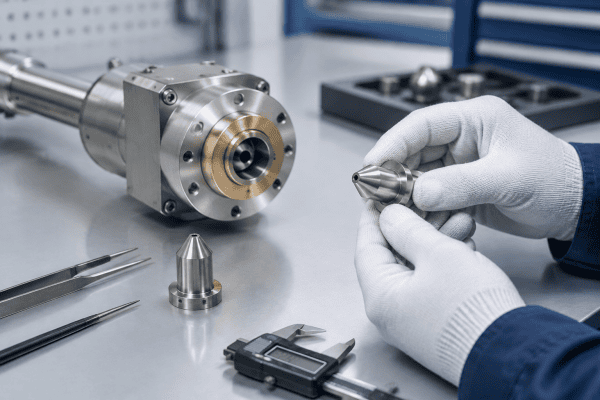
The burner body positions and feeds the gases; the nozzle defines how they leave. Orifice diameter, channel spacing, faceplate flatness, and the concentricity of one channel relative to another all influence flame shape, velocity distribution, and mixing. When a replacement nozzle differs subtly from the original, the effects usually show up as process drift rather than immediate failure: a shifting soot deposition profile, a flame that leans to one side, or a slowly changing refractive index profile in the preform. The relationship between nozzle geometry and preform outcomes is covered in more depth in this article on burner nozzle precision and preform yield.
That is why a Nextrom OVD burner nozzle replacement is a dimensional exercise first and a purchasing exercise second. Two nozzles can look identical and still differ in ways that matter after hours of deposition.
Dimensions to Verify Before Ordering a Nextrom OVD Burner Nozzle Replacement
Overall envelope and mounting geometry
Start with the outside of the part, because it determines whether the nozzle seats correctly in the torch body. A Nextrom OVD burner nozzle replacement should begin with a measured overall length — including any shoulder, flange, or step that registers the nozzle against the torch body.
- Overall length and diameter — including any shoulder, flange, or step that registers the nozzle against the torch body.
- Mounting features — thread pitch and class, retaining ring grooves, dowel or keyway positions, and bolt circle dimensions if the nozzle is fastened rather than threaded.
- Seating surfaces — the faces that must mate metal-to-metal or against a gasket. Note their width, angle, and surface condition.
- Orientation features — any asymmetry that forces the nozzle to be installed in one rotational position only.
Measure these on the removed part, not on a drawing of unknown revision, and record the measurement method (calipers, micrometer, CMM, optical comparator) alongside each figure. For small features, a CMM report or a dimensional inspection drawing is far more useful to a machinist than hand-sketched numbers.
Gas channel and orifice geometry
This is where most of the process-relevant variation lives:
- Number and arrangement of channels — a typical OVD torch may have separate precursor, fuel, and oxygen passages, sometimes with shielding or auxiliary channels. Count them and map their positions.
- Orifice diameters — measure each channel individually; do not assume they are all the same size.
- Center-to-center spacing — the pitch between orifices or between concentric rings of holes.
- Faceplate flatness — particularly on multi-orifice tips, where local flatness affects flame symmetry.
- Concentricity and runout — between the mounting datum and the gas passages, and between individual channels.
If the original nozzle is worn, clogged, or partially damaged, measure features that have not been affected by wear, and document the damage separately. An eroded orifice does not represent the original dimension.
Materials and surface condition
Record the material of the nozzle body and faceplate as best you can determine it, along with any coating. Nozzle material selection depends on the component’s function, its temperature exposure, the chemical environment near the torch face, and the engineering requirements of the process — not on a generic category.
Copper alloys, nickel-based alloys, stainless steels, and refractory metals all appear in torch components, and each brings different thermal conductivity, oxidation resistance, and machinability trade-offs. If the material is unknown, say so; a supplier can propose options and explain the reasoning rather than guess. The guide to custom burner sourcing and reverse engineering covers how material and geometry decisions interact.
Connections to Verify Alongside the Nozzle
A nozzle that fits the torch body but not the facility’s gas and cooling interfaces is still the wrong part. Verify the interfaces around the nozzle as part of the same survey. For a Nextrom OVD burner nozzle replacement, these connection checks are just as important as the dimensional set.
- Gas inlet fittings — thread type, size, sealing method (face seal, gasket, tapered thread), and the tubing or hose connection at the torch body. Note whether the nozzle itself carries any of these interfaces or whether they belong to the body.
- Cooling passages — if the torch is water-cooled, record the port locations, thread sizes, and flow direction markings. Never assume flow direction; confirm against equipment documentation.
- Seals and gaskets — material, cross-section, and groove dimensions. These are frequently the first items to be reordered with a nozzle and the easiest to mis-specify.
- Ignition or pilot features — if present, their position relative to the nozzle face.
- Adjacent components — the OVD burner head components and any auxiliary hardware that the nozzle must clear or align with during installation.
Where gas connections or cooling circuits are involved, follow the equipment manufacturer’s documentation and have qualified personnel confirm the setup. Replacing a nozzle should not become an occasion to change operating parameters by trial and error. A Nextrom OVD burner nozzle replacement therefore begins with the connections, not with the order form.
A Practical Inspection Workflow for the Removed Nozzle
Before you start measuring, set up a Nextrom OVD burner nozzle replacement file that will hold every photograph, number, and note generated by the inspection. An organized file makes the eventual quotation faster and reduces the chance that a key figure is lost between shifts.
- Photograph the part in place before removal, including the torch face, adjacent plumbing, and any orientation marks.
- Clean and inspect the removed nozzle. Distinguish wear (erosion, deformation, cracking) from deposits (soot, oxide scale, condensed material). Soot clogging on a faceplate is a common condition and is discussed in this article on preventing soot clogging on OVD burner faceplates.
- Measure the dimensional set listed above and log each value with its method.
- Inspect the mating surfaces on the torch body itself. A new nozzle seated against a damaged body surface will not reproduce the original flame.
- Compare against the last known-good baseline if one exists. A trend of measurements over several replacements is more informative than a single snapshot.
If the nozzle is severely degraded or the original dimensions are unknown, a reverse-engineering exercise based on the torch body and a sample part may be the practical route. That work still depends on the dimensional and connection data described here. Treat the reverse-engineered drawing as the reference for every future Nextrom OVD burner nozzle replacement on that torch position.
What to Include in a Sourcing Request
A clear request shortens quotation cycles and reduces the risk of a near-miss part. For a Nextrom OVD burner nozzle replacement, the more data you supply up front, the faster the quotation. Include:
- Machine type and burner position, described as specifically as you can, with photos of the torch and the removed nozzle.
- A dimensioned drawing or inspection report of the existing nozzle, or a physical sample for reverse engineering.
- Material of the original part if known, plus any coating or surface finish requirement.
- Connection details for gas inlets and cooling ports, including sealing method.
- Quantity needed, whether the request is for a one-off replacement or an ongoing supply, and any documentation requirements.
- Application notes: process (OVD, VAD, or another method), and anything known about the thermal and chemical environment. OVD, VAD, and MCVD torches are not interchangeable, and nozzle designs differ by process; this nozzle comparison across OVD, VAD, and MCVD explains the distinctions.
For a broader replacement part, review the supplier’s range of deposition torch consumables
to see whether standard options exist before committing to a fully custom build.
It also helps to state whether the Nextrom OVD burner nozzle replacement is urgent and whether the line can wait for a custom lead time, since that shapes the sourcing strategy. Suppliers often quote a Nextrom OVD burner nozzle replacement differently when a shutdown window is already booked.
For background on how high-purity quartz preforms are made and why torch geometry matters, the Corning optical fiber page provides an accessible overview of the deposition process.
Common Mistakes That Lead to a Missed Fit
Most failed replacements trace back to a handful of avoidable errors. Watch for these during your Nextrom OVD burner nozzle replacement or a custom burner replacement project.
- Measuring only the outside of the nozzle and assuming the internal channels match.
- Using a drawing of unknown revision instead of the actual installed part.
- Replicating worn dimensions as if they were original.
- Ignoring the condition of the mating surfaces on the torch body.
- Specifying material by habit rather than by function.
- Overlooking seals, gaskets, and cooling connections until installation day.
A short review of these points before you send a request prevents most of the back-and-forth that delays a Nextrom OVD burner nozzle replacement.
How to Read Tolerances When Dimensions Have Aged
Dimensions on an old part are not the same as nominal dimensions. Thermal cycling, chemical attack, and mechanical wear all shift the numbers. When you prepare data for a Nextrom OVD burner nozzle replacement, separate three categories of dimensions.
- Original nominal dimensions — what the part was made to, if a drawing exists.
- Current measured dimensions — what the part is now, including wear.
- Functional target dimensions — what the new part should be to restore the intended flame.
A supplier can only work with the first and third categories. If you supply only the second, you risk reproducing a degraded state — a mistake that will follow every subsequent Nextrom OVD burner nozzle replacement built from the same data.
Materials and Coatings: Where They Fit in Verification
Material choice is not a separate topic from dimensions — it affects how the part behaves in service. When you specify a Nextrom OVD burner nozzle replacement, note whether the original used a coating, a hardened surface, or a specific alloy, and share that with the supplier.
- Base material — copper alloy, nickel-based alloy, stainless steel, or refractory metal.
- Coating or surface treatment — if present, its type and purpose.
- Service environment — temperature range, gas exposure, and cleaning methods used.
These notes help a supplier recommend a material that matches the application rather than simply copying a label. If a coating on the original has worn away, say so — a Nextrom OVD burner nozzle replacement should restore the intended surface condition, not preserve an eroded one.
Seals, Gaskets, and the Small Parts People Forget
A Nextrom OVD burner nozzle replacement is rarely just the nozzle. Seals and gaskets wear faster than the metal components and are the most common cause of leaks after installation. Verify their material, cross-section, and groove dimensions as part of the same survey.
It is also worth photographing the orientation of every seal before removal, because a small gasket installed the wrong way can pass a pressure test and still fail in service. Keep a matched seal kit on the shelf for each torch position, and label it against the same drawing used to order the next Nextrom OVD burner nozzle replacement.
Quality and Inspection Documentation for a Nextrom OVD Burner Nozzle Replacement
For a critical torch component, inspection documentation is part of the specification. Ask the supplier what dimensional report they provide with the finished part, and whether it includes the features that matter most to your process — orifice diameter, channel spacing, faceplate flatness, and concentricity.
- Dimensional report — measured values against the drawing for the key features.
- Material certification — confirming the alloy delivered.
- Surface finish record — for sealing faces and the nozzle tip.
- Packaging and marking — so the part can be matched to the correct torch position on receipt.
Good documentation makes the next Nextrom OVD burner nozzle replacement easier, because you start from a known baseline instead of an unknown one. File the report with the seal kit and the drawing so the full assembly record stays in one place.
Spare Planning: When to Order More Than One Nozzle
Nozzle wear is inevitable in OVD deposition, and lead time for a custom part can be long. If the line cannot afford a stoppage, plan to keep at least one verified spare. A Nextrom OVD burner nozzle replacement sourced under pressure usually costs more and fits worse.
- Track the service hours on each nozzle.
- Record the reason for each removal — wear, clogging, or damage.
- Re-order from the same verified drawing to keep parts interchangeable.
- Review spares during scheduled maintenance rather than after a failure.
A simple log of removal reasons will, over time, tell you which torch position needs a Nextrom OVD burner nozzle replacement most often — a pattern that often points to an upstream problem in the burner body or the gas supply.
Cross-Checking the Nozzle Against the Rest of the Torch
The nozzle is only one interacting part. Before finalizing a Nextrom OVD burner nozzle replacement, walk through the rest of the torch and confirm that nothing else has changed since the last known-good run.
- Burner body — check for erosion at the seating face, distortion, or blocked internal passages.
- Feed lines — confirm flow rates and that no fittings have been changed during earlier maintenance.
- Mounting hardware — verify that the same fasteners, dowels, and keys are still present.
- Process records — compare the last few deposition runs to see whether drift started before or after the nozzle was last changed.
This cross-check is what turns a Nextrom OVD burner nozzle replacement from a reactive purchase into part of a controlled consumable program. When the geometry, the connections, and the surrounding hardware all agree, the new nozzle has the best possible chance of reproducing the original flame.
Where to Go Deeper on Related Components
If your project covers more than the nozzle, these related topics will help: which OVD, VAD, and MCVD burner parts need separate specifications, and a case study on upgrading OVD torch consumables to titanium alloy for a global fiber manufacturer.
Together, these resources show how a Nextrom OVD burner nozzle replacement fits into a broader consumable strategy.
Pitakonan sing Sering Ditakoni
Can I replace just the nozzle tip, or does the whole burner need to be replaced?
It depends on how the torch is constructed and on the condition of the body. If the nozzle is a discrete, serviceable component and the body’s mounting and sealing surfaces are within specification, tip replacement alone can be viable. If the seating surfaces are eroded or the channels in the body are damaged, a partial replacement may not restore the original flame. Inspect the body before deciding.
What if I don’t have a drawing for the original nozzle?
Reverse engineering from a physical sample is a common path. Send the removed part along with photos of the torch and the connection details. Note that worn dimensions should be identified rather than replicated — a supplier needs to know which features are original and which have changed through service.
How do I know whether a difference in measurement matters?
Not every dimension has equal process significance. Orifice diameter, channel spacing, faceplate flatness, and concentricity generally have a more direct effect on flame shape than, for example, an external chamfer. Discuss tolerances with the supplier in terms of function: tell them which features influence deposition and which are non-critical.
Do all Nextrom OVD torches use the same nozzle?
Do not assume so. Configurations vary, and the only reliable basis for a replacement is the actual part on your machine, verified by drawing or measurement. A supplier working from your data can match the specific configuration.
Langkah Sabanjure
Gather the dimensional record, photographs, connection details, and material information for the nozzle you need to replace. Then request a Nextrom OVD burner nozzle replacement quote with those files, or send a sample part for reverse engineering. Done carefully, a Nextrom OVD burner nozzle replacement becomes a predictable, repeatable maintenance task rather than a source of downtime. For questions on optical fiber deposition, Photonics.com publishes industry news that can help you stay current with process trends.
