
Wissen
Corning Preform Equipment Parts Sourcing: Ein Leitfaden zur Lieferantenqualifizierung
Okt.
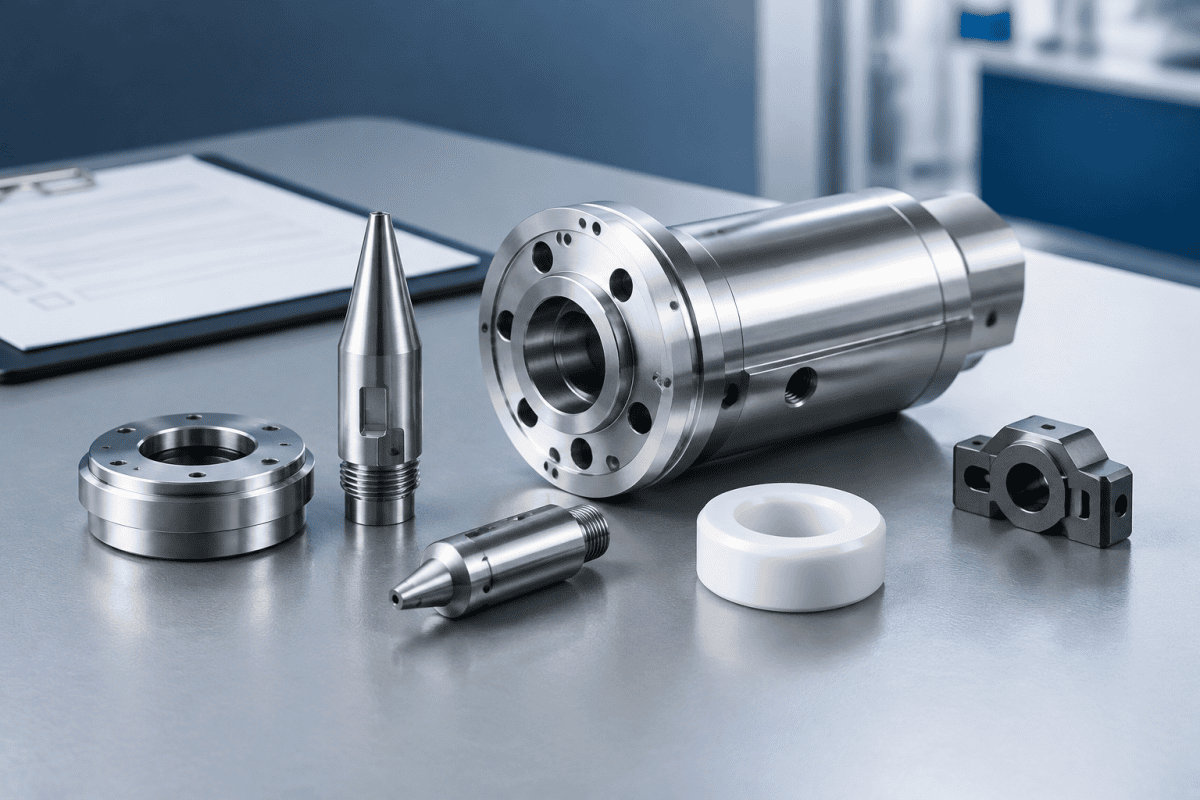
Corning Preform Equipment Parts Sourcing is rarely a simple catalog exercise. The people responsible for keeping OVD, VAD, and MCVD lines running need replacement burner components, deposition torch consumables, and precision-machined fixtures that match original drawings closely enough to preserve process stability. At the same time, most of these buyers are working with equipment that may be decades old, partially documented, or supported through third-party supply chains rather than the original builder. This guide walks through supplier qualification for preform equipment components: what to ask, what to inspect, and how to structure a commercial request so you get comparable quotes and parts that actually fit.
Why Corning Preform Equipment Parts Sourcing Differs From General Machining Procurement
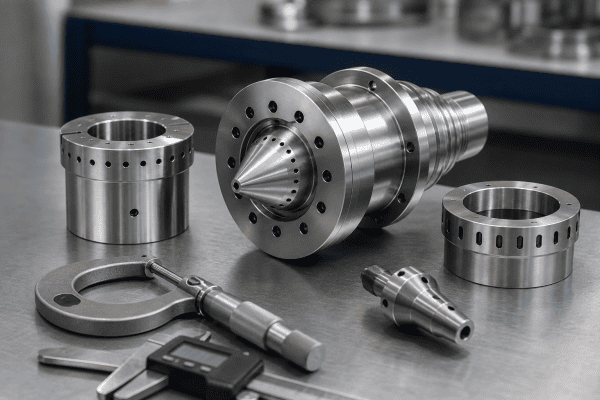
A preform line is a tightly coupled system. Burner geometry affects soot deposition, deposition affects preform quality, and preform quality determines draw yield. A component that is “close enough” on a general machining tolerance table may still be unacceptable in this context, because small deviations in nozzle position, concentricity, or gas passage geometry can shift the thermal and aerodynamic behavior of the whole process.
That means supplier qualification for Corning preform equipment parts sourcing cannot stop at price and lead time. You need to establish whether a supplier understands the function of the part, not just its shape. A shop that machines stainless steel well may still produce a poor OVD burner nozzle if it does not consider channel alignment, surface finish inside gas passages, or the thermal environment the part will see.
It also means documentation matters more than usual. Drawings, material certificates, dimensional reports, and inspection data are part of the qualification package, not optional add-ons. As an additional reference, the NIST Manufacturing Extension Partnership offers useful frameworks for assessing small and mid-size machining suppliers.
There is also a commercial dimension. Preform equipment components are often produced in low volumes with high documentation overhead, which makes them unattractive to general job shops. The suppliers who stay competitive in this niche are usually those who have built repeatable workflows around reverse engineering, first-article inspection, and revision control rather than around scale. When you qualify a supplier for Corning preform equipment parts sourcing, you are really qualifying their process discipline as much as their machine list.
Start With a Clear Part Definition
Before evaluating suppliers for Corning preform equipment parts sourcing, define the part as precisely as your records allow. Incomplete definitions are the single most common cause of mismatched quotations and rejected first articles.
What to gather for each component
- Current 2D drawings or 3D models, including revision level
- Nominal dimensions and critical tolerances, especially on gas passages and sealing faces
- Material specification and any material certification requirements
- Surface finish requirements on internal and external surfaces
- Connection details: threads, flanges, gas fittings, and orientation marks
- Operating context: which process (OVD, VAD, or MCVD) and which position in the line
- Known field history: wear patterns, failures, and any modifications made over time
For older equipment, drawings may be missing or incomplete. In that case, reverse engineering becomes part of the sourcing scope. A qualified supplier should be able to measure a sample part, reconstruct a model, and flag dimensions that are ambiguous or clearly worn. This is a core capability for OEM/ODM machining services and should be confirmed early rather than assumed.
Separating critical from non-critical features
Not every dimension on a burner component deserves the same attention. Gas passage geometry, sealing faces, and alignment features usually drive performance; cosmetic surfaces and non-functional radii rarely do. Marking these distinctions on the drawing does two things: it tells the supplier where to focus inspection effort, and it gives you an objective basis for accepting or rejecting a first article. Many Corning preform equipment parts sourcing teams maintain a short critical-feature list for each part number instead of relying on the full drawing alone.
Qualification Criteria for Custom Optical Fiber Manufacturing Components
When you evaluate a supplier for custom optical fiber manufacturing components, assess capability across several dimensions rather than a single sample part. The same structured approach applies whether you are buying a burner nozzle, a torch body, or a machined fixture for a deposition lathe.
Process capability and equipment fit
Ask what machining, turning, milling, drilling, and finishing processes the supplier uses, and how they control tolerances on features that matter for gas flow and alignment. Multi-channel burner components, for example, often require careful control of channel position and internal surface quality, not just external dimensions. Corning preform equipment parts sourcing programs that succeed tend to require suppliers to map each critical feature to a specific machine and inspection method.
Material selection reasoning
A supplier should be able to explain material recommendations in terms of the part’s function, temperature exposure, and chemical environment. Do not accept a default material answer without reasoning. The right choice depends on whether the part sees high heat, oxidizing or reducing conditions, repeated thermal cycling, or mechanical wear. General guidance on this is covered in the overview of OVD burner parts and in our related guide on Nextrom OVD burner replacement drawings for custom parts sourcing.
Metrology and inspection
Confirm how the supplier verifies critical features. Coordinate measuring machines, optical comparators, and surface roughness instruments are typical. Ask whether inspection reports are provided with each lot and whether critical dimensions are measured on every part or by sampling. For Corning preform equipment parts sourcing, a supplier’s metrology list should be specific to the features you actually care about, not a generic capability statement.
Traceability
Material certificates, lot numbers, and revision control should be standard. If a part fails in service, traceability determines whether you can isolate the cause. Corning preform equipment parts sourcing audits frequently include a documentation walk-through: can the supplier show you, live, how a finished part maps back to a specific heat number and a specific drawing revision?
Communication and engineering response
A good supplier raises questions before production: ambiguous tolerances, unclear fits, or features that cannot be reproduced reliably. Silence during quoting is a warning sign. In Corning preform equipment parts sourcing, engineering responsiveness is often the difference between a part that runs for years and a part that causes a deposition problem on the first shift.
Capacity and lead-time realism
Qualification should also confirm that a supplier can actually deliver on schedule. Ask how they plan jobs, whether preform work competes with higher-volume contracts, and how they handle expedited requests. A supplier who quotes a two-week lead time but routinely ships in six weeks creates a different risk profile than one who quotes four weeks and holds it. For critical burner components, the second behavior is usually preferable.
Inspection Considerations Before Accepting Replacement Components
Even a well-qualified supplier should be validated with incoming inspection, at least for the first several lots. The specific checks depend on the component type. This is also where Corning preform equipment parts sourcing and general machining procurement diverge most sharply, because functional performance is often invisible from the outside of the part.
Burner and torch components
For nozzle and torch-tip parts, verify bore dimensions, concentricity, face flatness, and channel alignment. Gas passage cleanliness matters as much as dimensional accuracy, since debris or machining residue can disturb flow. Related inspection logic is discussed in the context of Düsenpräzision von Brennern und Preform-Ausbeute and in the deposition burner reverse engineering guide for avoiding dimensional errors.
Deposition and auxiliary components
Manifolds, distribution blocks, and auxiliary burners should be checked for internal passage continuity, sealing surface condition, and correct port orientation. For deposition-related hardware, compare against the OVD deposition parts you currently run, noting any design revisions that were made in the field. Corning preform equipment parts sourcing teams often keep a reference sample of the last-known-good part for exactly this comparison.
Mechanical and handling components
Clamps, fixtures, and cutting assemblies should be checked for fit, alignment, and repeatability. Winding and take-up components are a separate category and should be evaluated against the specific handling requirements of your line rather than treated as generic hardware. The same discipline that applies to torch components should apply here: define the function, then define the features that control it.
Documentation review
Incoming inspection is not only dimensional. Confirm that the parts arrive with the material certificates, inspection data, and revision references you requested in the purchase order. Missing paperwork is easy to overlook in the rush to get a part onto the line, but it undermines traceability later. Treating documentation as a receiving checkpoint is one of the simpler improvements most Corning preform equipment parts sourcing programs can make.
Building a Supplier Qualification Checklist
A practical qualification checklist for Corning preform equipment parts sourcing usually includes the following:
- Documented part definition with drawings, material spec, and critical tolerances
- Supplier capability statement covering relevant processes and metrology
- Material certification and traceability practices
- First-article inspection report with measured values against drawing
- Sample or trial part evaluated in production or on a test bench
- Agreed change-control process for revisions and substitutions
- Defined communication path for technical questions and nonconformances
For standard replacement items, the same logic applies at a lighter level. Browsing a supplier’s range of optical fiber equipment parts can help you identify which components are offered as standard versus made to order, but always verify fit against your own drawings and equipment documentation. A Corning preform equipment parts sourcing policy that treats standard and custom parts as separate tracks usually shortens quote cycles without lowering quality.
Common Sourcing Mistakes to Avoid
Several recurring problems show up in preform equipment sourcing. Each of these also represents a common failure mode in Corning preform equipment parts sourcing programs.
- Assuming brand compatibility. A part described as suitable for a given equipment family is not automatically compatible with your specific machine. Compatibility must be verified against drawings, dimensions, gas connections, materials, and application requirements.
- Treating processes as interchangeable. OVD, VAD, and MCVD burners and torches differ in geometry, thermal load, and gas delivery. Components are not freely interchangeable between them.
- Under-specifying surface finish. Internal finish affects flow and contamination; it should be stated explicitly, not left to shop default.
- Skipping first-article inspection. Even trusted suppliers should be validated on the first article and periodically re-verified.
- Ignoring the operating environment. A material that works in one position may fail in another due to temperature or chemistry.
- Over-relying on a single supplier. Corning preform equipment parts sourcing programs benefit from having a qualified second source, especially for long-lead burner components.
- Accepting verbal agreements. If a tolerance, material substitution, or finish change is agreed in conversation, put it in writing and revise the drawing or specification. Undocumented changes are a frequent root cause of mismatched replacement parts.
Preparing a Sourcing Request That Gets Usable Quotes
The quality of the quotation depends heavily on the quality of the request. To get comparable responses from multiple suppliers, include:
- Drawing number and revision, or a sample part for reverse engineering
- Quantity and whether you expect one-time or recurring supply
- Material specification and any certification needs
- Critical tolerances and inspection requirements
- Operating conditions relevant to material and design decisions
- Any known failure history or field modifications
- Required documentation: material certs, inspection reports, and packaging requirements
If your drawings are incomplete or you are working from a worn sample, state that upfront. Suppliers who can handle reverse engineering will factor it into their quote; suppliers who cannot will either decline or produce a part that does not fit. Corning preform equipment parts sourcing managers who standardize their RFQ template tend to reduce back-and-forth significantly.
Quotation comparison tips
When quotes arrive, compare them line by line rather than on total price alone. A low quote may exclude material certification, first-article inspection, or packaging that protects delicate sealing faces. A higher quote may include engineering review, a documented reverse-engineering step, or a trial part. Normalize the scope before comparing numbers, and note which suppliers offered alternatives or flagged risks in the drawing package. The supplier who asks the most useful questions during quoting is often the one who will handle production problems best.
Häufig gestellte Fragen
Can I use the same supplier for OVD, VAD, and MCVD components?
Possibly, but the supplier must demonstrate experience with each process separately. The burner and torch requirements differ, and a supplier qualified for one process is not automatically qualified for another. Ask for process-specific evidence rather than a general machining capability statement. A side-by-side comparison of OVD-, VAD- und MCVD-Brennerdüsen can help you frame the questions.
How do I verify compatibility if I don’t have original drawings?
Reverse engineering from a physical sample is the usual path. This involves measuring the part, reconstructing a model, and confirming ambiguous or worn features with your engineering team. The resulting drawing becomes the controlled definition for future orders, and it becomes the reference document for every later Corning preform equipment parts sourcing cycle.
What material should replacement burner parts be made from?
Material suitability depends on the component’s function, temperature exposure, chemical environment, and engineering requirements. There is no universal answer. Discuss the operating conditions with the supplier and require a reasoning-based recommendation rather than a default choice.
How often should incoming inspection be performed?
At minimum, inspect the first article and the first few production lots closely. After that, sampling frequency should reflect the part’s criticality, the supplier’s demonstrated consistency, and your own quality system requirements. Many teams review their Corning preform equipment parts sourcing inspection plan annually alongside their internal quality audits.
Which internal links should I review before contacting a supplier?
Start with the technical primers on VAD Cladding Burner Components und SG Controls MCVD lathe spare parts. They cover the specific dimension and connection checks that most often cause first-article rejections, and they are useful preparation before any supplier qualification conversation.
Next Steps
If you are qualifying a supplier for Corning preform equipment parts sourcing or other preform line components, start by assembling the part definition and operating context described above. Then send the drawings, dimensions, material requirements, and operating conditions to potential suppliers and request a documented quotation with inspection and traceability details. A disciplined Corning preform equipment parts sourcing process turns a one-off purchase into a repeatable supply relationship, which matters when a torch component is on the critical path for a production run. To discuss a specific component or request a quotation, contact our team with your technical package and we can review fit, material, and manufacturing requirements against your application.
