
Kawruh
Panggantos OVD Burner Faceplate: Geometri Bolongan lan Inspeksi
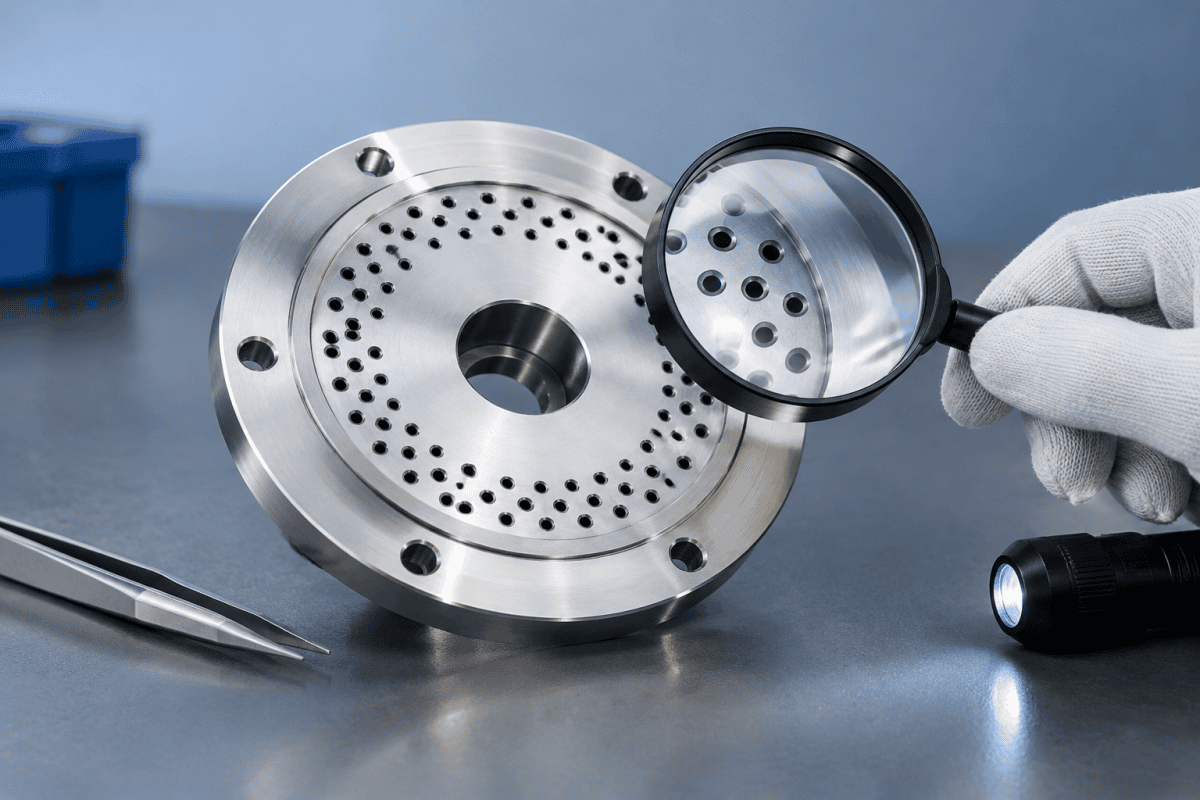
Okt
Panggantos OVD burner faceplate arang mung ganti parts. Faceplate—piring ngarep saka burner head, dibor karo orifice cilik sing mbentuk aliran gas sing nyedhiyakake flame deposisi—nyetel geometri sing nemtokake cara gas prekursor lan bahan bakar metu saka torch. Sawise bolongan kasebut erode, distorsi, utawa clogged, aliran soot sing mbangun preform owah, asring cukup bertahap nganti drift disalahake marang parameter proses tinimbang hardware. Artikel iki nyakup apa sing kudu diinspeksi, cara ngadili apa faceplate kudu diganti, lan informasi apa sing kudu disiapake nalika sumber sing anyar. Amarga faceplate minangka antarmuka mekanik pungkasan antarane pangiriman gas lan flame, nganggep panggantos OVD burner faceplate minangka owah-owahan consumable rutin tinimbang acara engineering sing dikontrol minangka kesalahan umum lan larang.
Apa sing Bener-bener Dilakoni Faceplate
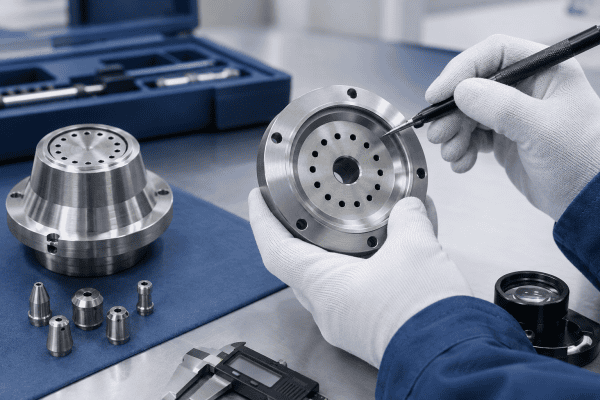
Ing proses outside vapor deposition (OVD), burner ngarahake flame menyang rod target sing muter. Sawetara saluran gas—biasane bahan bakar, oksigen, lan gas pembawa sing kebak uap prekursor—metu liwat faceplate lan kudu tetep stabil lan diposisikan kanthi bener relatif marang siji liyane. Faceplate minangka unsur mekanik pungkasan sing ndemek aliran kasebut sadurunge pembakaran lan deposisi.
Sing ndadekake geometri bolongan faceplate minangka variabel proses urutan pertama. Diameter bolongan, roundness, chamfer mlebu lan metu, jarak bolongan-kanggo-bolongan, lan orientasi sudut kabeh mengaruhi kecepatan gas lokal lan pencampuran. Penyimpangan cilik ing faceplate bisa nggeser profil flame, sing banjur mengaruhi efisiensi deposisi lan keseragaman awak soot sing tuwuh.
Iki uga tegese faceplate minangka bagean aus sing kahanane kudu dilacak kaya input proses liyane. Nalika tim ngrancang panggantos OVD burner faceplate, dheweke pancen mulihake sakumpulan kondisi wates geometris: area metu saben orifice, standoff saka target, lan orientasi aliran gas relatif marang siji liyane. Mulihake kondisi kasebut kanthi konsisten yaiku sing mbedakake panggantos sing dikontrol saka owah-owahan parts trial-and-error.
Napa Geometri Bolongan Drifts Sajrone Wektu
Siklus termal lan creep
Burner faceplate beroperasi ing lingkungan suhu dhuwur kanthi pemanasan lan pendinginan bola-bali sajrone siklus run. Gumantung saka materi lan desain, iki bisa ngasilake creep dimensi bertahap, warping, utawa owah-owahan cilik ing profil bolongan. Faceplate sing rata nalika anyar bisa ngalami distorsi sing cukup kanggo ngganti standoff antarane burner lan target.
Efek termal arang tumindak kanthi isolasi. Piring sing rada rata nalika dipasang bisa dadi visibly warped sawise cukup siklus, lan owah-owahan standoff sing diasilake ngowahi cara flame berinteraksi karo permukaan target. Iki minangka salah sawijining alasan interval panggantos OVD burner faceplate sing mung digandhengake karo jam layanan bisa ngliwati drift geometri awal sing wis mengaruhi deposisi.
Oksidasi lan mundhut materi
Sawetara materi faceplate ngoksidasi utawa erode ing suhu operasi. Mundhut materi ing pinggir bolongan nggedhekake utawa distorsi orifice, lan amarga efek kasebut ora seragam ing piring, pola outlet gas ilang simetri sing diduweni nalika anyar. Materi sing bener kanggo faceplate tartamtu gumantung marang fungsine, paparan suhu, lingkungan kimia, lan syarat engineering desain torch—ora mung ing kategori umum bagean kasebut.
Pamilihan materi mula dadi keputusan desain kanthi pengaruh langsung marang suwene faceplate njaga geometri. Nalika panggantos OVD burner faceplate direncanakake, mbandhingake materi asli karo lingkungan layanan sing nyata minangka bagean sing cukup saka review spesifikasi.
Akumulasi soot lan clogging
Silica soot lan produk sampingan reaksi bisa nglumpukake ing utawa ing njero bolongan faceplate. Penyumbatan parsial ngganti area orifice efektif, sing ngganti distribusi aliran tanpa owah-owahan ing setelan gas sing diwenehake. Iki minangka salah sawijining alasan paling umum burner wiwit tumindak beda nalika parameter gas sing mlebu katon ora owah. Pandhuan praktis babagan mode kegagalan iki dibahas ing artikel babagan pangopènan lan perpanjangan umur OVD lan VAD burner.
Inspeksi: Apa sing Kudu Dipriksa lan Cara Verifikasi
Inspeksi kudu misahake gejala sing diamati saka panyebab sing dikonfirmasi. Faceplate mung salah siji panjelasan sing bisa kanggo owah-owahan proses, lan ora kudu diganti mung amarga curiga nalika panyebab liya isih durung diilangi.
Urutan inspeksi sing migunani pindhah saka proses menyang njaba menyang bagean: pisanan dokumentasi gejala, banjur sempitake panyebab sing bisa, lan mung banjur mbongkar torch kanggo ndeleng langsung ing faceplate. Keputusan panggantos OVD burner faceplate luwih gampang dibela nalika adhedhasar bukti kaya ngono tinimbang mung firasat.
Miwiti saka gejala deposisi
Cathet apa sing bener-bener owah: tingkat deposisi soot, keseragaman diameter preform, penampilan flame, utawa profil indeks bias. Gejala kasebut nyempitake panelusuran. Penurunan alon ing tingkat deposisi bisa nuduhake keausan utawa clogging faceplate, nanging bisa uga ana hubungane karo pasokan gas, standoff torch, utawa rotasi target. Hubungan antarane penurunan tingkat deposisi lan kondisi burner dibahas ing artikel babagan napa flame OVD burner miring.
Penyimpangan profil indeks bias minangka gejala liya sing asring asale saka geometri tinimbang saka setelan gas. Nalika konsentrisitas utawa keselarasan aliran owah, lapisan sing diendapake bisa ilang simetri sing dibutuhake proses kasebut. Jalur kegagalan kasebut ditliti ing artikel babagan penyimpangan profil indeks bias ing OVD burners. Yen penyimpangan profil lan penurunan deposisi sing alon katon bebarengan, inspeksi faceplate kalebu ing ndhuwur dhaptar diagnostik.
Pemeriksaan visual lan dimensi
Kanthi burner dicopot lan digawe adhem miturut prosedur situs:
- Perbandhingan bolongan-bolongan—priksa saben orifice marang referensi sing wis dingerteni apik utawa gambar asli. Goleki pembesaran, ovalitas, burr, utawa pinggiran bunder sing ora cocog maneh karo profil sing ditemtokake.
- Kerataan lan warpage—priksa permukaan faceplate marang bidang referensi. Distorsi lokal ngganti standoff efektif antarane bolongan lan permukaan deposisi.
- Penyumbatan lan deposit—priksa bolongan kanthi pembesaran lan kanthi backlighting yen bisa. Deposit bisa katon ing entri, metu, utawa ing jero bore.
- Simetri pola bolongan—verify hole-to-hole spacing and alignment with the gas channel layout behind the plate. Pattern drift is easier to see by comparison than by absolute measurement.
- Sealing surfaces—check mating faces, gasket seats, and any locating features for wear, scoring, or distortion that could cause leakage or misalignment.
For dimensional measurement practices, the general guidance published by NIST on dimensional metrology is a useful reference for calibration and measurement uncertainty, which matters when the tolerance being judged is measured in micrometers.
Ngkonfirmasi apa faceplate minangka panyebabe
Where the process allows, the most reliable verification is substitution with a known-good faceplate, followed by a controlled run and comparison against baseline data. This converts a suspicion into evidence before committing to replacement. If symptoms persist after substitution, the faceplate was not the root cause, and attention should shift to gas delivery, torch position, or other components.
Timing matters here as well. If substitution restores baseline deposition, the case for a permanent OVD burner faceplate replacement is straightforward. If it does not, the investigation continues without spending a replacement cycle on the wrong component.
Nemtokake Antarane Reresik, Rekondisi, lan Panggantos
Not every contaminated faceplate needs replacement. Surface deposits that can be removed without altering hole geometry may be addressed through the cleaning procedure specified by the equipment documentation and approved by qualified personnel. Follow manufacturer guidance and your site’s safety rules for any cleaning operation—this article does not prescribe chemical or mechanical cleaning methods.
Replacement is the more appropriate path when:
- Hole geometry has measurably changed—enlargement, ovality, or profile deviation beyond the drawing tolerance.
- The faceplate is warped or distorted beyond acceptable flatness.
- Deposits have bonded or penetrated in a way that cannot be removed without damaging the orifice.
- Cleaning has already been attempted and the process symptom returns.
- Sealing or locating features are worn enough to affect alignment.
Where dimensional evidence is ambiguous, a dimensional report from a qualified inspection source is more useful than a judgment call at the machine. An OVD burner faceplate replacement performed on ambiguous evidence tends to be repeated sooner than one backed by measurement.
Apa sing Penting ing Faceplate Panggantos
The quality of an OVD burner faceplate replacement depends less on how the part is ordered than on how completely its geometry is specified. Three areas deserve attention before a purchase order is raised: the hole pattern, the material, and the interfaces that seat and seal the plate.
Geometri bolongan minangka spesifikasi
The defining requirement of a replacement is that the hole pattern matches the original drawing—diameter, tolerance, spacing, orientation, and edge condition. A faceplate that fits mechanically but differs in hole geometry is not an equivalent replacement. This is why drawing-based production and dimensional verification matter more here than broad dimensional similarity. Precision in nozzle and orifice features has a direct relationship to preform outcomes, as explored in the article on panggantian nozzle burner OVD custom.
It also explains why a faceplate should not be accepted on the basis of a visual match alone. Two plates can look identical and still differ in one chamfer angle or spacing dimension that governs local mixing. When an OVD burner faceplate replacement is specified, the drawing is the acceptance criterion, not the appearance of the part.
Pamilihan materi
Faceplate material should be selected against the actual service conditions: peak temperature, thermal cycling, exposure to process gases and reaction products, and mechanical requirements. Two burners with the same external dimensions may legitimately use different faceplate materials. Treat any recommendation as conditional on the specific application rather than as a general rule.
Material also interacts with replacement frequency. A plate that resists oxidation and retains flatness longer will extend the interval between services, which is often worth more than a marginal reduction in part cost. For context on how alloy choices have performed in demanding service, the case study on titanium OVD burner parts for a tier-one fiber manufacturer reviews one such upgrade.
Pas, alignment, lan sambungan gas
Mounting features, locating pins, gasket interfaces, and gas inlet geometry all affect how the faceplate seats and seals. A replacement should be checked against the burner body drawing, not just the faceplate outline. Gas connection details are frequently where substitution goes wrong, and they are examined in the article on OVD burner head replacement and gas connections.
Alignment features deserve the same scrutiny. A locating pin that no longer seats cleanly can rotate the plate slightly relative to the torch body, which shifts the entire stream pattern even though every individual hole is within tolerance. That is why an OVD burner faceplate replacement should include verification of how the plate registers against the body, not only how the holes measure on the bench.
Kesalahan Umum Sajrone Panggantos Faceplate
Most failed replacements share a small number of causes. Reviewing them before the job starts is cheaper than repeating the work.
- Replacing on symptom alone. A process shift without dimensional evidence may point somewhere other than the faceplate.
- Accepting mechanical fit as equivalence. A plate that bolts up correctly can still have the wrong hole pattern.
- Skipping the post-change baseline. Without a controlled run against baseline data, there is no way to confirm the replacement actually resolved the issue.
- Mixing parts across processes. OVD, VAD, and MCVD burners differ in design and operating conditions and components are not interchangeable without engineering review.
- Reusing worn sealing hardware. Gaskets and sealing faces that were acceptable on the old plate may not seal correctly on a new one.
Each of these mistakes turns a single OVD burner faceplate replacement into a sequence of replacements, and each one is avoidable with a short checklist and a drawing on the bench.
Nyiapake Panjalukan Sumber
A clear request shortens the path to a usable part. Include:
- The faceplate drawing, including hole pattern, tolerances, and edge specifications.
- Material specification and any surface or hardness requirements.
- Photos of the existing part, including any wear or damage.
- Burner model or torch assembly identification, with the caveat that compatibility must be verified against drawings rather than assumed from a model name.
- Operating conditions relevant to material selection—temperature range, gas environment, and cycling pattern.
- Quantity and any inspection documentation required.
Where drawings are unavailable or incomplete, reverse engineering from a physical sample is a practical route. Custom faceplates and other non-standard components can be produced through OEM and ODM machining services based on supplied drawings, dimensions, and material requirements.
For standard replacement options across burner and torch assemblies, the Spare part obor OVD range includes burner heads, nozzle components, and related consumables, and specific configurations are listed under OVD auxiliary tail burner lan oxygen distribution manifold. Note that OVD, VAD, and MCVD burners differ in design and operating conditions; components are not interchangeable across these processes without engineering review.
Pitakonan sing Sering Ditakoni
Sepira kerep OVD burner faceplate kudu diinspeksi?
Inspection frequency depends on duty cycle, process sensitivity, and how quickly the burner environment degrades the faceplate. Rather than a fixed interval, tie inspection to process monitoring: when deposition rate, flame stability, or profile uniformity drifts beyond your control limits, add a faceplate inspection to the diagnostic sequence.
Apa faceplate sing clogged bisa diresiki tinimbang diganti?
Sometimes, if the deposit is surface-level and can be removed without changing hole geometry. If cleaning alters the orifice edge, enlarges the hole, or if the symptom returns quickly, replacement is the more reliable option. Cleaning methods should follow equipment documentation and qualified personnel guidance.
Apa dimensi paling penting sing kudu dipriksa ing faceplate panggantos?
Hole geometry—diameter, tolerance, spacing, and edge condition—because it directly governs gas distribution. Flatness and mounting alignment come next, since they affect seating and standoff. Mechanical fit alone does not confirm a faceplate is equivalent.
Apa faceplate saka siji model burner bisa digunakake ing model liyane?
Not without verification. Compatibility must be confirmed against drawings, dimensions, gas connections, materials, and application requirements. Model names alone are not sufficient evidence of interchangeability.
Dokumentasi apa sing kudu dilampirake karo panggantos OVD burner faceplate?
At minimum, a dimensional report covering hole geometry and flatness, plus material certification where the application requires it. Records of the pre-change symptom and the post-change baseline run are equally useful, because they establish whether the replacement achieved its purpose and give the next inspection a reference point.
Langkah Sabanjure
If you are evaluating an OVD burner faceplate replacement, the fastest route to a correct part is a complete data package. Send the faceplate drawing, material requirements, photos of the current part, and the relevant operating conditions to request a quotation. Where drawings are missing or incomplete, note that in your inquiry so the reverse engineering route can be assessed alongside standard replacement options. A complete package also makes it easier to confirm that the replacement you receive matches the geometry your process was built around, which is ultimately the point of planning an OVD burner faceplate replacement carefully in the first place.
