
Wissen
OVD-Brenner-Gasverteilungsringe: Konzentrizität und Inspektion
Okt.
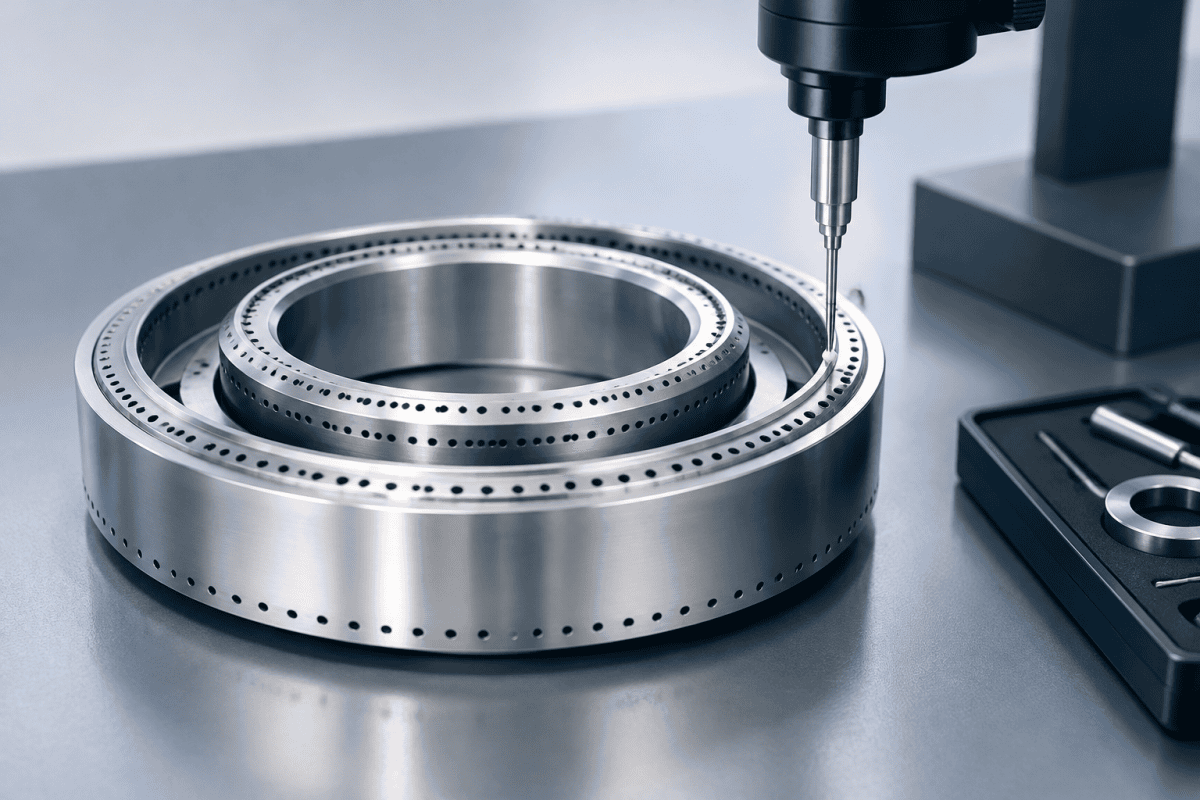
OVD-Brenner-Gasverteilungsringe gehören zu den am wenigsten sichtbaren Komponenten in einem OVD-Abscheidungssystem, dennoch beeinflussen sie maßgeblich, wie Reaktant- und Brenngase die Brennerstirnfläche verlassen. Für Ingenieure und Instandhaltungsteams, die an optischen Faser-Vorformanlagen arbeiten, ist das Verständnis dessen, was OVD-Brenner-Gasverteilungsringe bewirken, wie Konzentrizität die Leistung beeinflusst und wie sie inspiziert werden, wesentlich für eine stabile Rußabscheidung. Dieser Artikel behandelt die Funktion von OVD-Brenner-Gasverteilungsringen, häufige Anzeichen von Verschleiß oder Fehlausrichtung, praktische Inspektionsschritte und die Informationen, die bei der Beschaffung von Ersatz-OVD-Brenner-Gasverteilungsringen oder kundenspezifisch gefertigten Alternativen benötigt werden.
Was Gasverteilungsringe in einem OVD-Brenner bewirken
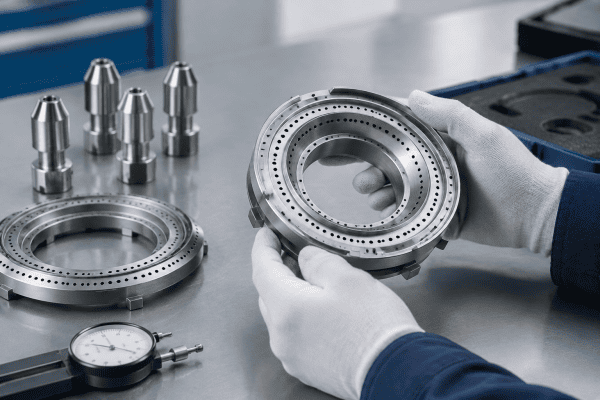
OVD-Brenner-Gasverteilungsringe sitzen innerhalb der Brennerbaugruppe und tragen dazu bei, die Zufuhr von Prozessgasen zum Düsenarray und zur Stirnplatte zu steuern. Je nach Brennerdesign können diese Ringe dienen als:
- Strömungslenkende Elemente die Gas von Versorgungskanälen zu einzelnen Düsenöffnungen führen
- Dichtungsflächen die benachbarte Gaskreisläufe trennen, damit Brennstoff-, Sauerstoff- und Precursorströme nicht vorzeitig vermischt werden
- Abstands- oder Ausrichtungskomponenten die die relative Position innerer Kanäle und der Stirnplatte aufrechterhalten
- Plenum- oder Verteilerkomponenten die eine gleichmäßigere Verteilung über ein Mehrdüsenmuster fördern
Der Begriff “Gasverteilungskomponenten” umfasst eine Reihe von Teilen, und nicht jeder OVD-Brenner verwendet dieselbe interne Architektur. Einige Designs stützen sich auf einen einzelnen Ring, während andere gestapelte Ringe oder Ring-und-Einsatz-Kombinationen verwenden. Das bedeutet, dass OVD-Brenner-Gasverteilungsringe stets anhand der spezifischen Brennerzeichnung bewertet werden sollten und nicht anhand einer allgemeinen Kategoriebeschreibung.
Da diese Ringe die Strömungssymmetrie beeinflussen, können sich kleine geometrische Abweichungen in ungleichmäßigen Flammeneigenschaften niederschlagen. Konzentrische OVD-Brenner-Gasverteilungsringe — Ringe, deren Innen- und Außendurchmesser einen gemeinsamen Mittelpunkt teilen und deren Oberflächen innerhalb der Spezifikation senkrecht zur Brennerachse bleiben — tragen dazu bei, die Gaswege um den Umfang herum ausgeglichen zu halten. Wenn die Konzentrizität driftet, kann sich der Effekt allmählich zeigen statt als offensichtlicher Ausfall.
Warum Konzentrizität wichtig ist
Konzentrizität bezieht sich in diesem Zusammenhang darauf, wie genau die Mittellinien der inneren und äußeren Merkmale eines OVD-Brenner-Gasverteilungsrings mit der Brennerachse und miteinander ausgerichtet sind. Ein Ring, der außermittig, unrund oder nicht flach aufliegend ist, kann lokale Unterschiede im Strömungswiderstand erzeugen.
Diese Unterschiede können beeinflussen:
- Flammensymmetrie — ungleichmäßige Gaszufuhr kann dazu führen, dass die Flammenhülle neigt oder um die Brennerstirnfläche variiert
- Gleichmäßigkeit der Rußabscheidung — ein verzerrtes Strömungsfeld kann beeinflussen, wo Silicapartikel auf der wachsenden Vorform auftreffen
- Wärmeverteilung — asymmetrische Erwärmung kann die Abscheidungseffizienz und die Oberflächenqualität der Vorform beeinträchtigen
- Ablagerungsstabilität über die Zeit — kleine Ungleichgewichte können sich im Verlauf eines Durchlaufs verstärken
Es ist wichtig, diese als potenzielle Effekte zu betrachten und nicht als garantierte Ergebnisse. Ein einzelner außermittiger OVD-Brenner-Gasverteilungsring ist nicht automatisch die Grundursache eines Abscheidungsproblems; er ist eine Variable unter vielen. Der praktische Wert der Konzentrizitätsinspektion besteht darin, dass sie die Liste der Verdächtigen eingrenzt, wenn die Leistung driftet. Leser, die sich mit profilbezogenen Problemen befassen, finden möglicherweise auch nützlichen Kontext in diesem Artikel über Brechungsindexprofil-Drift und Brennerkonzentrizität, der diskutiert, wie geometrische Faktoren mit dem Abscheidungsverhalten interagieren.
Häufige Ursachen für den Verlust der Ringkonzentrizität
Verteilungsringe verlieren im Allgemeinen aus einigen wiederkehrenden Gründen ihre Konzentrizität. Das Verständnis dieser Gründe hilft Instandhaltungsteams zu entscheiden, ob ein OVD-Brenner-Gasverteilungsring neu gesetzt, nachbearbeitet oder ersetzt werden soll.
Thermische Wechselbeanspruchung und Verformung
Burner internals experience repeated heating and cooling. Over many cycles, differential expansion between OVD burner gas distribution rings and surrounding hardware can cause slight warping or relaxation of fits. This is a gradual process, and its severity depends on the material, the torch design, and actual operating conditions.
Mechanische Beschädigung bei Handhabung oder Reinigung
Cleaning operations are a common source of unintended damage. Prying an OVD burner gas distribution ring free, using abrasive tools, or dropping a component can introduce nicks, burrs, or bending that shift the centerline. Even small dents on a sealing surface can prevent the ring from seating flat.
Ablagerungsbildung und Verstopfung
Silica soot and process byproducts can accumulate in gas passages and around ring edges. Build-up that is uneven around the circumference can effectively change the flow geometry. Readers dealing with this pattern may benefit from the discussion in preventing cleanroom downtime through OVD/VAD burner maintenance, since faceplate and ring contamination often occur together.
Verschleiß an Positionierungsmerkmalen
Pins, shoulders, and counterbores that position an OVD burner gas distribution ring can wear over time. Once a locating feature is worn, the ring may shift slightly under gas pressure, and the resulting position may not be repeatable from one assembly to the next.
Inspektionsüberlegungen für OVD-Brenner-Gasverteilungsringe
Inspection should combine visual examination, dimensional checks, and — where possible — functional verification. The following sequence is practical for most maintenance environments.
Den Vorgefundenen Zustand dokumentieren
Before cleaning or disassembly, record the ring’s orientation and any visible deposits. Photographs and notes help determine whether a problem is recurring. If OVD burner gas distribution rings have been reinstalled multiple times with the same orientation, mark them so the pattern can be tracked.
Reinigen ohne die Geometrie zu verändern
Use methods recommended in the equipment documentation. Avoid abrasive media or sharp tools on sealing faces and locating diameters. If deposits are stubborn, follow the manufacturer’s or site’s approved cleaning procedure rather than improvising. When in doubt, consult qualified personnel before using any chemical or mechanical cleaning method.
Ebenheit und Auflage prüfen
Place the OVD burner gas distribution ring on a known-flat surface such as a surface plate or a verified reference face. Look for rocking, visible gaps, or light leakage under the ring. A ring that does not sit flat will not maintain concentricity when clamped.
Innen- und Außendurchmesser messen
Use calipers or micrometers appropriate to the tolerance. Measure at multiple points around the circumference to detect out-of-roundness. Record the maximum and minimum readings rather than a single value; the difference is often more informative than the absolute dimension.
Konzentrizität direkt bewerten wo möglich
If the OVD burner gas distribution ring has a bore and an outer locating diameter, measure the wall thickness at several points. Consistent wall thickness around the circumference is a practical indicator of concentricity. For tighter requirements, a dial indicator on a rotating fixture or a coordinate measuring machine can quantify runout.
Positionierungsmerkmale und Passflächen inspizieren
Check pins, shoulders, and counterbores for wear, burrs, or corrosion. Verify that the surfaces OVD burner gas distribution rings register against are clean and undamaged. In many cases, a concentricity problem originates in the housing rather than the ring itself.
Einbauposition nach der Installation verifizieren
After re-assembly, confirm that the ring is fully seated and that any fasteners are tightened in the specified pattern and to the specified values. If the torch design allows, check runout of the installed OVD burner gas distribution ring relative to the burner axis. Re-checking after a short operating interval can reveal movement that was not apparent on the bench.
Befunde interpretieren: Ursachen vs. bestätigte Diagnosen
It is easy to attribute a deposition problem to OVD burner gas distribution rings when the actual cause lies elsewhere. The table below separates common observations from the verification steps needed to confirm each one.
- Observation: Flame appears asymmetric. Mögliche Ursache: ring concentricity loss. Verification: inspect ring seating and runout, and check for passage blockages. Also consider nozzle condition and gas supply balance before concluding the ring is at fault.
- Observation: Soot deposition varies around the preform. Mögliche Ursache: uneven gas distribution. Verification: confirm ring and faceplate condition, then review flow settings against documentation. Multiple variables can produce this symptom.
- Observation: Ring does not seat flat. Mögliche Ursache: warping, burrs, or damaged housing. Verification: check the ring on a reference surface, then inspect the mating feature in the torch body.
- Observation: Repeatability issues after re-assembly. Mögliche Ursache: worn locating features. Verification: measure pin and bore wear, and compare assembly position across multiple builds.
Only after verification should an OVD burner gas distribution ring be replaced or re-machined. Replacing a component that is within specification may mask the real issue temporarily while leaving the underlying cause unaddressed.
Material- und Designfaktoren bei der Beschaffung von Ersatzteilen
Material selection for OVD burner gas distribution rings depends on the component’s function, temperature exposure, chemical environment, and the engineering requirements of the torch. Common considerations include:
- Thermal stability — the ring must maintain geometry across the operating temperature range of the torch
- Corrosion and oxidation resistance — relevant where process gases or cleaning agents are aggressive
- Bearbeitbarkeit und Oberflächengüte — sealing faces and flow passages often require specific finishes
- Compatibility with mating materials — differences in expansion or hardness can affect fit and wear
Do not assume a material is suitable simply because it appears in a similar application. One OVD burner gas distribution ring may see very different conditions than another used elsewhere in the same torch. Where aluminum components are relevant to a specific OVD application, they are covered separately in the range of aluminum OVD parts; suitability still depends on the actual operating environment and design intent.
For non-standard rings or legacy torch designs, drawing-based manufacturing is often the most reliable route. Providing a complete drawing — including dimensions, tolerances, surface finish, material specification, and any heat treatment or coating requirements — allows a supplier to evaluate feasibility and propose a suitable manufacturing approach. OVDParts offers OEM/ODM machining services for custom optical fiber equipment parts, including reverse engineering when original drawings are unavailable. In those cases, a physical sample plus key measurements can support the process, though the resulting OVD burner gas distribution ring should always be verified against the application requirements.
For broader guidance on matching burner geometry, materials, and gas connections to an existing torch, the overview of OVD-Brennerkopf-Ersatz provides useful context on how individual components must align with the assembly as a whole.
Informationen, die vor der Angebotsanfrage vorzubereiten sind
A clear sourcing request reduces back-and-forth and helps ensure the delivered OVD burner gas distribution ring matches the application. Useful items to prepare include:
- Drawings or sketches with dimensions and tolerances
- Material specification, or the operating conditions that drive material choice
- Surface finish and flatness requirements for sealing faces
- Quantity needed and whether the requirement is one-time or recurring
- Any known constraints, such as mating hardware dimensions or installation clearance
- Photos of the existing component, including any wear or damage
If the original OVD burner gas distribution ring is no longer available, note which dimensions are critical to function and which have flexibility. This distinction helps a machinist prioritize tolerances that affect concentricity and sealing.
Normen und Referenzmaterial für Brennerkomponenten
When specifying tolerances for sealing faces, flatness, or surface finish, referencing recognized dimensional and geometric standards helps both the requester and the machinist share the same expectations. For example, the ISO 1101 specification for geometrical product specifications (GPS) — geometrical tolerancing provides a common vocabulary for form, orientation, and location tolerances, which are exactly the characteristics that govern whether OVD burner gas distribution rings will seat and center correctly inside a torch body.
Standards alone do not replace the original torch drawing, but they provide a neutral reference when the drawing is incomplete, when reverse engineering is required, or when a supplier and an end user need to agree on how a concentricity or flatness requirement will be measured. Weld quality and material documentation for welded assemblies are also commonly covered by references such as ISO 13920 on general tolerances for welded constructions, which can be relevant when a ring is part of a fabricated or repaired assembly.
Where inspection is carried out in-house, documenting which standard or method was used to verify a given OVD burner gas distribution ring makes the records far more useful during a later failure investigation. A dimensional result without a stated method is difficult to compare against a supplier’s data sheet.
Häufig gestellte Fragen
Können OVD-Brenner-Gasverteilungsringe nachbearbeitet werden anstatt ersetzt zu werden?
In some cases, light re-machining of a seating face may restore flatness, provided the operation stays within the drawing’s dimensional limits and does not compromise the sealing function. Whether this is acceptable depends on the specific OVD burner gas distribution ring, the amount of material available, and the engineering requirements. Consult the equipment documentation and qualified personnel before committing to re-machining.
Wie oft sollten Verteilungsringe inspiziert werden?
Inspection frequency for OVD burner gas distribution rings depends on the torch design, operating conditions, and maintenance history. Many facilities include ring inspection in scheduled burner maintenance rather than on a fixed interval. Any event that involves disassembly, cleaning, or a change in deposition behavior is a reasonable trigger for inspection.
Sind Gasverteilungsringe zwischen OVD-Brennermodellen austauschbar?
Not automatically. OVD burner gas distribution rings differ in diameter, thickness, passage geometry, material, and locating features. Interchangeability must be verified against drawings, dimensions, gas connections, and application requirements. Do not assume compatibility based on a shared product category or equipment brand.
Was ist das häufigste Anzeichen dafür, dass ein Ring Aufmerksamkeit benötigt?
Difficulty seating the OVD burner gas distribution ring flat, visible warping, uneven wall thickness, or a change in deposition uniformity after re-assembly are common indicators. Because these symptoms can have other causes, they should be confirmed through measurement and inspection rather than assumed.
Wie hängt die Brennerdüsenpräzision mit Gasverteilungsringen zusammen?
Both influence the flow field at the burner face. OVD burner gas distribution rings control how gas is fed to the nozzle array, while nozzle geometry controls how it exits. Precision in one cannot fully compensate for wear in the other, which is why burner nozzle precision and optical fiber preform yield are usually reviewed together with ring condition during troubleshooting.
Best Practices für langfristige Ringleistung
Concentricity is easier to preserve than to restore. A few practical habits reduce the likelihood that OVD burner gas distribution rings will drift out of tolerance between scheduled maintenance events.
- Handle rings as precision parts. Store them in protective packaging or dedicated trays, and avoid stacking components loosely, since a bumped sealing edge is often enough to cause a seating problem.
- Keep spares on hand. Having a verified spare OVD burner gas distribution ring available reduces the temptation to reinstall a suspect part just to keep a run going.
- Track orientation and history. A simple log of installation date, orientation, and observed condition makes it much easier to spot a pattern.
- Re-verify after every re-assembly. Even a ring that measured perfectly on the bench can shift once fasteners are torqued, so installed-position checks matter.
- Review gas supply and cleaning records together. Many apparent ring problems are actually flow or contamination problems that show up first at the ring.
These practices do not eliminate wear, but they make the condition of OVD burner gas distribution rings far more predictable, which in turn makes preform yield more predictable.
Nächster Schritt
If you are evaluating replacement OVD burner gas distribution rings or need a custom-machined component for a non-standard torch, having the right information ready speeds up the process. Send your drawings, dimensions, material requirements, and operating conditions to request a quotation, and the team can review the application and discuss suitable manufacturing options for your OVD burner gas distribution rings.
