
Knowledge
MCVD Rotary Seal Replacement for Quartz Lathe Gas Joints
Nov
When an MCVD lathe starts leaking at the gas feed end, the symptom is often reported as a “seal problem,” but the actual cause may be wear on a rotary union, a scored shaft, thermal distortion of a gas joint, or a mismatch between the seal material and the process gas. MCVD rotary seal replacement is a maintenance task that sits at the intersection of mechanical precision, gas containment, and high-temperature operation—and treating it as a simple O-ring swap is one of the most common reasons for repeat failures.
This article covers how engineers and maintenance teams can evaluate a quartz lathe gas joint, plan an MCVD rotary seal replacement, verify the causes of leakage, and specify rotary union spares accurately enough for a supplier to quote the right part.
What a Quartz Lathe Gas Joint Does
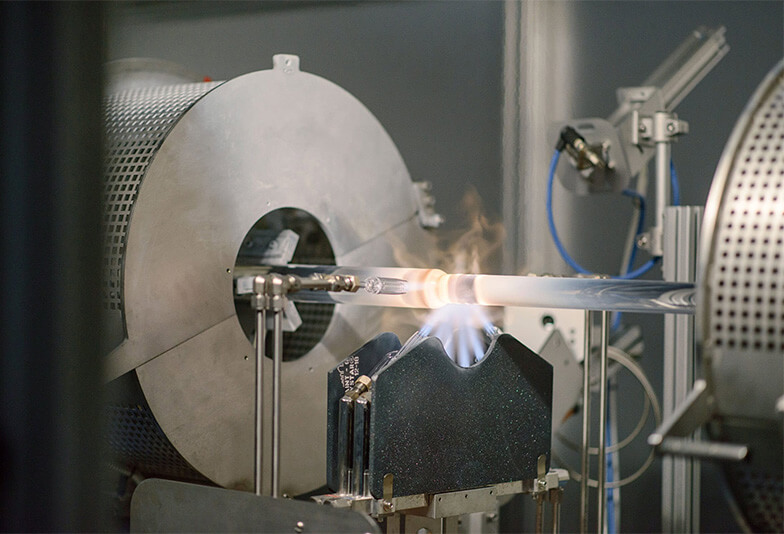
In MCVD (Modified Chemical Vapor Deposition), a quartz glass tube is mounted in a glassworking lathe that rotates it while a burner traverses beneath it. Process gases—typically chlorides such as SiCl₄, GeCl₄, and POCl₃, carried with oxygen—must enter the rotating tube through a stationary gas supply. The component that bridges that stationary-to-rotating interface is the quartz lathe gas joint, frequently built around a rotary union or rotary seal assembly.
Its job is deceptively simple in description and demanding in practice: contain chlorides and oxygen without leakage, allow continuous rotation, tolerate the heat radiating from the adjacent hot zone, and avoid introducing particulate or elastomer debris into the gas stream. Any contamination that reaches the deposition zone can end up as a defect in the preform.
The rotary seal itself is only one part of this interface. A gas joint typically includes a rotating shaft or journal, one or more seal elements, face or radial sealing surfaces, bearing or bushing support, gas inlet ports, and a mounting flange that aligns to the lathe axis. Failures attributed to “the seal” are often failures of the assembly as a whole.
Understanding where the seal sits within the assembly is critical for planning a successful MCVD rotary seal replacement, because the replacement procedure must respect the alignment and surface finish requirements of every mating component.
Common Failure Modes in MCVD Rotary Seals
Before ordering replacement parts, it is worth identifying which failure mode you are actually seeing. Each one leads to a different corrective action, and several can present with the same external symptom of gas leakage or unstable flow. An MCVD rotary seal replacement based on the wrong failure mode simply resets the clock on the same problem.
Seal face wear and abrasion
Mechanical seals rely on controlled contact between two faces. If the faces run dry, see particulate contamination, or lose the spring or bellows force that keeps them engaged, they wear quickly. Abrasive particles—including fine silica dust from nearby glassworking—accelerate this. Verification: disassemble the union and inspect the seal faces for scoring, chipping, or a visible wear track. A face that shows uniform light contact is normal; a face with radial scratches points to contamination ingress and may require a full MCVD rotary seal replacement rather than a simple re-lapping.
Thermal degradation of elastomer components
MCVD lathes place the gas joint close to a hot zone, and radiant heat can raise the local temperature beyond what standard elastomers tolerate. An O-ring or gasket that has hardened, cracked, or taken a permanent set has failed from heat, not from pressure. Verification: check for loss of elasticity and a glazed or cracked surface. If the same seal position fails repeatedly at short intervals, thermal exposure or insufficient shielding is a likely contributor—confirm against your equipment and process documentation before changing any thermal management.
Shaft or journal scoring
The rotating shaft surface is the sealing counterface in many radial seal designs. Once it is grooved or scored, a new seal cannot conform to it and will leak again shortly after installation. This is one of the most common reasons a “new seal still leaks.” Verification: measure the shaft surface finish and diameter at the seal contact band; visible grooves or measurable diameter loss indicate the shaft needs rework or replacement, not just a new seal. In this case, plan for a more extensive MCVD rotary seal replacement that addresses both the seal and the shaft.
Misalignment and runout
If the gas joint is not concentric with the lathe axis, the seal is forced to follow an orbital path, which causes uneven wear and leakage. Misalignment can come from a worn coupling, a bent shaft, or an improperly seated mounting flange. Verification: indicate the rotating assembly and check runout against the lathe manufacturer’s specification. Correcting alignment before MCVD rotary seal replacement will greatly extend the new seal’s life.
Chemical attack on seal materials
Chloride precursors and their reaction byproducts are aggressive toward many common elastomers. A seal that swells, softens, or crumbles rather than wearing smoothly has likely been attacked chemically. Verification: match the visible damage pattern to the material’s known compatibility, and confirm the correct seal compound against equipment documentation and your process gas list. Selecting the right compound is a key specification step in any MCVD rotary seal replacement.
Planning an MCVD Rotary Seal Replacement
A replacement that lasts begins before disassembly. The following sequence helps avoid the two most common outcomes: damaging a sealing surface during removal, and installing a part that fits geometrically but not functionally. Every successful MCVD rotary seal replacement follows a similar logic.
- Identify the assembly, not just the seal. Record the rotary union make, model if legible, shaft dimensions, seal cross-section, gas port sizes and threads, and mounting flange pattern. If the assembly is custom or the markings are gone, this becomes a reverse-engineering task rather than a catalog lookup.
- Capture dimensions before cleaning. Worn parts can still be measured for the original interface dimensions. Photograph seal cross-sections, note spring or bellows configuration, and record the installed position of each component.
- Confirm the seal material against the process environment. Material suitability depends on the specific gases, byproducts, temperature at the seal location, and required service interval—not on the part category. Where hot chlorides are present, material selection often narrows to a small set of options, and that decision should be made with the equipment documentation and a qualified materials engineer.
- Inspect and prepare the counterface. Clean the shaft, check for scoring, and verify runout. Installing a new seal against a damaged counterface wastes the replacement.
- Verify concentricity on reassembly. Re-check runout after mounting. Seal leakage that appears only at certain rotational speeds usually points to alignment rather than seal condition.
- Leak-check and monitor before returning to production. Use the leak-test procedure defined for your equipment. Do not introduce process gases until the mechanical assembly has passed verification.
If the union has a multi-channel design or shares an interface with a burner or deposition assembly, confirm that the MCVD rotary seal replacement does not disturb channel alignment or gas distribution geometry. Component references are covered in the guide to optical fiber preform equipment parts.
Selecting and Sourcing MCVD Rotary Union Spares
Rotary union spares for MCVD lathes are rarely a generic catalog item. Availability varies by lathe generation, manufacturer, and whether the joint was originally custom-built. Purchasing teams generally face one of three situations:
- Standard replacement available. A like-for-like seal or union is available with known dimensions. The task is verification: confirm dimensions, material, and gas compatibility before ordering.
- Partial replacement. The seal is available but the shaft or housing is worn. Both must be addressed or the repair will not hold, and the MCVD rotary seal replacement will remain incomplete.
- Custom or obsolete assembly. No drawing exists, or the original supplier no longer supports the part. This requires reverse engineering from the existing component, often leading to a bespoke MCVD rotary seal replacement solution.
For the third case, a supplier experienced in custom optical fiber equipment parts can work from the removed assembly—plus measured dimensions, material requirements, and operating conditions—to produce a replacement. The critical inputs are the same as for any precision component: shaft diameter and tolerance, seal groove dimensions, face flatness requirements, gas port thread standards, flange geometry, and the temperature and chemical exposure at the joint.
Because seal performance depends on the interaction between the seal, the counterface, and the operating environment, any quotation should be based on measured or supplied data rather than an assumption that two unions with similar external dimensions are interchangeable. Do not assume a part is compatible with a specific lathe brand or model—including Nextrom—until drawings, dimensions, gas connections, materials, and application requirements have been verified against the equipment. This verification step is central to a reliable MCVD rotary seal replacement.
Readers sourcing across a broader set of components may find it useful to review how seal assemblies, burner components, and gas distribution hardware are typically categorized. For issues that trace back to gas flow rather than the seal itself, the article on pressure balancing and gas flow dynamics in multi-channel torches explains how upstream restrictions and channel imbalance can mimic a leaking joint.
Questions to include in a sourcing request
- What is the equipment and gas joint identification, and is a drawing available?
- What are the shaft diameter, seal cross-section, and sealing face dimensions (measured if no drawing exists)?
- What gases and byproducts contact the seal, and at what temperature range?
- What is the mounting flange pattern and gas port thread specification?
- Is a complete union required, or individual seal and wear components?
- What inspection criteria apply—surface finish, runout, face flatness, leak rate?
- What documentation is required with the part (dimensional report, material certificate)?
When the Leak Is Not the Seal
Before assuming a seal failure, rule out two adjacent causes. First, a gas joint leak can originate at a static connection—a port fitting, flange gasket, or tubing joint near the union—rather than the dynamic seal. Pressure-test or leak-check individual joints to isolate the source. Second, symptoms that look like leakage—unstable flow, fluctuating deposition—can come from downstream restriction or channel imbalance. A diagnostic article on why soot deposition rate drops describes how deposition behavior changes with flow and thermal conditions, which can help distinguish a gas supply problem from a seal problem.
In both cases, the verification step is the same: isolate and test one interface at a time rather than replacing parts by assumption. Rushing to an MCVD rotary seal replacement without this isolation can waste time and parts.
Frequently Asked Questions
How do I know whether to replace just the seal or the whole rotary union?
Inspect the counterface first. If the shaft or sealing face is scored, out of round, or measurably worn, a new seal alone will not restore sealing. If all contact surfaces are within specification and only the seal element shows wear or hardening, a seal-only MCVD rotary seal replacement is reasonable. When in doubt, measure rather than judge visually.
Can I substitute a different seal material to extend service life?
Only after confirming compatibility with the actual process gases, byproducts, and local temperature. A material that performs well in one position may degrade in another. Seal compound selection should be based on the specific exposure conditions, and changes should be reviewed with a qualified engineer before installation to ensure the MCVD rotary seal replacement achieves its intended service life.
Why does a newly installed rotary seal leak again within a short time?
The most frequent causes are a damaged or worn counterface, misalignment or excess runout, incorrect seal installation (reversed or pinched), or a material that is chemically or thermally unsuitable for the location. Each cause has a distinct inspection signature, so examine the failed seal and the shaft before ordering another MCVD rotary seal replacement.
What information is needed to have a replacement gas joint custom-machined?
Measured dimensions of the existing assembly, seal groove and face geometry, shaft diameter and tolerance, gas port specifications, mounting flange pattern, and the temperature and chemical exposure at the joint. If a drawing exists, supply it; if not, the removed part plus dimensional measurements is usually sufficient to begin. A custom nozzle and gas joint sourcing reference shows how this data is usually structured.
Next Step
If your MCVD lathe gas joint requires a replacement seal, a reworked shaft, or a complete custom union, the fastest path to an accurate quotation is to send drawings, measured dimensions, material requirements, gas connections, and operating conditions. You can discuss your component requirements with the team and receive a response based on the actual interface data rather than a generic part match. Planning the MCVD rotary seal replacement around verified data is what separates a one-time repair from a recurring maintenance cost.
Additional Resources
For more detailed guidance on related components, you may find these articles helpful:
- SG Controls MCVD Lathe Spare Parts: Custom Machined Holders and Carriage
- SG Controls MCVD Burner Replacement with Drawing and Mounting Verification
- Nextrom MCVD Heating Burner Components: Custom Replacement Evaluation
- OVD VAD MCVD Burner Parts: Which Components Need Separate Specifications
