
Знание
Установочные фланцы горелок для заготовок и заказные переходники горелок для оборудования для изготовления заготовок оптического волокна: полное руководство по закупке и обслуживанию
Окт
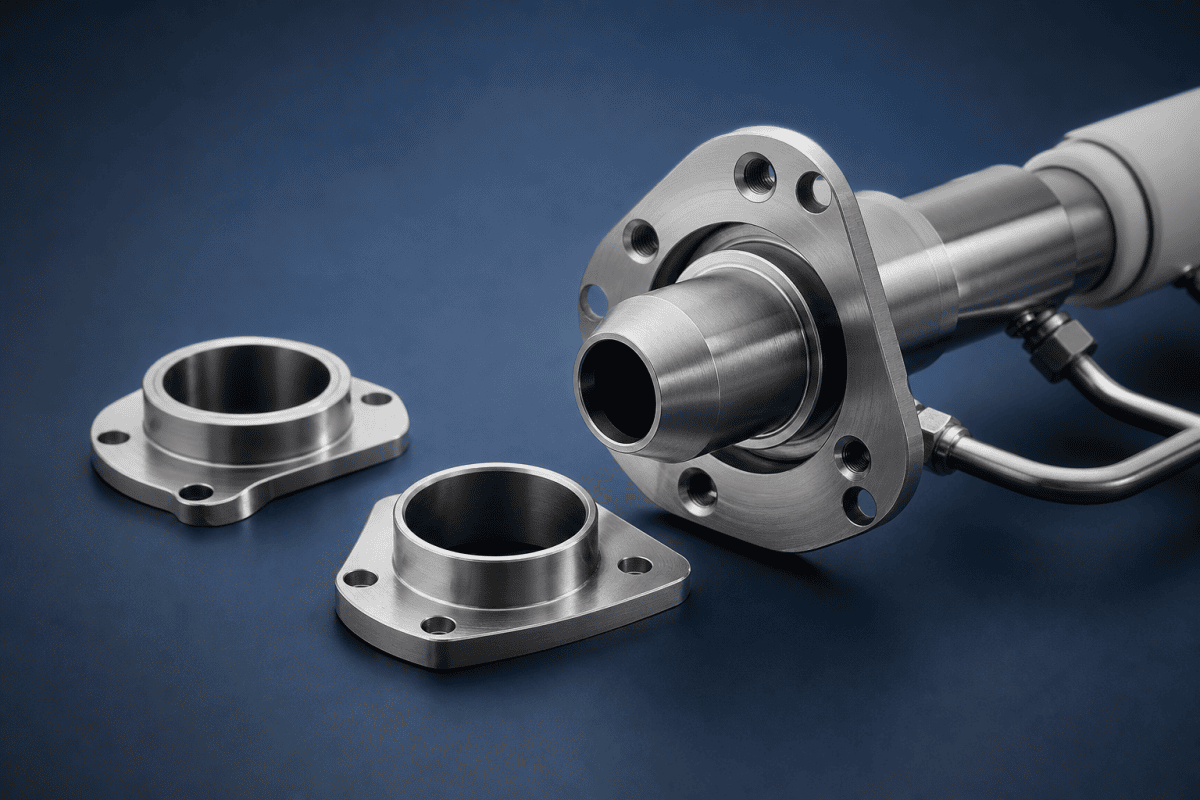
Установочные фланцы горелок для заготовок и заказные переходники горелок находятся на стыке между узлом горелки и кареткой станка, и часто оказываются последними компонентами, которые инженеры проверяют при ухудшении качества осаждения. Поскольку они не контактируют напрямую с сажей или стеклом, предполагается, что они сохраняют размерную стабильность. На практике установочный фланец горелки для заготовок, который деформировался, подвергся коррозии или был отрегулирован прокладками для установки сменной горелки, может сместить ось горелки на доли миллиметра — этого достаточно, чтобы нарушить геометрию пламени, осаждение на заготовку и результирующий профиль показателя преломления. В этой статье объясняется, что эти установочные детали оборудования для оптического волокна делают, как следует осматривать установочные фланцы горелок для заготовок и как точно задавать сменные детали или заказные переходники горелок для систем OVD, VAD и MCVD.
Что на самом деле делает установочный фланец горелки для заготовок
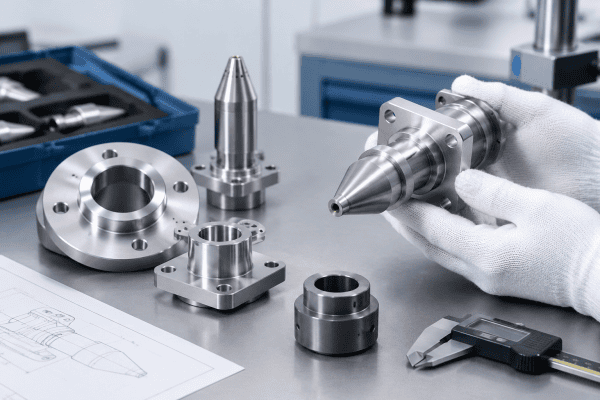
Установочный фланец горелки для заготовок — это механический кронштейн, который удерживает горелку или корпус горелки в фиксированном, повторяемом положении относительно заготовки. В зависимости от конструкции станка он может крепиться болтами к плите каретки, зажиматься на узле линейной направляющей или базироваться по обработанной установочной поверхности. Его задача — не просто удерживать вес. Правильно спроектированный установочный фланец горелки для заготовок должен:
- Поддерживать расстояние от горелки до заготовки и угловое совмещение в течение термоциклов
- Противостоять вибрации от перемещения каретки без ослабления или ползучести
- Обеспечивать герметичный или направляемый тракт для линий подачи газа и охлаждающих соединений, где применимо
- Позволять снимать и переустанавливать горелку без потери заданного положения
Поскольку скорость осаждения и форма пламени чувствительны к расстоянию выноса и наклону, состояние фланца является переменной процесса, а не просто элементом обслуживания. Установочный фланец горелки для заготовок, который был повторно обработан без документированного чертежа или накопил прокладки во время замены горелки, изменяет геометрию, на которой был квалифицирован процесс. Для получения информации о том, как это влияет на осаждение, см. обсуждение точности сопла горелки и выхода заготовок.
Режимы отказа установочных фланцев, которые стоит проверять
Установочные фланцы горелок для заготовок редко отказывают катастрофически. Они деградируют способами, которые легко упустить во время окна обслуживания. Когда однородность осаждения или контроль профиля становятся нестабильными, проверьте следующее, прежде чем винить саму горелку.
Термическая деформация и ползучесть
Повторяющиеся циклы нагрева и охлаждения могут снять остаточные напряжения в установочном фланце горелки для заготовок, особенно если он тонкий, переограничен крепежом или установлен без учета дифференциального расширения. Деформация может проявляться как изменение наклона горелки, а не как очевидный изгиб. Наклон, появляющийся постепенно в течение недель, является типичным симптомом ползучести, а не ошибки установки. Диагностический подход к наклону пламени горелки полезен здесь, поскольку он отделяет наклон, связанный с фланцем, от износа сопла и газового дисбаланса.
Коррозия и деградация поверхности
Установочный фланец горелки для заготовок вблизи зоны осаждения может подвергаться воздействию тепла, конденсации и следовых технологических побочных продуктов. Продукты коррозии или оксидная окалина на сопрягаемой поверхности создают зазор, который изменяет положение горелки. Точечная коррозия вокруг крепежных отверстий также может снизить усилие зажима, позволяя горелке смещаться при ускорении каретки. Любую видимую окалину на установочной поверхности следует рассматривать как размерное изменение, а не косметическую проблему. Для контекста закупки смежных компонентов см. Запасные части для OVD-горелки Nextrom.
Износ крепежа и интерфейса
Болтовые соединения со временем теряют предварительную нагрузку. Резьбовые вставки вытягиваются, продолговатые отверстия удлиняются, а штифты изнашивают свои отверстия. Как только установочный фланец горелки для заготовок может двигаться в пределах своего крепежа, повторяемость теряется — горелка может возвращаться в другое положение при каждой переустановке. Документирование значений момента затяжки и их повторная проверка после первого термоцикла — простая практика, позволяющая выявить это на ранней стадии. Общие рекомендации по обслуживанию этого класса крепежа приведены в руководстве по обслуживанию горелок OVD и VAD.
Несоответствие материалов на интерфейсе
Если сменный установочный фланец горелки для заготовок изготовлен из другого сплава, чем оригинал, его тепловое расширение и жесткость будут отличаться. Это не обязательно проблема, но это необходимо оценить с учетом температурного воздействия на компонент, окружающего крепежа и требуемой позиционной стабильности. Выбор материала исключительно потому, что он “высокотемпературный”, без учета поведения при расширении, может внести именно тот дрейф, который замена должна была устранить. Это одна из причин, по которой услуги OEM/ODM machining следует информировать об оригинальном материале и причине замены, а не только о размерах.
Когда стандартного фланца недостаточно: заказные переходники горелок
Заказные переходники горелок становятся необходимыми, когда горелка и станок больше не имеют собственного интерфейса, или когда установочный фланец горелки для заготовок невозможно закупить в требуемой конфигурации. Типичные ситуации включают:
- Установка сменного корпуса горелки или факела с иной геометрией крепления на существующую каретку
- Модернизация старого токарного станка под новую конструкцию горелки
- Добавление контрольно-измерительных приборов, экранирования или контура продувки, требующих собственного крепёжного узла
- Объединение нескольких устаревших вариантов фланцев на одном стандартном интерфейсе
Адаптер представляет собой прецизионный переходный элемент, поэтому он наследует все требования к допускам соединяемых компонентов. Наиболее важны два принципа. Во-первых, адаптер должен сохранять проектную ориентацию и вылет горелки; если это невозможно, технологический рецепт должен быть переквалифицирован. Во-вторых, адаптер не должен становиться самым слабым звеном в сборке — податливый адаптер сместится раньше горелки, что обычно предпочтительнее разрушения корпуса факела, но он всё равно должен быть достаточно жёстким для данного применения. Примеры того, как адаптеры специфицируются для различных семейств горелок, см. замена головки горелки OVD.
Специальные переходники для горелок, имеющие газовые каналы, требуют дополнительного внимания. Внутренняя геометрия влияет на распределение потока, и переходник с плохими внутренними переходами может создать дисбаланс давления между каналами. Принципы, лежащие в основе этого, рассматриваются в разделах о балансировке давления и динамике газовых потоков в многоканальных горелках. Если специальные переходники для горелок изменяют путь газа, убедитесь, что горелка по-прежнему получает те условия потока, для которых она была спроектирована, и подтвердите любые изменения с помощью документации на оборудование и квалифицированного технологического персонала.
Контрольный список для осмотра установочных фланцев горелок для заготовок и переходников
Используйте эту последовательность при плановом техническом обслуживании или при неожиданном изменении результатов осаждения. Одни и те же шаги применимы как при осмотре стандартного preform burner mounting flange, так и единичного адаптера.
- Record the current position before disassembly — standoff, tilt, and any index marks. Photographs with a scale reference are more useful than memory.
- Check the reference faces for scale, galling, dents, or embedded debris. Clean and re-inspect; do not file a reference face flat without a drawing.
- Measure flatness and parallelism against the original drawing where one exists. Without a drawing, measure the interface that matters — the face that sets burner orientation.
- Inspect fastener holes and pins for elongation, ovality, and thread condition.
- Verify material and finish if the part is a replacement or has been repaired by a third party. Do not infer material from appearance alone.
- Re-torque after the first thermal cycle and confirm the burner has not moved.
- Correlate with process data — if profile drift or deposition changes track the flange condition, that is supporting evidence, not proof. Confirm by restoring a known-good geometry and repeating the measurement.
Where the preform burner mounting flange interfaces with burner-side hardware, inspect the mating components at the same time. Soot buildup and faceplate condition are covered in the article on preventing silica soot clogging on OVD burner faceplates, and nozzle-related geometry issues are compared across processes in the OVD, VAD, and MCVD nozzle guide. Note that OVD, VAD, and MCVD burners differ in function and mounting practice; do not assume hardware or maintenance intervals transfer between them. Additional guidance on distinguishing components appears in деталям горелок OVD, VAD и MCVD.
Закупка сменных установочных фланцев горелок для заготовок и переходников: что предоставить
Accurate sourcing starts with accurate inputs. Whether you are buying a like-for-like replacement or commissioning custom burner adapters, the following information removes most of the back-and-forth.
- Drawings or a physical sample. A dimensioned drawing is ideal. If none exists, a sample plus critical measurements allows reverse engineering, but state which features are functional and which are incidental.
- Critical dimensions and datums. Identify the faces and bores that control burner position, not every dimension on the part.
- Material and finish requirements. Specify the original material if known. If substitution is acceptable, describe the temperature exposure, chemical environment, and mechanical loads so the choice can be evaluated properly.
- Interface details. Fastener sizes and thread types, dowel or pin locations, gas connection types and sizes, and sealing method.
- Quantity and repeatability needs. A one-off repair part and a fleet-wide standard interface have different documentation requirements.
- Operating context. Machine type, burner type, and what problem the new part is solving.
The broader set of questions buyers should ask appears in the optical fiber equipment sourcing FAQ. For standard flange configurations and related hardware, the optical fiber equipment parts range can be reviewed alongside burner-specific items such as OVD burner parts and OVD torch replacement parts.
Выбор материала и отделки для фланцев и переходников
Material selection is one of the most consequential decisions when specifying a preform burner mounting flange or custom burner adapter. The wrong alloy can introduce thermal expansion mismatches, galvanic corrosion, or premature creep. Consider the following factors before committing to a specification.
Температурное воздействие и термоциклирование
A preform burner mounting flange close to the deposition zone may experience sustained temperatures well above ambient, interspersed with rapid cooling during maintenance. Alloys with low thermal expansion, such as Inconel or certain stainless grades, are often chosen for this reason. However, even a low-expansion alloy can distort if the flange design is over-constrained. Allow for differential expansion between the flange, the burner body, and the carriage plate.
Коррозия и химическая среда
Trace process byproducts, condensation, and cleaning agents can all attack a preform burner mounting flange surface. Stainless steels with higher molybdenum content, such as 316L, offer better resistance than 304 in chloride-bearing environments. If the flange is exposed to reducing atmospheres at elevated temperature, consider whether the alloy is susceptible to sigma phase embrittlement or sensitization. For more detail, see aluminum OVD burner components for a contrasting material approach.
Механическая жесткость и вес
Custom burner adapters must be stiff enough to resist deflection under gas pressure and vibration, yet not so heavy that they overload the carriage or slow axis response. Aluminum offers an excellent stiffness-to-weight ratio but has high thermal expansion; steel offers lower expansion but higher weight. The right choice depends on whether positional stability or dynamic response is the limiting factor. In some cases a hybrid design — a steel interface plate with an aluminum body — provides the best compromise.
Обработка поверхности и отделка
Surface finish on reference faces directly affects repeatability. A ground or lapped face provides better contact and is less likely to trap debris than a machined finish. Anodizing, passivation, or nickel plating can improve corrosion resistance, but some coatings add thickness that must be accounted for in the tolerance stack. Never specify a coating without confirming its dimensional impact on critical faces. More on this topic is available in Nextrom OVD burner replacement drawings.
Конструктивные соображения для заказных переходников горелок
When off-the-shelf preform burner mounting flanges cannot accommodate a new burner or a retrofitted carriage, custom burner adapters bridge the gap. Designing them well requires attention to several factors beyond simple dimensions.
Сохранение ориентации и выноса горелки
The primary function of custom burner adapters is to position the burner exactly where the process expects it. This means the adapter must define both the angular orientation and the standoff distance. If the adapter introduces any tilt or offset, the flame geometry changes and the deposition profile shifts. Use dowel pins or a machined register to define orientation positively, rather than relying on bolt clearance.
Герметичность газового тракта
If custom burner adapters include gas passages, the internal geometry must be designed to avoid dead volumes, sharp steps, or asymmetric transitions that could cause flow imbalance. Computational fluid dynamics (CFD) analysis is sometimes warranted for high-flow multi-channel designs. Even a simple chamfer or radius at a transition can make a measurable difference in flow distribution.
Ремонтопригодность и повторяемость
Custom burner adapters should be designed so the burner can be removed and reinstalled without losing position. This usually means a kinematic mounting scheme — three points of contact, a dowel pin and slot, or a taper interface. Threaded fasteners should be accessible with standard tooling and torqued to specified values. Consider adding a witness mark or a dowel pin that allows quick visual confirmation of correct seating. See also Nextrom VAD burner replacement parts for related component design notes.
Документация и прослеживаемость
Every preform burner mounting flange and custom burner adapter should have a drawing that records critical dimensions, material, finish, and any special processes. Without documentation, future replacements become reverse-engineering exercises that introduce variability. Mark the part with a unique identifier and maintain a revision history. This is especially important for custom burner adapters that may be replicated across multiple machines.
Часто задаваемые вопросы
Можно ли отремонтировать установочный фланец горелки для заготовок вместо замены?
Sometimes, but repair changes geometry. Welding, re-machining, or straightening a distorted preform burner mounting flange alters its dimensions and may change its heat treatment or residual stress state. If the flange controls burner position, a repaired part should be re-measured against the original drawing and re-qualified before being returned to production. In many cases a new part made to drawing is faster than verifying a repair.
Как определить, вызван ли дрейф фланцем или горелкой?
You cannot confirm it from symptoms alone. Establish a baseline by measuring burner position with a known-good preform burner mounting flange, then compare. If the geometry is correct and the problem persists, move upstream to nozzle condition, gas delivery, and faceplate cleanliness. If geometry changes after a thermal cycle or a reinstall, the mounting interface is the stronger suspect.
Влияют ли заказные переходники горелок на квалификацию процесса?
Any part that changes burner orientation, standoff, or the gas path can affect the process. Treat new custom burner adapters as a change: verify dimensions against the drawing, confirm the burner sits at the intended position, and re-qualify the recipe through your normal engineering change process with qualified personnel.
Из какого материала следует изготавливать установочный фланец горелки для заготовок?
It depends on the part’s function. Consider the maximum temperature it sees, whether it is in a reducing or oxidizing environment, whether corrosion or condensation is present, the required stiffness versus weight, and thermal expansion relative to adjacent components. There is no single correct alloy for every preform burner mounting flange, and material should be selected together with the supplier based on the application rather than the product category.
Как часто следует осматривать установочные фланцы горелок для заготовок?
Inspection frequency depends on the duty cycle and the criticality of the deposition process. As a baseline, inspect preform burner mounting flanges during every major maintenance window and after any thermal event or abnormal shutdown. If deposition uniformity is critical, consider a dimensional check at least quarterly. Document each inspection so trends in wear or distortion can be detected early.
Какие допуски типичны для заказных переходников горелок?
Custom burner adapters typically require tolerances in the range of ±0.05 mm on critical faces and bores, with tighter tolerances where the adapter directly controls burner orientation. Flatness and parallelism on reference faces are often specified at 0.02 mm or better. These values should be confirmed with the burner manufacturer and the process engineering team, as requirements vary by equipment generation and process sensitivity.
Следующий шаг
If you are replacing a worn preform burner mounting flange, standardizing an interface, or commissioning custom burner adapters to fit a burner onto existing equipment, the fastest path to an accurate quotation is a drawing or sample plus the critical dimensions, material requirements, and operating conditions. Contact our team with those details, and we can review whether a standard component fits or whether a drawing-based custom part is the better answer. For related case studies, see optical fiber proof test equipment parts and our overview of optical fiber preform equipment parts. External guidance on high-temperature alloys and corrosion resistance is available from Special Metals technical documents.
