
Kawruh
Preform Burner Mounting Flanges lan Custom Burner Adapters kanggo Peralatan Preform Serat Optik: Pandhuan Sumber lan Pangopènan Lengkap
Okt
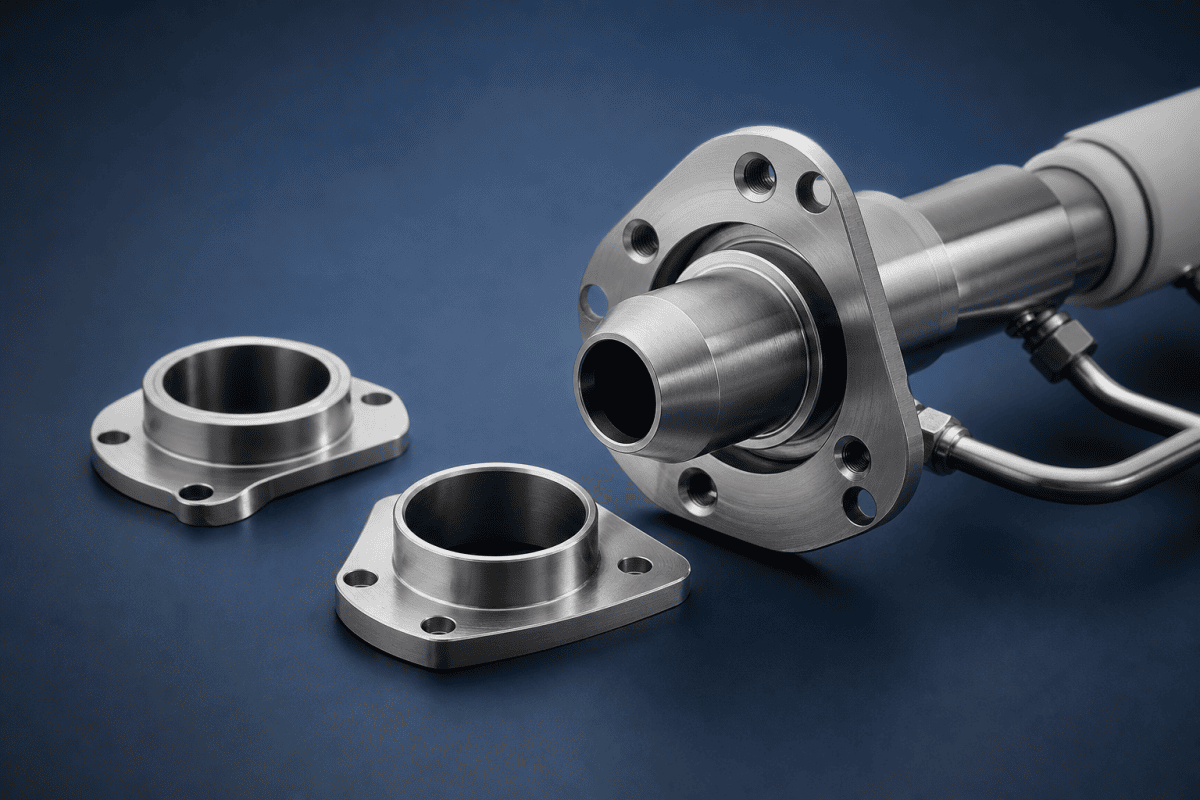
Preform Burner Mounting Flanges lan custom burner adapters dumunung ing antarmuka antarane burner assembly lan lathe carriage, lan asring dadi komponen pungkasan sing dipriksa dening insinyur nalika kualitas deposisi drift. Amarga ora ndemek soot utawa kaca langsung, dheweke dianggep stabil kanthi dimensi. Ing praktik, preform burner mounting flange sing wis warped, corroded, utawa wis shimmed supaya pas karo torch pengganti bisa nggeser sumbu burner kanthi sekedhik milimeter — cukup kanggo ngganggu geometri flame, deposisi preform, lan profil indeks bias sing diasilake. Artikel iki nerangake apa bagean pemasangan peralatan serat optik apa, kepiye preform burner mounting flanges kudu dipriksa, lan kepiye nemtokake pengganti utawa adaptor burner khusus kanthi akurat kanggo sistem OVD, VAD, lan MCVD.
Apa sing Bener-bener Ditindakake dening Preform Burner Mounting Flange
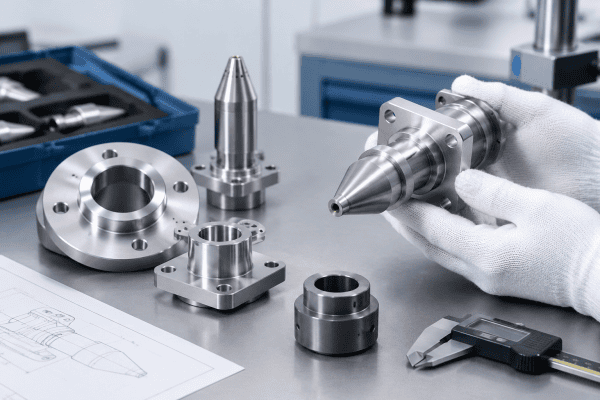
Preform burner mounting flange yaiku bracket mekanik sing nahan burner utawa torch body ing posisi sing tetep lan bisa diulang relatif marang preform. Gumantung saka desain mesin, bisa uga bolt menyang carriage plate, clamp menyang linear rail assembly, utawa index marang machined reference face. Tugase ora mung nahan bobot. Preform burner mounting flange sing dirancang kanthi bener kudu:
- Njaga jarak burner-to-preform lan alignment sudut sajrone siklus termal
- Nolak getaran saka carriage travel tanpa loosening utawa creeping
- Nyedhiyakake jalur sing disegel utawa dipandu kanggo gas feed lines lan sambungan pendinginan yen ana
- Ngidini burner dicopot lan dipasang maneh tanpa ilang posisi sing wis disetel
Amarga tingkat deposisi lan wujud flame sensitif marang jarak standoff lan tilt, kondisi flange minangka variabel proses, dudu mung item pangopènan. Preform burner mounting flange sing wis di-machining maneh tanpa drawing sing didokumentasikake, utawa sing wis nglumpukake shims sajrone torch swap, ngganti geometri sing proses kasebut wis dikualifikasi. Kanggo latar mburi babagan kepiye iki mengaruhi deposisi, deleng diskusi babagan presisi burner nozzle lan preform yield.
Mode Gagal Mounting Flange sing Perlu Dipriksa
Preform Burner Mounting Flanges arang banget gagal kanthi catastrophic. Dheweke degradasi kanthi cara sing gampang diabaikan sajrone maintenance window. Nalika keseragaman deposisi utawa kontrol profil dadi ora konsisten, priksa ing ngisor iki sadurunge nyalahake burner dhewe.
Distorsi termal lan creep
Siklus pemanasan lan pendinginan sing bola-bali bisa nyuda residual stresses ing preform burner mounting flange, utamane yen tipis, over-constrained dening fasteners, utawa dipasang tanpa allowance kanggo differential expansion. Distorsi bisa katon minangka owah-owahan ing burner tilt tinimbang bend sing jelas. Tilt sing katon alon-alon sajrone pirang-pirang minggu minangka gejala khas creep tinimbang kesalahan instalasi. Pendekatan diagnostik kanggo burner flame tilt migunani ing kene amarga misahake tilt sing ana gandhengane karo flange saka keausan nozzle lan ketidakseimbangan gas.
Korosi lan degradasi permukaan
Preform burner mounting flange sing cedhak karo zona deposisi bisa kena panas, kondensasi, lan trace process byproducts. Produk korosi utawa oxide scale ing mating face ngenalake celah sing ngganti posisi burner. Pitting ing sekitar bolongan fastener uga bisa nyuda clamping force, saéngga burner bisa shift nalika carriage acceleration. Sembarang scale sing katon ing reference face kudu dianggep minangka owah-owahan dimensi, dudu masalah kosmetik. Kanggo konteks sumber komponen sing gegandhengan, deleng Spare parts obor OVD Nextrom.
Keausan fastener lan antarmuka
Bolted joints ilang preload saka wektu. Threaded inserts pull, slotted holes elongate, lan dowel pins nganggo bores. Sawise preform burner mounting flange bisa obah ing fasteners, repeatability wis ilang — burner bisa bali menyang posisi sing beda saben dipasang maneh. Nyathet nilai torsi lan mriksa maneh sawise siklus termal pisanan minangka praktik prasaja sing bisa nyekel iki luwih awal. Pandhuan layanan umum babagan kelas hardware iki katon ing pandhuan kanggo pangopènan OVD lan VAD burner.
Ketidakcocokan material ing antarmuka
Yen preform burner mounting flange pengganti digawe saka alloy sing beda karo asline, ekspansi termal lan kekakuane bakal beda. Iki ora otomatis dadi masalah, nanging kudu dievaluasi marang paparan suhu komponen, hardware ing saubengé, lan stabilitas posisi sing dibutuhake. Milih material mung amarga “suhu dhuwur” tanpa nimbang prilaku ekspansi bisa ngenalake drift sing sejatine arep didandani. Iki minangka salah sawijining alasan layanan machining OEM/ODM kudu diwenehi katrangan babagan material asli lan alasan penggantian, ora mung dimensi.
Nalika Flange Standar Ora Cukup: Custom Burner Adapters
Custom burner adapters dadi perlu nalika burner lan mesin ora nuduhake antarmuka asli maneh, utawa nalika preform burner mounting flange ora bisa ditemokake ing konfigurasi sing dibutuhake. Kahanan sing umum kalebu:
- Masang burner panggantos utawa torch body kanthi geometri pemasangan sing beda menyang carriage sing wis ana
- Retrofit lathe lawas nganggo desain burner sing luwih anyar
- Nambahake instrumentasi, shielding, utawa jalur purge sing mbutuhake pranata pemasangan dhewe
- Nggabungake sawetara varian flange warisan menyang siji antarmuka standar
Adapter minangka potongan transisi presisi, mula nggawa kabeh syarat toleransi saka komponen sing disambungake. Loro prinsip sing paling penting. Pisanan, adapter kudu njaga orientasi lan standoff burner sing wis dirancang; yen ora bisa, resep proses kudu dikualifikasi maneh. Kapindho, adapter ora kena dadi tautan paling lemah ing tumpukan — adapter sing komplen bakal obah sadurunge burner, sing biasane luwih disenengi tinimbang ngrusak torch body, nanging isih kudu cukup kaku kanggo aplikasi kasebut. Kanggo conto carane adapter ditemtokake ing antarane kulawarga burner, deleng panggantos sirah OVD burner.
Custom burner adapter sing nggawa saluran gas mbutuhake perawatan tambahan. Geometri internal mengaruhi distribusi aliran, lan adapter kanthi transisi internal sing ora apik bisa nggawe ketidakseimbangan tekanan ing antarane saluran. Prinsip ing mburi iki dibahas ing pressure balancing lan gas flow dynamics ing multi-channel torches. Yen custom burner adapter ngganti jalur gas, verifikasi manawa burner isih nampa kondisi aliran sing dirancang, lan konfirmasi owah-owahan apa wae karo dokumentasi peralatan lan personel proses sing mumpuni.
Daftar Priksa kanggo Preform Burner Mounting Flanges lan Adapters
Gunakake urutan iki sajrone pangopènan sing direncanakake utawa nalika asil deposisi owah-owahan sing ora dikarepake. Langkah-langkah sing padha ditrapake manawa sampeyan mriksa preform burner mounting flange standar utawa adapter siji-off.
- Record the current position before disassembly — standoff, tilt, and any index marks. Photographs with a scale reference are more useful than memory.
- Check the reference faces for scale, galling, dents, or embedded debris. Clean and re-inspect; do not file a reference face flat without a drawing.
- Measure flatness and parallelism against the original drawing where one exists. Without a drawing, measure the interface that matters — the face that sets burner orientation.
- Inspect fastener holes and pins for elongation, ovality, and thread condition.
- Verify material and finish if the part is a replacement or has been repaired by a third party. Do not infer material from appearance alone.
- Re-torque after the first thermal cycle and confirm the burner has not moved.
- Correlate with process data — if profile drift or deposition changes track the flange condition, that is supporting evidence, not proof. Confirm by restoring a known-good geometry and repeating the measurement.
Where the preform burner mounting flange interfaces with burner-side hardware, inspect the mating components at the same time. Soot buildup and faceplate condition are covered in the article on preventing silica soot clogging on OVD burner faceplates, and nozzle-related geometry issues are compared across processes in the OVD, VAD, and MCVD nozzle guide. Note that OVD, VAD, and MCVD burners differ in function and mounting practice; do not assume hardware or maintenance intervals transfer between them. Additional guidance on distinguishing components appears in Bagian burner OVD, VAD, lan MCVD.
Sumber Pengganti Preform Burner Mounting Flanges lan Adapters: Apa sing Perlu Disedhiyakake
Accurate sourcing starts with accurate inputs. Whether you are buying a like-for-like replacement or commissioning custom burner adapters, the following information removes most of the back-and-forth.
- Drawings or a physical sample. A dimensioned drawing is ideal. If none exists, a sample plus critical measurements allows reverse engineering, but state which features are functional and which are incidental.
- Critical dimensions and datums. Identify the faces and bores that control burner position, not every dimension on the part.
- Material and finish requirements. Specify the original material if known. If substitution is acceptable, describe the temperature exposure, chemical environment, and mechanical loads so the choice can be evaluated properly.
- Interface details. Fastener sizes and thread types, dowel or pin locations, gas connection types and sizes, and sealing method.
- Quantity and repeatability needs. A one-off repair part and a fleet-wide standard interface have different documentation requirements.
- Operating context. Machine type, burner type, and what problem the new part is solving.
The broader set of questions buyers should ask appears in the optical fiber equipment sourcing FAQ. For standard flange configurations and related hardware, the optical fiber equipment parts range can be reviewed alongside burner-specific items such as OVD burner parts and OVD torch replacement parts.
Pilihan Material lan Finish kanggo Flanges lan Adapters
Material selection is one of the most consequential decisions when specifying a preform burner mounting flange or custom burner adapter. The wrong alloy can introduce thermal expansion mismatches, galvanic corrosion, or premature creep. Consider the following factors before committing to a specification.
Paparan suhu lan siklus termal
A preform burner mounting flange close to the deposition zone may experience sustained temperatures well above ambient, interspersed with rapid cooling during maintenance. Alloys with low thermal expansion, such as Inconel or certain stainless grades, are often chosen for this reason. However, even a low-expansion alloy can distort if the flange design is over-constrained. Allow for differential expansion between the flange, the burner body, and the carriage plate.
Korosi lan lingkungan kimia
Trace process byproducts, condensation, and cleaning agents can all attack a preform burner mounting flange surface. Stainless steels with higher molybdenum content, such as 316L, offer better resistance than 304 in chloride-bearing environments. If the flange is exposed to reducing atmospheres at elevated temperature, consider whether the alloy is susceptible to sigma phase embrittlement or sensitization. For more detail, see aluminum OVD burner components for a contrasting material approach.
Kekakuan mekanik lan bobot
Custom burner adapters must be stiff enough to resist deflection under gas pressure and vibration, yet not so heavy that they overload the carriage or slow axis response. Aluminum offers an excellent stiffness-to-weight ratio but has high thermal expansion; steel offers lower expansion but higher weight. The right choice depends on whether positional stability or dynamic response is the limiting factor. In some cases a hybrid design — a steel interface plate with an aluminum body — provides the best compromise.
Perawatan permukaan lan finish
Surface finish on reference faces directly affects repeatability. A ground or lapped face provides better contact and is less likely to trap debris than a machined finish. Anodizing, passivation, or nickel plating can improve corrosion resistance, but some coatings add thickness that must be accounted for in the tolerance stack. Never specify a coating without confirming its dimensional impact on critical faces. More on this topic is available in Nextrom OVD burner replacement drawings.
Pertimbangan Desain kanggo Custom Burner Adapters
When off-the-shelf preform burner mounting flanges cannot accommodate a new burner or a retrofitted carriage, custom burner adapters bridge the gap. Designing them well requires attention to several factors beyond simple dimensions.
Njaga orientasi burner lan standoff
The primary function of custom burner adapters is to position the burner exactly where the process expects it. This means the adapter must define both the angular orientation and the standoff distance. If the adapter introduces any tilt or offset, the flame geometry changes and the deposition profile shifts. Use dowel pins or a machined register to define orientation positively, rather than relying on bolt clearance.
Integritas jalur gas
If custom burner adapters include gas passages, the internal geometry must be designed to avoid dead volumes, sharp steps, or asymmetric transitions that could cause flow imbalance. Computational fluid dynamics (CFD) analysis is sometimes warranted for high-flow multi-channel designs. Even a simple chamfer or radius at a transition can make a measurable difference in flow distribution.
Serviceability lan repeatability
Custom burner adapters should be designed so the burner can be removed and reinstalled without losing position. This usually means a kinematic mounting scheme — three points of contact, a dowel pin and slot, or a taper interface. Threaded fasteners should be accessible with standard tooling and torqued to specified values. Consider adding a witness mark or a dowel pin that allows quick visual confirmation of correct seating. See also Nextrom VAD burner replacement parts for related component design notes.
Dokumentasi lan traceability
Every preform burner mounting flange and custom burner adapter should have a drawing that records critical dimensions, material, finish, and any special processes. Without documentation, future replacements become reverse-engineering exercises that introduce variability. Mark the part with a unique identifier and maintain a revision history. This is especially important for custom burner adapters that may be replicated across multiple machines.
Pitakonan sing Sering Ditakoni
Apa preform burner mounting flange bisa didandani tinimbang diganti?
Sometimes, but repair changes geometry. Welding, re-machining, or straightening a distorted preform burner mounting flange alters its dimensions and may change its heat treatment or residual stress state. If the flange controls burner position, a repaired part should be re-measured against the original drawing and re-qualified before being returned to production. In many cases a new part made to drawing is faster than verifying a repair.
Kepiye aku ngerti apa drift disebabake dening flange utawa burner?
You cannot confirm it from symptoms alone. Establish a baseline by measuring burner position with a known-good preform burner mounting flange, then compare. If the geometry is correct and the problem persists, move upstream to nozzle condition, gas delivery, and faceplate cleanliness. If geometry changes after a thermal cycle or a reinstall, the mounting interface is the stronger suspect.
Apa custom burner adapters mengaruhi kualifikasi proses?
Any part that changes burner orientation, standoff, or the gas path can affect the process. Treat new custom burner adapters as a change: verify dimensions against the drawing, confirm the burner sits at the intended position, and re-qualify the recipe through your normal engineering change process with qualified personnel.
Material apa sing kudu digunakake kanggo preform burner mounting flange?
It depends on the part’s function. Consider the maximum temperature it sees, whether it is in a reducing or oxidizing environment, whether corrosion or condensation is present, the required stiffness versus weight, and thermal expansion relative to adjacent components. There is no single correct alloy for every preform burner mounting flange, and material should be selected together with the supplier based on the application rather than the product category.
Sepira kerep preform burner mounting flanges kudu dipriksa?
Inspection frequency depends on the duty cycle and the criticality of the deposition process. As a baseline, inspect preform burner mounting flanges during every major maintenance window and after any thermal event or abnormal shutdown. If deposition uniformity is critical, consider a dimensional check at least quarterly. Document each inspection so trends in wear or distortion can be detected early.
Toleransi apa sing umum kanggo custom burner adapters?
Custom burner adapters typically require tolerances in the range of ±0.05 mm on critical faces and bores, with tighter tolerances where the adapter directly controls burner orientation. Flatness and parallelism on reference faces are often specified at 0.02 mm or better. These values should be confirmed with the burner manufacturer and the process engineering team, as requirements vary by equipment generation and process sensitivity.
Langkah Sabanjure
If you are replacing a worn preform burner mounting flange, standardizing an interface, or commissioning custom burner adapters to fit a burner onto existing equipment, the fastest path to an accurate quotation is a drawing or sample plus the critical dimensions, material requirements, and operating conditions. Contact our team with those details, and we can review whether a standard component fits or whether a drawing-based custom part is the better answer. For related case studies, see optical fiber proof test equipment parts and our overview of optical fiber preform equipment parts. External guidance on high-temperature alloys and corrosion resistance is available from Special Metals technical documents.
