
Knowledge
Titanium deposition manifold: Hastelloy vs Gas Parts for Acidic HCl Resistance
Oct
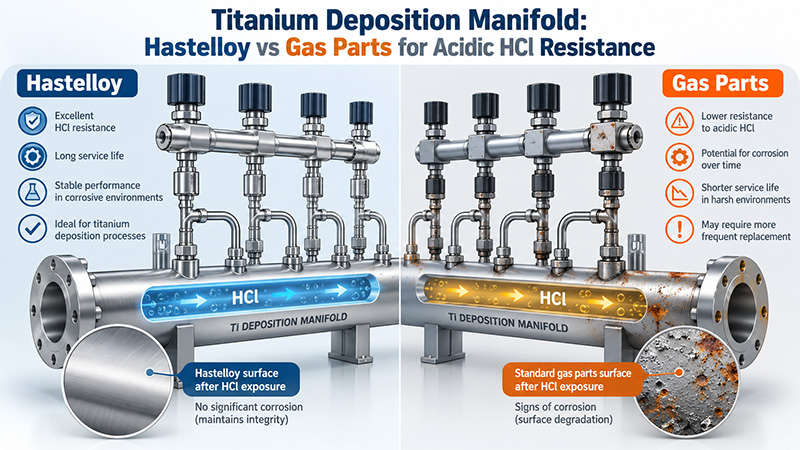
Acid resistance is one of the factors that separates a manifold that survives years of service from one that fails early, and the choice between a titanium deposition manifold and a Hastelloy OVD burner part is not as simple as picking the more expensive metal. In optical fiber preform manufacturing, deposition manifolds and burner gas passages can be exposed to acidic species carried in process streams, cleaning agents, and ambient plant environments. When HCl or chloride-bearing moisture is present, material selection drives both corrosion behavior and the reliability of the entire gas delivery assembly. A titanium deposition manifold is often proposed for its light weight and passive oxide film, while nickel alloys such as Hastelloy are proposed for their broader chemical resistance. This article compares titanium and Hastelloy alloys for acidic HCl service, explains the mechanisms behind their different responses, and outlines the inspection and sourcing factors that engineers and maintenance teams should verify before ordering replacements.
Why HCl Exposure Is a Different Problem from High-Temperature Oxidation
Many burner and torch part discussions focus on oxidation resistance at elevated temperature. Chloride attack follows different rules. In the presence of moisture, HCl can promote localized pitting, crevice corrosion, and stress corrosion cracking in susceptible alloys, even when the environment is not strongly acidic by industrial standards. Trace chlorides that concentrate in crevices, stagnant gas pockets, or deposits on a faceplate can be more damaging than a bulk concentration that appears harmless.
This matters for manifolds because they combine several risk factors: machined internal passages, tight sealing faces, threaded or flanged joints, and regions where condensate or particulate can collect. A titanium deposition manifold may resist uniform corrosion yet still fail at a crevice if chlorides concentrate there. Material alone does not determine outcome. Geometry, surface finish, joint design, and cleaning practice all influence whether a given alloy performs as intended.
Titanium deposition manifold Behavior in Chloride Environments
Commercially pure titanium and common titanium alloys are widely used in optical fiber equipment because they offer a favorable strength-to-weight ratio and form a stable passive oxide film. In many aqueous chloride environments, titanium resists attack well because that film re-forms quickly after damage. This is the basis for titanium’s use in seawater and chloride-containing chemical service.
However, the passive film has limits. Titanium can suffer localized attack in certain conditions, including anhydrous or strongly reducing environments, some high-temperature chloride situations, and crevices where oxygen availability is restricted. Hydrogen uptake is also a concern in some acidic or cathodic conditions, because titanium can become embrittled when hydrogen is absorbed. A titanium deposition manifold that performs well in one HCl-exposed duty may behave differently in another where temperature, moisture, aeration, or concentration shifts.
The practical lesson is that “titanium is corrosion resistant” is not a sufficient specification. For a titanium deposition manifold exposed to HCl, engineers should state the actual environment as precisely as possible and confirm that titanium is suitable for that specific combination of chemistry, temperature, and geometry.
Hastelloy OVD Burner Parts Under Acidic Gas Conditions
The nickel-based alloys grouped under the Hastelloy name are generally selected for aggressive chemical service because of their combination of corrosion resistance and mechanical toughness. Many of these alloys are designed to resist both oxidizing and reducing acids, and they typically outperform titanium in chloride-induced pitting and crevice corrosion scenarios. That is why Hastelloy OVD burner parts are often considered when acidic gas resistance in optical fiber processes involves chlorides or mixed acid exposure.
This does not make every nickel alloy interchangeable. Hastelloy is a family of alloys, and their behavior depends on composition and the specific environment. Some grades are optimized for reducing acid service, others for oxidizing conditions, and selection without considering the actual gas chemistry can lead to poor results. Machinability also differs considerably between grades, which affects cost, lead time, and achievable surface finish on small internal gas passages.
For acid resistance, the important point is that a qualified nickel alloy often provides a wider margin of safety than titanium when chlorides and moisture are present. That margin can justify the higher material and machining cost in manifolds that are difficult to access and expensive to replace. A titanium deposition manifold may still be the right answer when the duty is mild and well documented, but the burden of proof is higher.
Comparing the Two Materials for Deposition Manifold Service
A direct comparison should avoid blanket statements. The table below summarizes general tendencies rather than universal rules.
| Factor | Titanium | Nickel Alloy (Hastelloy Family) |
|---|---|---|
| Mass and density | Lower, lighter assemblies | Higher, heavier assemblies |
| Chloride pitting/crevice resistance | Good in many aqueous duties, weaker in crevices | Generally stronger across chloride duties |
| Reducing acid behavior | Limited in some conditions | Broader resistance by grade |
| Hydrogen embrittlement risk | Higher in certain acidic/cathodic conditions | Generally lower |
| Machining and cost | Easier to source, lower material cost | Higher cost, more careful machining |
For a manifold that is regularly exposed to HCl-bearing moisture, the corrosion margin of a properly selected nickel alloy is often the deciding factor. For drier service or for conditions where titanium is known to perform, titanium may offer weight and cost advantages without a meaningful penalty. A titanium deposition manifold used in a clean, dry, low-chloride stream is a different risk profile than the same part installed where condensate and cleaning chemicals collect.
Contamination and Process-Side Considerations
Material selection is not only about the part surviving. It is also about whether the part introduces contamination into the deposition process. Metal ions, particulates, and corrosion products that enter the gas stream can affect preform quality and downstream fiber performance. A manifold that corrodes slowly but releases particles into a gas passage may be more problematic than one that fails visibly.
This is why inspection should include internal passages, not just external surfaces. Discoloration, pitting, pinholes, and deposits near gas exits can indicate that a manifold or burner component is contributing contamination. For related failure modes, see our discussion of OVD burner faceplate replacement and hole geometry inspection, which covers how deposits and flow disruption interact at the burner face.
Inspection Points Before Choosing a Replacement Material
Before replacing a manifold or burner gas component, gather objective evidence rather than relying on the original material name. Useful inspection steps include:
- Confirm the actual exposure. Identify which gas and liquid streams contact the part, including cleaning agents, purge gases, and any condensate that forms during shutdown.
- Document temperature range. Record the operating temperature and any thermal cycling. Corrosion behavior can change significantly between continuous and cyclic service.
- Look for localized damage. Pitting, crevice attack, and cracking are more informative than uniform surface discoloration. Note the exact location relative to joints and flow paths.
- Check for hydrogen damage indicators. In titanium parts, unexpected cracking or embrittlement may point to hydrogen uptake rather than simple corrosion.
- Verify dimensions and interfaces. Material change should not compromise sealing faces, thread fit, or gas connection geometry.
- Review cleaning and handling. Residual chlorides from cleaning agents or plant air can create the very conditions that drive attack.
If the failure pattern is unclear, treat the material as a hypothesis rather than a conclusion. A corrosion diagnosis should be supported by the environment data and the observed damage morphology. For general guidance on chloride stress corrosion cracking and alloy selection, the NACE International corrosion standards organization is a useful reference for engineers writing material specifications.
When a titanium deposition manifold is being considered as a replacement for a failed nickel alloy part, the same inspection logic applies in reverse: confirm that the lighter metal will actually tolerate the chloride and moisture profile, and confirm that the replacement will not introduce hydrogen embrittlement risk. If the part is not accessible after installation, the cost of a second failure is usually higher than the cost of a more conservative alloy.
How Material Choice Interacts with Manifold Design
The same alloy can behave differently in two manifolds because of design details. Sharp internal corners, dead-end passages, and poorly drained cavities create crevices where chloride solutions concentrate. Surface finish influences how easily deposits attach and how effectively cleaning removes them. Joint design determines whether moisture can penetrate a sealing interface and remain trapped.
For gas flow behavior in multi-channel torches, the internal aerodynamics of the manifold and torch interact with the burner channels. Our article on VAD core deposition burner parts and custom manufacturing specifications explains how passage geometry and pressure distribution affect deposition consistency. Material selection should not be separated from that geometry, because a corrosion-resistant alloy will not compensate for a manifold design that traps condensate.
When a titanium deposition manifold is being redesigned, use the opportunity to eliminate dead ends, improve drain paths, and specify surface finishes that support cleaning. The same discipline applies to nickel alloy versions. Design improvements often extend service life more than a material upgrade alone, especially when the failure originates at a crevice rather than on a free surface.
Sourcing Questions for Acid-Resistant Components
When requesting a quotation for an HCl-exposed manifold or burner part, provide enough detail for the supplier to make a material recommendation rather than simply matching a drawing. Consider including:
- The specific alloy or alloys under consideration, and whether an alternative is acceptable.
- The gas and liquid chemistry, including chloride concentration and pH where known.
- Operating temperature range and thermal cycling conditions.
- Pressure and flow requirements for each passage.
- Connection types, sealing methods, and interface dimensions.
- Cleaning agents and maintenance procedures used on the part.
- Whether the part is a direct replacement or a redesign opportunity.
If the original component is obsolete or undocumented, drawing-based production and reverse engineering may be required to reproduce internal passages accurately. Our CNC machining of preform burner components for small-batch production covers custom optical fiber equipment parts manufactured to supplied drawings or measured from existing hardware.
Suppliers who routinely machine both titanium and nickel alloys can usually advise on the practical trade-offs for a titanium deposition manifold, including lead time, surface finish limits, and the availability of certified material. Ask for the material certificate and, where relevant, the heat lot number so the delivered part can be traced to the alloy chemistry that was quoted.
Frequently Asked Questions
Is titanium ever the better choice for an HCl-exposed manifold?
Yes, in specific conditions. Titanium can be appropriate when the environment is well characterized, chloride levels and moisture are controlled, crevice risk is low, and the weight or cost advantage matters. A titanium deposition manifold should be chosen on the basis of the actual exposure rather than a general preference for one metal.
Does “Hastelloy” guarantee resistance to every acidic gas?
No. Hastelloy refers to a family of nickel-based alloys with different compositions and different resistance profiles. Selection should match the specific grade to the specific chemistry, temperature, and stress conditions. A generic material callout is not enough for aggressive service, and a titanium deposition manifold should not be swapped to a nickel alloy without the same level of review.
Can I simply swap a titanium manifold for a nickel alloy part?
Not without verification. Differences in density, thermal expansion, machining behavior, and surface finish can affect fit, sealing, and gas flow. The replacement should be checked against the original drawing, dimensions, connection types, and application requirements before installation.
What information is most useful when requesting a quote?
The process environment, temperature range, gas connections, and drawing or sample dimensions are the most valuable inputs. Providing these details allows a supplier to recommend a suitable material and manufacturing approach instead of quoting a lookalike part that may not meet the service conditions.
Next Step
If you are evaluating a titanium deposition manifold against a nickel alloy alternative for acidic HCl service, the most reliable path is a drawing-based review of the actual component and its operating conditions. Share your drawings, dimensions, material requirements, and process details with our team through the contact page to discuss the component and request a quotation. Whether the final choice is a titanium deposition manifold or a qualified Hastelloy grade, the decision should be traceable to the chloride exposure, temperature profile, and geometry of the part in service.
