
Knowledge
OVD vs. VAD vs. MCVD Torch Nozzles: Technical Comparison & Consumable Sourcing Guide
Aug
In the optical fiber manufacturing industry, the quality and attenuation of optical fiber preforms depend directly on the performance of the deposition torch assembly. Whether your plant utilizes Outside Vapor Deposition (OVD), Vapor Phase Axial Deposition (VAD), or Modified Chemical Vapor Deposition (MCVD), selecting and maintaining high-precision torch nozzles is critical to optimizing flame geometry and soot deposition efficiency.
Because these torch nozzles operate under continuous thermal stress and corrosive chemical environments SiCl₄, GeCl₄, O₂, and H₂, they are high-wear consumables.
This comprehensive technical guide compares the unique engineering requirements of OVD, VAD, and MCVD burner nozzles and highlights best practices for sourcing cost-effective, high-precision OEM replacement parts.
Key Differences Between OVD, VAD, and MCVD Torch Nozzles
While all three deposition processes synthesize high-purity silica SiO₂ soot particles via chemical vapor deposition, their flame dynamic requirements and torch head structures vary significantly.
| Process Type | Deposition Direction | Core Nozzle Material | Primary Technical Challenge |
| OVD Burner | Radial (Outside Target Rod) | OFHC Copper / 316L Stainless Steel | Maintaining symmetrical flame geometry across large preform diameters |
| VAD Burner | Axial (End-Face Growth) | Fused Quartz / OFHC Copper | Precise temperature gradient control for refractive index profile shaping |
| MCVD Torch | Internal (Inside Quartz Tube) | High-Purity Fused Quartz / Alloy | Uniform outer heating to induce internal thermophoretic soot deposition |
1. OVD Burner Nozzles (Outside Vapor Deposition)
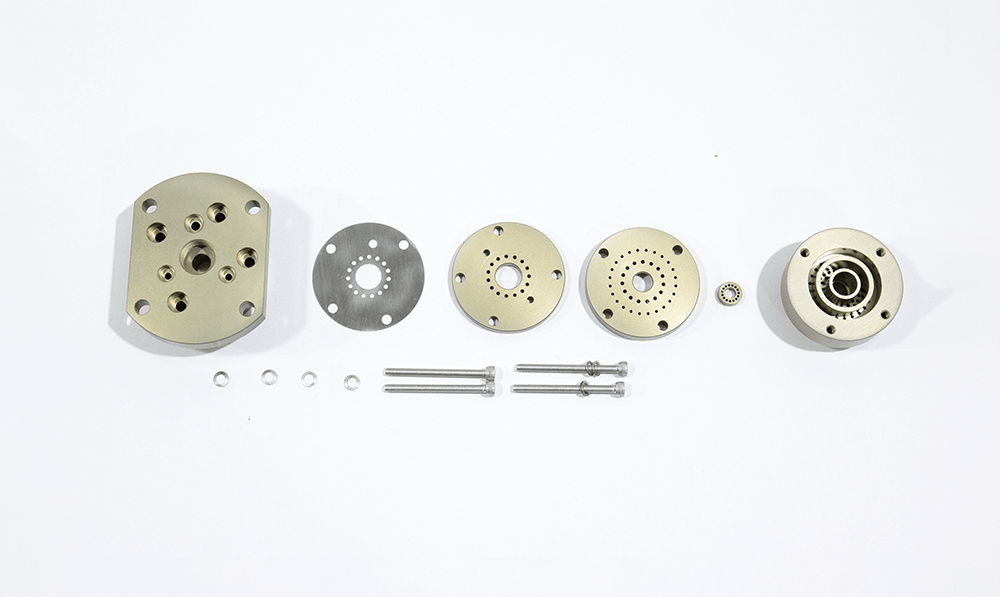
In the OVD process, chemical vapors are sprayed radially onto a rotating target rod. The OVD burner nozzle features a multi-concentric micro-orifice design that controls fuel gas H₂/O₂, carrier gas, and precursor vapors SiCl₄.
-
Gas Velocity Balance: Requires precise micro-channel alignment to prevent premature chemical combustion at the nozzle tip.
-
Thermal Management: Typically machined from Oxygen-Free High-Conductivity (OFHC) Copper or 316L Stainless Steel with integrated cooling channels to prevent thermal deformation during long deposition runs.
2. VAD Burner Nozzles (Vapor Phase Axial Deposition)
VAD technology deposits soot end-wise onto a growing vertical rod. Unlike OVD, VAD burners often utilize specialized multi-stream quartz or metal torch heads to synthesize both the core and cladding simultaneously.
-
Refractive Index Control: The multi-ring nozzle geometry must maintain strict gas velocity ratios to control Germanium GeO₂ dopant distribution.
-
Material Purity: Fused quartz and cleanroom-grade copper burner tips are standard to avoid metallic particle contamination in the core rod.
3. MCVD Heating Torches (Modified Chemical Vapor Deposition)
In MCVD, reactions occur inside a rotating quartz tube. The external gas burner or plasma torch moves axially along the tube, heating the glass to induce internal deposition and vitrification.
-
High Heat Resistance: MCVD torches must endure intense external heating 1600℃ to 2000℃ to achieve consistent glass collapse and consolidation.
Causes of Torch Nozzle Degradation and Wear
Deposition nozzles are high-wear consumable components subject to continuous physical and chemical degradation, including:
-
Micro-Orifice Chemical Erosion: Corrosive chloride gases gradually etch gas channels, altering gas velocity and causing flame tilting.
-
Thermal Stress and Distortion: Repeated heating cycles cause subtle micro-expansions, compromising single-digit micron tolerances.
-
Soot and Chemical Buildup: Micro-particles accumulating on the nozzle face distort the flame pattern, leading to uneven preform density and higher fiber attenuation.
Why Precision Micro-Machining Matters for Replacement Parts
Replacing worn torch nozzles with direct-fit OEM replacement parts restores optimal flame characteristics without requiring complete torch assembly overhauls. However, replacement parts must meet strict manufacturing standards:
-
Single-Digit Micron Tolerances ±.002mm: Ensures exact orifice concentricity and stable flame geometry.
-
Mirror Surface Polishing Ra < 0.2 μm: Eliminates internal channel roughness to prevent turbulence and particle clogging.
-
100% Direct OEM Compatibility: Guarantees seamless drop-in installation without cleanroom recalibration.
Direct OEM Replacement Parts: Balancing Quality and Cost
Sourcing original equipment manufacturer (OEM) replacement nozzles often incurs excessive costs and extended lead times. Sourcing field-tested, direct OEM replacement burner parts from specialized precision machining manufacturers allows plant operators to slash consumable expenses while maintaining strict optical fiber attenuation standards.
Whether you need standard OVD burner heads, custom VAD quartz nozzles, or OEM modification based on CAD drawings, working with a precision-focused supplier ensures reliable production uptime.
Need direct OEM replacement burner parts or custom CAD machining? Contact Our Technical Sourcing Team today to request technical spec sheets and custom factory quotes.
