
Kawruh
Komponen Burner Preform Mesin CNC kanggo Produksi Batch Cilik
Okt
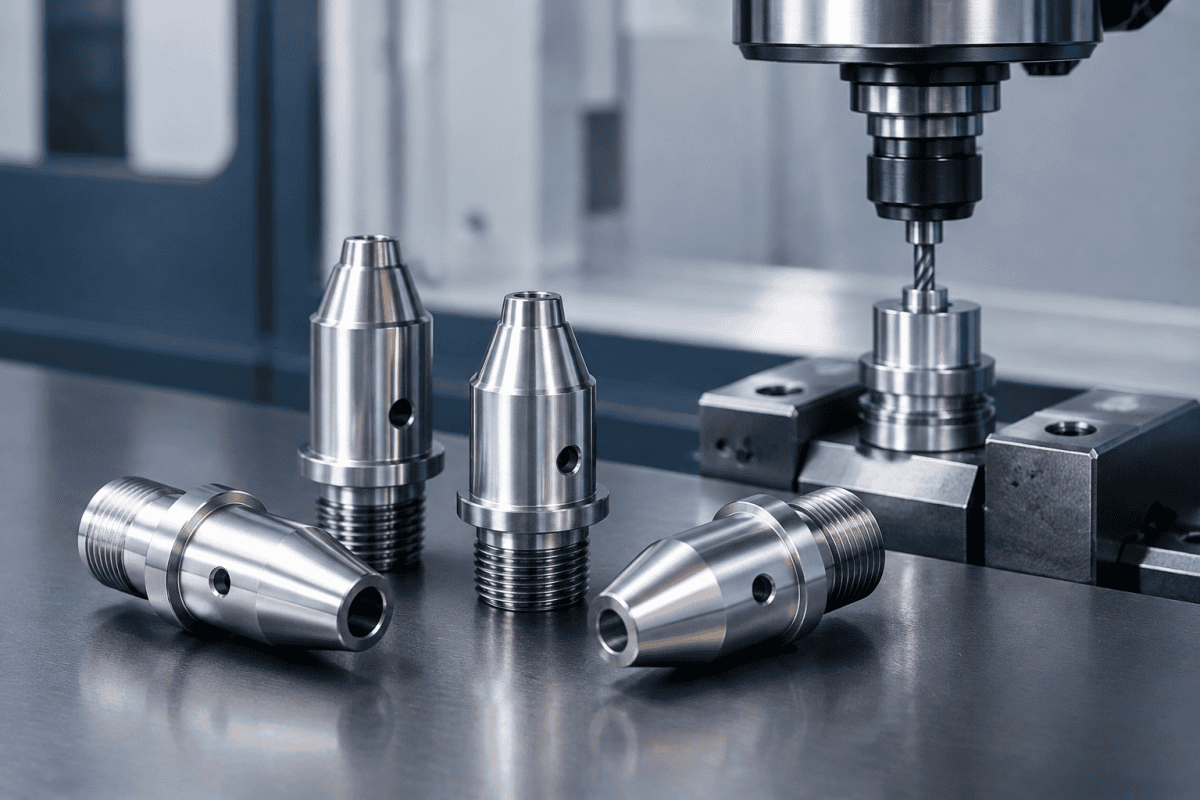
When a fiber preform line needs a small run of replacement burner bodies, nozzle plates, or mounting adapters, CNC machining preform burner components is often the fastest route from a drawing to a working part. Small-batch production sits between one-off repair work and high-volume manufacturing: quantities are typically low enough that dedicated tooling is hard to justify, yet high enough that repeatability across the batch matters. For engineers and maintenance teams, the practical question is not whether CNC machining can make the part, but how to specify, inspect, and qualify it so the burner behaves the same way it did before the component was removed. The same logic applies whether you are dealing with a single OVD torch faceplate or a set of manifold blocks across several deposition stations.
Why CNC machining preform burner components behave differently from one-off repairs
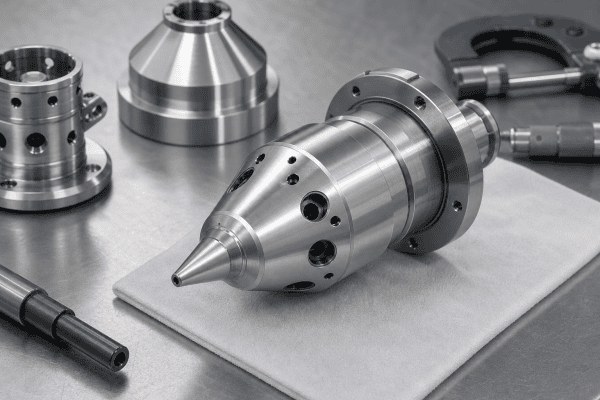
A single emergency part can sometimes be hand-fitted to the machine. A small batch cannot rely on that approach, because every unit must be interchangeable with the others and with the existing assembly.
First, the drawing or reverse-engineered model must be correct before machining starts. If dimensions are taken from a worn original, the first article will simply reproduce the wear. Second, process consistency matters more than in a one-off job. The same setup, tooling, and inspection plan should apply across the batch so that unit five matches unit one. Third, documentation becomes useful rather than optional, because the next batch may be produced months later from the same files.
Small batch burner parts are also frequently a mix of standard and non-standard features. A mounting flange may follow an existing pattern while the gas passages are specific to a particular torch design. Separating these two categories during quoting helps avoid unnecessary custom work on features that could otherwise follow a proven reference.
When CNC machining preform burner components for a batch of five to fifty pieces, the setup cost is spread across fewer units than in mass production. That makes it worth reviewing whether any feature can be simplified without affecting function, whether a standard insert or thread form can replace a bespoke one, and whether the batch size itself could be adjusted to reduce unit cost without creating excess inventory of parts that may be superseded by a design change.
Component types commonly produced in small runs
Preform deposition equipment includes a range of machined components that wear, distort, or become contaminated over time. Typical small-batch items include burner bodies and housing sections with internal gas passages, nozzle plates, orifice arrays, and faceplate inserts, mounting adapters, brackets, and alignment fixtures, manifold blocks and distribution plates, plus shielding, spacing, and positioning components.
OVD, VAD, and MCVD torches differ in how they deliver reactants and how many channels they use, so a component that works in one process is not automatically suitable in another. A nozzle geometry that suits an outside vapor deposition flame may be entirely wrong for a modified chemical vapor deposition torch. Treat the process type as part of the specification, not as background information.
For equipment that uses standard replacement hardware, it is worth checking whether an existing item already matches the requirement before committing to a custom run. The OVD deposition parts range covers common burner, torch, and deposition components, and comparing dimensions against a catalogue item is usually faster than starting a new design.
Material selection for small-batch burner components
Material choice should follow function, not habit. The relevant factors are the maximum temperature the part sees, the gases and vapors it contacts, whether it must conduct or resist heat, how it is cooled, and how often it will be handled during maintenance.
In practice, small-batch preform burner components are often made from stainless steels, nickel-based alloys, or aluminum where weight and thermal conditions allow. Quartz and certain ceramic materials appear where high-temperature or chemical resistance requirements demand them, though they behave very differently under machining and usually need separate process planning. Each of these families has trade-offs in machinability, thermal expansion, and cost, and none of them is universally correct.
Two cautions are worth repeating. Do not infer a material from a product category or a similar-looking part, and do not assume that changing material will solve a wear problem without understanding the wear mechanism. If the original failed through oxidation, galling, thermal cycling, or erosion, the replacement material should be selected to address that specific mechanism. Where aluminum is appropriate, for example, aluminum OVD parts can be a practical option for certain housings and support components, but aluminum is generally unsuitable for the hottest or most chemically aggressive locations.
When CNC machining preform burner components in heat-resistant alloys, tool wear and surface integrity deserve attention. Nickel-based alloys work-harden quickly, so light passes and sharp tooling help avoid subsurface damage that might later release particles into a gas path. Titanium alloys require similar care and also demand clean handling to avoid contamination. For a small batch, it is reasonable to ask the supplier how tool wear is monitored and whether the last part in the batch is inspected as carefully as the first.
What to put on a small-batch machining request
The quality of a quotation depends heavily on the completeness of the request. For precision deposition torch machining, a supplier needs enough information to plan setups and inspection without guessing.
A useful request package includes drawings or models with dimensions and tolerances, or a 3D model plus a drawing for critical features. If no drawing exists, provide a sample or measured data and state clearly which dimensions are critical and which are approximate. Name the alloy or grade where known, and describe the operating environment if it is not. State the batch size and whether a first article is expected before the remainder is produced. Identify concentricity, flatness, hole position, surface finish, and any feature that directly affects flame shape or gas distribution. Include gas connection type and size, thread forms, sealing surfaces, and how the part locates in the assembly. Specify which dimensions must be reported, and whether a dimensional report is required with the shipment. Note any cleaning, passivation, deburring, marking, or surface treatment that the part must undergo before installation.
Reverse engineering is common in this field because original drawings are often unavailable or outdated. Measuring a worn part and reproducing it exactly can carry the wear forward. A better approach is to measure the part, compare it with the mating components and the intended function, and reconstruct the drawing around the original design intent. This is a normal part of sumber burner OVD lan VAD khusus and is worth discussing before any material is cut.
General guidance on drawing practice and tolerance interpretation is available from standards bodies such as ISO 8015 on GPS fundamental principles, which can help both parties agree on what an untoleranced dimension means. Making that agreement explicit before CNC machining preform burner components starts avoids disputes later when a feature is found to be outside the expected range.
Machining considerations that affect burner performance
Not every dimension on a burner component carries equal weight. Features that influence gas flow, flame geometry, or thermal contact deserve tighter control, while cosmetic or non-functional surfaces can often be looser. Knowing which is which prevents unnecessary cost and prevents the wrong feature from being treated casually.
Concentricity between the nozzle and the mounting axis is a recurring concern because small offsets can translate into flame asymmetry and downstream variation in the deposited soot. The relationship between burner concentricity and preform quality is examined in more detail in this discussion of drift profil indeks bias lan konsentrisitas burner.
Surface finish inside gas passages is another area where judgement is required. A finish that is too rough may trap particles or disturb flow; an unnecessarily fine finish adds machining time without functional benefit. The right target depends on the passage size, the gas involved, and whether the passage is intended to be cleaned periodically.
CNC Machining Preform Burner Components also involves decisions about how the part is held during cutting. Thin faceplates and nozzle arrays can distort under clamping pressure, so the fixture design may matter as much as the cutting parameters. A supplier who understands this will often propose a sacrificial backing plate or a low-stress clamping arrangement rather than simply tightening the vise and cutting.
Inspection points for a small batch
Inspection should be planned alongside the machining, not added at the end. For a small batch, a practical inspection plan usually covers first-article inspection of all critical dimensions before the batch continues, dimensional verification at defined intervals during production, visual checks for burrs, tool marks, and contamination in gas paths, verification of thread forms and sealing surfaces against mating parts, and cleanliness checks appropriate to the component’s function.
Where a cause of a problem is suspected but unconfirmed, for example a drift in deposition behavior, the component should be measured before it is replaced. Replacing a part without measuring it removes the evidence and makes it difficult to tell whether the component was actually the cause.
Troubleshooting: separating component issues from process issues
When preform quality changes, it is tempting to replace the burner first. That is not always the correct diagnosis. Component-related causes and process-related causes can produce similar symptoms, and the way to distinguish them is through measurement rather than assumption.
Possible component-related causes include geometric wear on the nozzle face, a partially blocked orifice, distortion of a mounting surface, or a sealing surface that no longer seats correctly. Verifiable indicators include measured dimensional deviation from the drawing, visible deposits or damage, and a change in the fit of mating parts. Possible process-related causes include changes in gas supply, cooling conditions, exhaust behavior, or ambient conditions in the production area. These are usually confirmed by checking equipment records and instrumentation rather than by inspecting the burner.
If a component is confirmed as the source, the replacement should be specified against the original design intent, not against the failed part. If the failure is recurring, the pattern itself is useful information: repeated clogging points toward a review of thermal stress or gas flow rather than simply ordering another identical part. Where the underlying geometry is complex, reviewing the guidance on controlling preform end-taper cracking can help clarify how much of the design needs to be re-established from first principles.
It can also help to compare the titanium replacement option for torch consumables against the original material. A worked example of that comparison is documented in this case study on upgrading OVD torch consumables to titanium alloy, which describes the performance changes observed after the switch.
Planning the next batch
The main advantage of small-batch CNC production is that it supports iteration without committing to tooling. That advantage is only realized if the information from one batch is retained for the next. Keeping the drawing revision, material certificate, inspection report, and any notes about fit or performance with the part record makes the second order considerably easier than the first.
It also helps to record which features were treated as critical and why. That reasoning is easily lost between maintenance cycles, and it is often the most valuable part of the documentation when a component is revisited years later.
For teams that expect to reorder, a short internal standard for CNC machining preform burner components can save time on every subsequent batch. It might specify the preferred material grade for each functional area, the minimum inspection data to request, and the naming convention for drawing revisions. None of this is complex, but it prevents the same questions being asked each time a part is needed and reduces the risk of a well-meaning substitution that changes burner behavior.
Storing a reference sample from each accepted batch is another simple practice that pays off later. A physical part is the most direct way to check that a future batch matches what actually worked on the line, even if drawings and reports are available.
Working with a supplier on small-batch orders
Small-batch work sits awkwardly in many machine shops because it carries engineering effort similar to a prototype but with the expectation of production reliability. Choosing a supplier who is comfortable with that balance matters more than choosing one with the lowest hourly rate.
A useful conversation to have before the first order covers how first articles are handled, what happens if a critical dimension is borderline, and how changes to the drawing are communicated once cutting has started. Suppliers experienced with CNC machining preform burner components will usually have a view on these points already, because they have seen how a small dimensional question can affect deposition results.
It is also reasonable to ask how the supplier handles part traceability. For a small batch, a simple record linking each part or sub-lot to its material certificate and inspection data is enough. That record becomes valuable if a burner later behaves unexpectedly and the question turns to whether the part or the process changed.
Pitakonan sing Sering Ditakoni
How small can a batch be before CNC machining stops making sense?
There is no fixed threshold. A single part can be worth machining when the alternative is extended downtime or an unavailable spare. The economics depend on part complexity, material availability, and how much design work is required, not on quantity alone. For very simple geometry it is still worth comparing against a standard catalogue item first.
Can a worn burner component be copied directly?
It can be measured, but copying it exactly may reproduce the wear that caused the problem. A better approach is to measure the part, examine the mating components, and reconstruct the drawing around the intended function. This usually requires a short discussion about which dimensions reflect original design and which reflect service wear.
Informasi apa sing dibutuhake kanggo penawaran?
At minimum: drawings or models, material, quantity, critical features, and interface details such as gas connections and sealing surfaces. If drawings are unavailable, a sample or a set of measurements with notes on which dimensions are known to be reliable is a workable starting point.
Do machined replacements need to match the original material?
Not necessarily, but any change should be justified by the operating conditions. Temperature exposure, chemical environment, thermal cycling, and mechanical loading all influence material suitability. Changing material without understanding why the original failed can simply move the failure elsewhere.
How long does a small-batch order usually take?
Lead time depends mainly on material availability and whether the drawing is ready. A straightforward batch in a stocked stainless grade may move quickly, while a nickel-based alloy or a part requiring a new fixture will take longer. Asking for a quoted lead time before committing helps planning, especially if the part is needed during a scheduled maintenance window.
If you are preparing a small-batch order for burner, torch, or deposition components, sending drawings, dimensions, material requirements, and operating conditions together will produce a faster and more accurate response. You can contact our team to discuss your component requirements and confirm what information is needed to move forward with CNC machining preform burner components.
