
Connaissances
Custom OVD Burner Nozzle Replacement: Key Specifications to Confirm
FAQ
Replacing a burner nozzle on an OVD deposition system is not a simple parts swap. The nozzle is one of the last components to shape the gas stream before combustion, so small differences in geometry, fit, or material can change flame shape, soot deposition behavior, and the stability of the preform build. When a standard catalog part is unavailable or no longer matches the drawing, a custom OVD burner nozzle replacement is often the practical route — but only if the specifications are confirmed before machining begins. Getting the specification right is a technical exercise in geometry, gas flow, and material behavior, not just a purchasing transaction.
This article outlines the specifications that matter most when sourcing a custom OVD burner nozzle replacement, how to verify them, and what information a supplier needs to quote accurately. It focuses on OVD deposition burners specifically; VAD and MCVD torch designs differ in geometry and operating logic — a comparison covered in our OVD vs. VAD vs. MCVD torch nozzle guide — and their nozzles should not be treated as interchangeable.
Why Custom OVD Burner Nozzle Replacement Happens
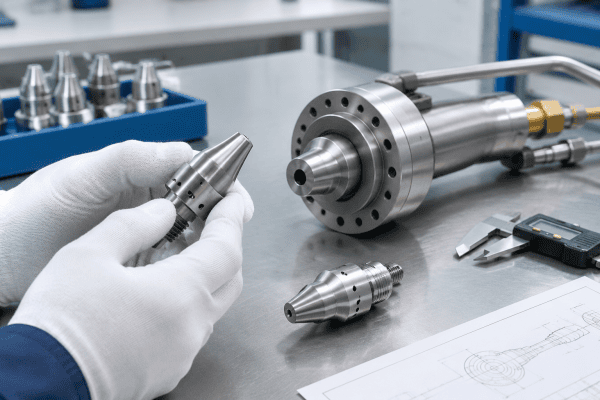
Nozzles are consumable in a real sense. Over time, the faceplate and nozzle bores are exposed to high temperature, thermal cycling, and process chemistry. Common reasons a custom OVD burner nozzle replacement is needed include:
- Soot accumulation and clogging on the faceplate or inside small passages, which can restrict flow and distort the flame.
- Wear or erosion at the nozzle exit, changing the effective orifice shape.
- Distortion or creep after prolonged thermal exposure, affecting concentricity.
- Obsolete or undocumented parts, where the original drawing is missing and a reverse-engineered replacement is the only option.
- Non-standard configurations, where the existing torch has been modified or the process requires a change in gas distribution.
In each case, the goal of a custom OVD burner nozzle replacement is the same: restore the gas-flow and flame characteristics the process was designed around, without introducing a new variable into the deposition run. That goal is why specifications, not price alone, should drive the sourcing decision. Purchasing teams that treat the nozzle as a commodity part often discover the difference during the first deposition run after installation.
Key Specifications to Confirm Before Ordering
The specifications below form the checklist for any custom OVD burner nozzle replacement. Each item should be confirmed in writing and traced to a measurement from the failed part, the original drawing, or the equipment documentation — not assumed from a catalog category.
1. Nozzle Dimensions and Tolerances
OVD nozzle dimensions are the foundation of any custom OVD burner nozzle replacement. Dimensional confirmation should cover:
- Overall length, outer diameter, and mounting interface dimensions.
- Bore diameters for each gas channel, including any stepped or tapered sections.
- Orifice size, exit angle, and the spacing between concentric channels.
- Faceplate flatness and surface finish where the flame forms.
- Thread or flange geometry, if the nozzle mounts mechanically.
Where possible, request that critical dimensions be taken from the failed part and cross-checked against the original equipment documentation. If the part is badly worn, note which surfaces are worn and which are still reference-grade — measuring a distorted part can encode the distortion into the new one. A custom OVD burner nozzle replacement built on a distorted sample will replicate the very error it was meant to remove.
Tolerances deserve the same attention as nominal dimensions. A bore that is nominally correct but at the loose end of the tolerance band may behave differently from one at the tight end, particularly on small orifices where a few hundredths of a millimeter change the effective flow area. State which tolerances are critical and which are conventional, so the machine shop can allocate inspection effort appropriately.
2. Gas Channel Configuration
Multi-channel OVD torches rely on carefully balanced gas flows. The nozzle must preserve the number of channels, their relative cross-sectional areas, and the way they open to atmosphere. A change in the ratio between center and outer channel areas, even a small one, can shift the flame and affect deposition. This is the specification most often underestimated when a custom OVD burner nozzle replacement is quoted from a simple sketch.
If the burner uses an oxygen distribution manifold or auxiliary tail burner, confirm how the nozzle interfaces with that hardware. Distribution geometry is part of the flow path, not a separate detail. The interface between nozzle and manifold determines how the gas arrives at the orifice, and a mismatch there can undo correct nozzle geometry.
For a broader discussion of how channel geometry interacts with flow, the article on sourcing custom OVD and VAD burners through material science and reverse engineering is a useful reference, particularly when the original channel layout must be reconstructed from a physical sample rather than a drawing.
3. Concentricity and Alignment
Concentricity determines whether the flame remains centered on the preform. Eccentric nozzles can produce asymmetric soot deposition, which in turn contributes to refractive index profile drift. When specifying a custom OVD burner nozzle replacement, state the concentricity requirement explicitly, ideally as a measured value relative to the mounting datum, not as a general note like “centered.”
Alignment also depends on the mounting interface, not just the nozzle body. If the torch body has shifted or the mounting seat is worn, a perfectly concentric nozzle will still sit off-axis. The relationship between alignment and profile control is covered in more detail in the article on why OVD burner flames tilt and how alloy selection restores deposition stability.
4. Material Selection
Nozzle material should be chosen based on function, not habit. The relevant factors for a custom OVD burner nozzle replacement are:
- Temperature exposure at the nozzle face and along the bore.
- Chemical environment, including the gases and vapors present and any reaction products that may form deposits.
- Thermal cycling, which drives fatigue and dimensional drift.
- Usinabilité et état de surface, since fine bores and smooth faces are often required.
Common choices include high-temperature alloys and, for some mounting or support components, aluminum where thermal and chemical conditions allow. Aluminum is not a universal substitute for hot-face nozzle materials; it is appropriate only for components whose function and environment suit it. An aluminum OVD part may be a good fit for certain brackets or manifolds, but hot-section nozzles require different selection logic.
If the original material is unknown, a supplier may need to infer suitability from the part’s function and the process conditions, rather than assuming a material from the part number or category. Where the process has moved to higher deposition rates or more aggressive chemistry, material selection for a custom OVD burner nozzle replacement may also justify upgrading from the original alloy rather than matching it.
5. Surface Finish and Faceplate Condition
The faceplate is where soot tends to collect first. Surface roughness and edge condition influence how deposits form and how easily they can be removed. For custom nozzles, specify the required finish on sealing surfaces and on the flame-facing face, and clarify whether any coating or treatment is required. A custom OVD burner nozzle replacement that matches dimensions but not surface finish may still show different deposition behavior over a long run.
Faceplate condition also evolves during service. Understanding how deposits build and how cleaning procedures affect the surface helps set realistic replacement intervals and finish specifications. The article on Pièces de dépôt OVD shows the range of components affected by the same deposition environment, which is useful context when the replacement decision touches more than the nozzle.
6. Mounting and Sealing Interface
Mechanical fit is where many replacement projects fail quietly. Confirm bolt patterns, thread pitch, flange thickness, O-ring or gasket grooves, and gas inlet connections. Sealing surfaces should be dimensioned to the same standard as the original, and any change in sealing method should be reviewed against the torch body design. A nozzle that fits but leaks will not reproduce the original flow behavior.
Sealing materials matter as well. Elastomer compatibility with the gases in use, and with the temperature reached at the sealing location, determines whether the seal survives a full campaign or fails early. For a custom OVD burner nozzle replacement, the sealing specification should be reviewed alongside the nozzle geometry rather than treated as a consumable detail.
7. Thermal Growth and Fit at Operating Temperature
Dimensions measured at room temperature are not the dimensions that matter at operating temperature. Different materials expand at different rates, and a custom OVD burner nozzle replacement made from a different alloy than the original can change the fit at the mounting interface once the torch reaches process temperature.
For critical interfaces, consider whether the drawing should specify dimensions at operating temperature, or whether the room-temperature dimensions already account for thermal growth. Where the original drawing includes this information, preserve it; where it does not, discuss the operating temperature range with the supplier so the fit can be reviewed analytically before machining.
8. Documentation and Traceability
A custom OVD burner nozzle replacement should come with documentation that supports future maintenance: a final drawing reflecting as-built dimensions, material certification, and inspection records for critical features. Without this, the next replacement cycle starts from a physical sample again, and any measurement uncertainty compounds over successive generations of parts.
Traceability also helps when deposition behavior changes. If the nozzle can be linked to a specific build record and material lot, the investigation can focus on process variables instead of questioning the hardware.
Inspection and Verification Considerations
Before accepting a custom OVD burner nozzle replacement, verify what can be verified:
- Dimensional check against the confirmed drawing, with particular attention to bore diameters and concentricity.
- Visual inspection for machining marks, burrs, or blocked passages.
- Fit check on the torch body, without gas flow, to confirm seating and alignment.
- Flow verification, where the equipment and procedures allow, using the manufacturer’s guidance and qualified personnel.
- First-run monitoring, comparing deposition behavior against the established baseline for that torch position.
A dimensional match does not guarantee a process match. It establishes that the hardware is correct; the process behavior still needs to be observed under controlled conditions. Standards such as those published by the International Organization for Standardization provide useful reference frameworks for dimensional verification and quality documentation in this kind of procurement.
Common Causes and Confirmed Diagnoses
When deposition quality changes, the nozzle is one possible cause among several. It helps to separate likely causes from confirmed ones before committing to a custom OVD burner nozzle replacement:
- Cause possible : nozzle wear or distortion. How to verify: measure the installed part against the drawing and inspect the faceplate and orifices.
- Cause possible : soot clogging. How to verify: inspect passages and faceplate for deposits; compare flow behavior before and after cleaning according to approved procedures.
- Cause possible : gas supply or distribution issue. How to verify: check upstream hardware, including manifolds and regulators, against equipment documentation.
- Cause possible : mounting or alignment shift. How to verify: check concentricity and seating relative to the torch datum.
Only after the cause is confirmed should a replacement be specified. A custom OVD burner nozzle replacement ordered for a nozzle that was not the root cause adds cost and introduces a new variable into a process that was already drifting.
Sourcing a Custom Nozzle: What to Send
A clear sourcing request shortens lead time and reduces the risk of a non-conforming part. Useful information for a custom OVD burner nozzle replacement quote includes:
- Drawings or sketches with critical dimensions and tolerances.
- Photos of the failed part, including close-ups of the faceplate and any wear.
- The material, if known, or the operating conditions that govern material choice.
- The torch position and function (for example, main deposition versus auxiliary).
- Any known constraints on gas connections, mounting, or available space.
- Quantity and expected replacement interval, which influence manufacturing method and cost.
Where no drawing exists, reverse engineering from a sample is often the practical path. This is a normal part of OEM and ODM machining services for optical fiber equipment, and it works best when the sample is accompanied by as much process context as the customer can share. Customers who supply operating data, not just a worn part, tend to receive a more robust custom OVD burner nozzle replacement that accounts for the conditions the nozzle actually sees.
Foire aux questions
Can a custom nozzle be made without an original drawing?
Yes, in many cases. The supplier measures the sample, identifies critical dimensions, and produces a drawing for customer approval before machining. The accuracy of the result depends heavily on the condition of the sample and the clarity of the customer’s requirements.
Is an OVD nozzle interchangeable with a VAD or MCVD nozzle?
No. These processes use different torch designs, flow configurations, and deposition geometries. A nozzle that fits mechanically may not reproduce the intended flame or flow behavior. Confirm the process before specifying a replacement.
How do I choose the nozzle material?
Base the choice on temperature exposure, chemical environment, thermal cycling, and required surface finish. Where the original material is unknown, describe the operating conditions and let the supplier recommend candidates for review.
Quelles informations sont nécessaires pour un devis ?
At minimum, dimensions or a sample, the quantity, the material requirement or operating conditions, and the interface details. Drawings and photos speed up the review considerably.
How long does a custom OVD burner nozzle replacement take to produce?
Lead time depends on whether a drawing exists, whether material is in stock, and how much inspection is required. Reverse-engineering projects that include drawing approval typically take longer than repeat orders against an existing drawing.
Should the nozzle material always match the original?
Not necessarily. Matching the original is the safe default, but if the process conditions have changed — higher temperature, different chemistry, longer campaigns — an upgraded alloy may deliver better service life. Discuss the operating conditions with the supplier before deciding.
Prochaine étape
If you are planning a custom OVD burner nozzle replacement, gather the drawing, the failed part, and the operating context, then send them for review. For a wider view of available components, the étude de cas sur la mise à niveau des consommables de torche OVD vers un alliage de titane shows how material selection has played out in a real production environment. You can contact our team to discuss dimensions, material requirements, and interface details, and to request a quotation based on your actual component rather than a generic assumption. A well-specified custom OVD burner nozzle replacement restores the deposition behavior the process was designed around — and gives the maintenance team a documented starting point for the next cycle.
